
NSW HSC & ATAR Complete Guide
: Understanding Results and Strategies for High Scores
Dec 18 2025

HSC ATAR explained: A simple guide for parents
Today, the NSW HSC and ATAR results are being released, and this HSC ATAR explained guide helps families understand what the results mean. To every student — well done. You’ve worked hard, and you should be proud of completing this journey.
Many parents ask the same questions on results day, so here is a simple, fact-based guide.
1. What is an HSC mark?
HSC marks are subject results. Each subject is reported as a mark out of 100, and students also receive a performance band (for example, Band 6 or E4 for Extension courses).
Most HSC courses are made up of two parts.
● School assessment (50%)
● HSC exam (50%)
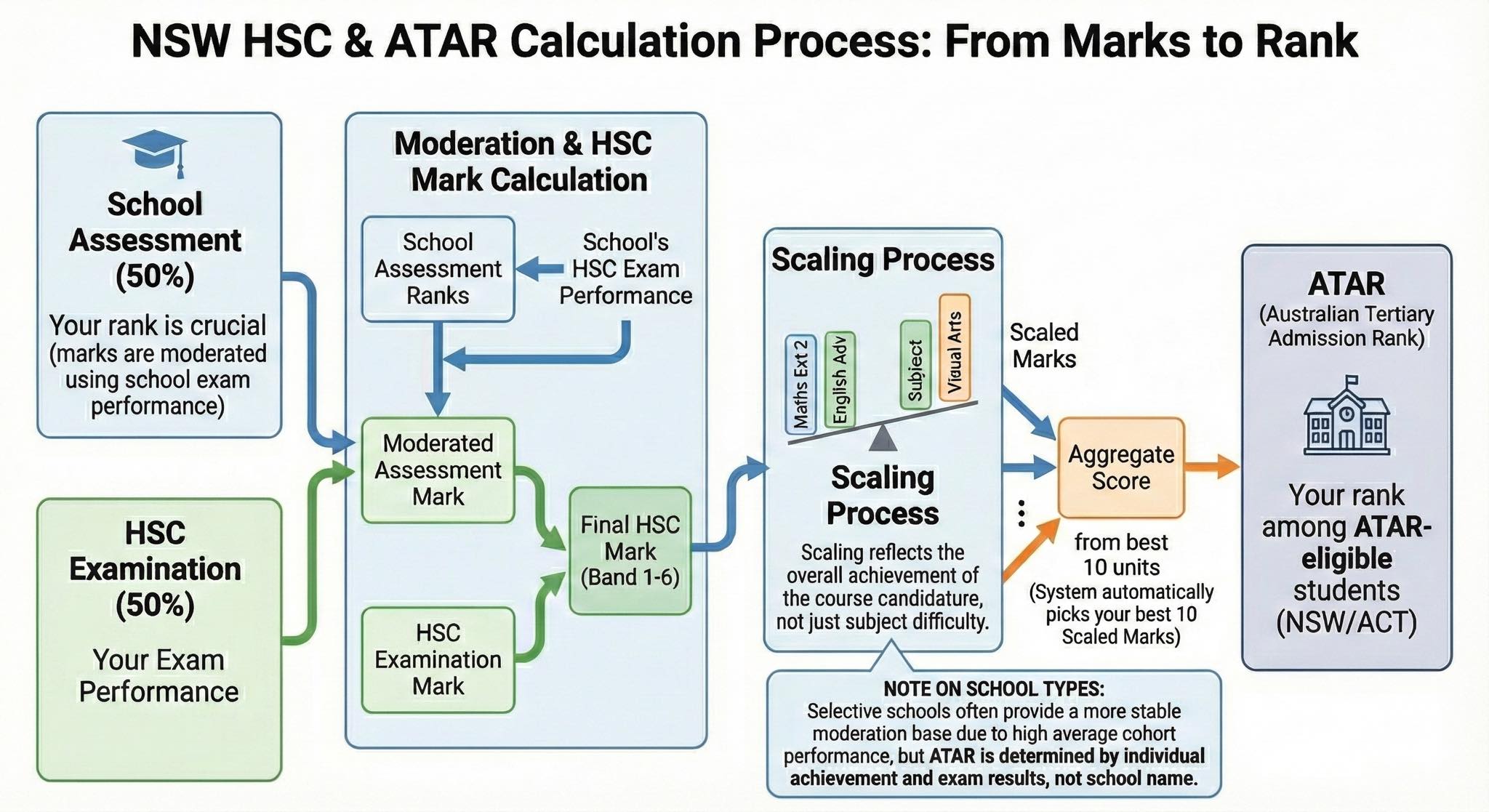
2. Does an HSC mark include school assessment?
Yes. School assessment counts for 50% and the HSC exam counts for 50%.
However, school assessment is not used as a simple raw mark. It is moderated.
This means it is adjusted using the HSC exam performance of students in the same school and course.
In simple terms, this is why a student’s rank within the school often matters more than the raw assessment marks.
3. What is moderation (school assessment adjustment) and why does it happen?
Moderation is used to make school assessments fair across different schools.
Schools do not all set assessments of the same difficulty. Without moderation, raw school marks from different schools would not be comparable.
NESA uses the HSC exam (the same exam for everyone) to help balance school assessments. A simple way to think about it is:
● The external HSC exam helps “check” school assessments
● The school rank keeps the order of students within that school
One point that helps families understand this clearly:
Even if the moderated assessment marks change, a student’s position (rank) within the school for that course does not change.
Here is an easier way to understand moderation, using selective vs non-selective examples.
Example A: A top selective school environment
● In simple words: if the whole group performs well in the external exam, the school assessment results usually remain stable after moderation.
● Many students in the class perform strongly in the HSC exam.
● Because the exam results are strong overall, the school’s assessment marks can be moderated in a way that stays strong.
Example B: A non-selective school environment
● The class may have a wider range of ability, and the overall HSC exam results may be lower.
● Even if the school gave high assessment marks, moderation may adjust those marks downward to match the external exam results.
● In simple words: if the overall group exam results are lower, school assessment marks may be pulled down.
4. What is an ATAR?
ATAR is not a mark. It is a rank.
ATAR shows a student’s position among ATAR-eligible students (not every student receives an ATAR). It is a percentile ranking within the ATAR-eligible group.
For example:
● ATAR 90 means a student is in the top 10% of ATAR-eligible students
● ATAR 95 means a student is in the top 5% of ATAR-eligible students
ATAR is calculated using scaled marks, and the system uses the student’s best 10 units (it automatically selects the best combination).
5. What is scaling?
Scaling is used only for ATAR, not for the HSC mark shown on the report.
A simple way to understand it: scaling is based on the overall strength of the students taking the course, not just whether a subject feels hard.
More specifically, a course tends to scale well when the students who take that course also perform strongly across their other subjects. That is why scaling is not simply about “difficulty.”
So:
● The HSC mark stays the same
● Scaling is applied only when calculating ATAR
What scaling can look like (simple subject examples)
1. Some courses are often chosen by very strong academic students.
Because the overall group is strong, these courses often scale well. Examples often include:
● Mathematics Extension 2
● Mathematics Extension 1
● Physics
● Chemistry
2. Some courses have a wider range of student ability.
Because the group is more mixed, these courses may scale lower. Examples can include:
● Visual Arts
● Drama
● PDHPE
● Some VET courses
| This does not mean these courses are “bad.” It just means the ATAR calculation adjusts them differently. |
How “best 10 units” works (simple example)
ATAR uses a student’s best 10 units after scaling. The system automatically chooses the combination that gives the highest aggregate.
Example: a student studies 12 units
● English Advanced (2 units)
● Maths Extension 2 (2 units)
● Maths Extension 1 (2 units)
● Physics (2 units)
● Chemistry (2 units)
● Visual Arts (2 units)
→ Total = 12 units
For ATAR, only the best 10 units are used. In many cases, the system might choose:
● English Advanced (2)
● Maths Ext 2 (2)
● Maths Ext 1 (2)
● Physics (2)
● Chemistry (2)
→ Total = 10 units
Visual Arts may become the “backup” subject. If Visual Arts scales higher than one of the other subjects for that student, then it can be included instead.
The student does not need to decide — the calculation chooses the best combination automatically.
6. Selective vs non-selective schools — what is the real difference?
Key idea : ATAR is not a “school score.” ATAR is a ranking of the student, compared with other students in the ATAR-eligible group.
So the real question is not “Which school is better?”
It is “How does the school environment affect a student’s learning habits and performance?”
7. Why do many parents choose selective schools?
Common reasons include:
● A strong peer group where studying is normal
● A strong academic culture and high expectations
● More structure and competition, which can help some students stay focused
| These can be real advantages, but they do not guarantee results. |
8. Does a selective school guarantee a high ATAR?
No.
A selective school can provide a strong environment, but the student still needs to perform consistently. Because many students are high-achieving, internal competition can be intense, and maintaining a strong school rank can be more challenging.
9. Can non-selective students achieve high ATARs?
Yes, absolutely.
Many students from non-selective schools achieve Band 6 / E4 results and very high ATAR outcomes. In many cases, strong HSC exam performance and consistent preparation are the biggest factors.
10. For a high ATAR, do marks within the same band matter?
Yes.
A band is a broad category. Many students can be in the same band, but their marks can still be very different.
Example (Band 6)
● A student with 90 is Band 6
● A student with 99 is also Band 6
Both are “Band 6,” but the second student is much higher within that band.
For ATAR, what matters is the scaled mark used in the aggregate. That means small differences inside the same band can make a real difference.
≫ In simple words:
● The band tells you the level
● The number tells you how high you are within that level
● For a high ATAR, the number matters.
◈ Practical takeaway for families
Reaching Band 6/E4 is a great goal. But to push towards a very high ATAR, students usually need to aim for the top end of the band, not just the minimum score that enters the band. This is why consistent practice and strong exam technique matter so much.
11. What matters most for long-term success?
A good school can support a student, but it cannot replace habits.
What matters most is :
regular reading and learning routines, consistent practice over time, time management and self-discipline, and resilience when work gets harder.
These habits are built gradually, often from primary school.
Final takeaway from this HSC ATAR explained guide
● HSC marks are subject results (out of 100)
● School assessment is included, but it is moderated for fairness (rank stays the same within the school)
● ATAR is an overall rank among ATAR-eligible students
● Scaling is used only for ATAR and reflects the overall achievement of the course candidature across subjects
● ATAR uses the best 10 scaled units automatically
● For high ATAR goals, marks within the same band still matter
● Schools can help, but habits and consistency decide outcomes
● Starting good study habits early makes the biggest difference
© Pre-Uni New College Head Office. All rights reserved. If you would like to share this article, please use the official article link rather than reproducing its content.


More articles