
On Campus

Year K Courses

EM

The Year K EM program is geared towards fostering a strong foundation in literacy and numeracy through its tailored syllabus. By participating in this program, your child will not only have the advantage of getting a head start, but also lay a solid groundwork for future school assessments.

EM
EM Course

Our Foundation Courses provide a nurturing environment where young learners develop essential skills across English and Maths.
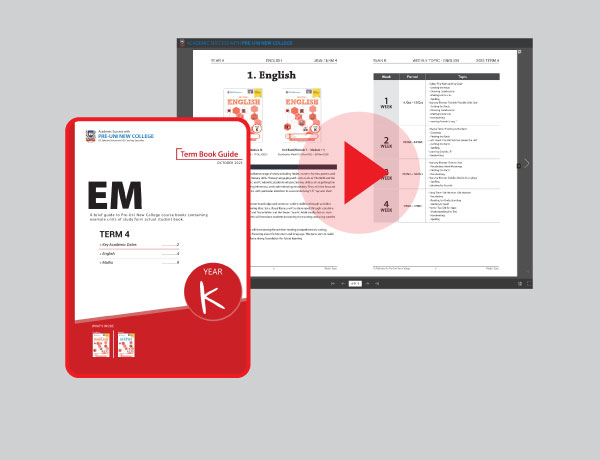
What students will study
icon
ENGLISH

In our English lessons, teachers concentrate on honing students’ spelling, vocabulary, and comprehension skills. Students will improve their spelling through targeted exercises and interactive games, expand their vocabulary by exploring new words and their meanings, and enhance their reading comprehension by engaging with a variety of texts. These engaging activities help build a solid foundation in English, fostering confidence and preparing students for future academic success.

icon
MATHEMATICS

The Mathematics lessons will cover a range of mathematical topics aimed at helping students grasp fundamental mathematical concepts and theories.In our Mathematics lessons, teachers focus on helping students understand fundamental mathematical concepts and theories. Through interactive and enjoyable activities, students will learn basic arithmetic, explore shapes and patterns, and develop a strong number sense, laying the groundwork for future academic success.

Info course
Face to Face Lesson

Face-to-face lessons offer a dynamic, interactive educational experience, fostering direct engagement with experienced educators and peers. These sessions encourage active participation, critical thinking, and collaborative learning, tailored to nurture each student’s curiosity and academic growth. With a focus on personalised instruction and real-time feedback, our approach enhances understanding, builds confidence.

Info course
Up-to date Resource

Stay ahead of the curve with our up-to-date resouces. The educational landscape is ever-evolving, and so are we.
Our materials are continuously reviewed and updated to align with the latest syllabus changes and educational best practices.

Info course
Managing Student Progress

Track growth and progress with our systematic approach to managing student development Through personalised progress management we ensure that every student receives the support they need to excel.

How our program works?

STEP 1
Lesson
In this initial stage, students attend weekly theory lessons that introduce new concepts and build foundational knowledge. Teachers use lectures, multimedia presentations, and interactive discussions to engage students and motivate them throughout the lesson. Active participation, question-asking, and note-taking are encouraged to enhance understanding of the material.
STEP 2
Complete Weekly Homework and S.O.Q
Following the lesson, students must complete their assigned homework to reinforce their learning. This includes reading assignments, problem-solving tasks, essays, or projects that apply their knowledge. Additionally, students engage with the S.O.Q (Special Online Quiz) to test their comprehension and retention of the material. Emphasis is made on the need to review and memorise new information to solidify learning.
STEP 3
Watch VOD
Students use Video On Demand (VOD) to review the material at their own pace. This enables them to revisit the lesson, clarify doubts, and address any missed content. VOD provides the flexibility to pause, rewind, and rewatch parts of the lesson, ensuring a thorough understanding of complex topics.
STEP 4
Term Progress Test
Students undertake a term test to assess their understanding of the material covered throughout the term. This comprehensive test evaluates topics taught during the term and measures students’ grasp of the subject matter. It serves as a formal assessment of learning progress and identifies areas needing improvement. In turn, it offers valuable feedback on student’s performance and achievement of key learning outcomes.
STEP 5
Review the Term Progress Test
The final step involves a detailed review of the test. Students analyse questions they answered incorrectly to understand their mistakes and refresh on the content. This review is crucial for consolidating knowledge, improving test-taking strategies, and preparing for future assessments. Teachers assist with explanations and additional practice to ensure confidence in the material prior to class commencing the following term.
Year K Course Structure
TERM 1
TERM 2
TERM 3
TERM 4
English
Mathematics
Module 1
  • Poetry: ‘The Five Senses’
    – Join the Dots 1
    – Join the Dots 2
    – First Letters
    – Short Vowel ‘A’
    – Word Endings ‘-at’, ‘-an’, ‘-ad’, ‘-am’
    – Short ‘A’ – Reading Time
    – Getting the Facts
    – Short Vowel ‘E’
    – Word Endings ‘-en’, ‘-ed’, ‘-ell’, ‘-et’
    – Short ‘E’ – Reading Time
    – Getting the Facts
Module 2
  • There will be no class on Anzac Day (Saturday, 25 April)
Module 3
  • Picture Story: ‘Here is Pip’
    – Consonants
    – Find Short ‘I’
    – Short ‘I’ Sound
    – Word Endings ‘-ig’, ‘-ill’, ‘-ip’, ‘-id’
    – Short ‘I’ – Reading Time
    – Getting the Facts
    – Colour Short ‘O’
    – Short ‘O’ Sound
    – Word Endings ‘-ocks’, ‘-og’, ‘-op’, ‘-ong’
    – Short ‘O’ – Reading Time
    – Getting the Facts
Module 4
  • Picture Story: ‘Here Comes Scruff’
    – Find Short ‘U’
    – Short ‘U’ Sound
    – Word Endings ‘-ug’, ‘-ut’, ‘-un’, ‘-uff’
    – Follow ‘U’
    – Short ‘U’ – Reading Time
    – Getting the Facts
    – ABC Review
Module 5
  • Phrases: ‘Opposites’ (Antonyms)
    – Sight Words
    – Rhyming Pairs
    – Learning ‘and’
    – Rhyme Time
    – Beginning Sounds ‘M’, ‘P’
    – Beginning Sounds ‘T’, ‘N’
    – ‘I’
Module 6
  • Narrative: ‘The Noisy Farm’
    – Sight Words
    – Letter Match
    – In That Case
    – Write ‘is’
    – Learning ‘he’ and ‘she’
    – Learning ‘they’
    – All About Sally
    – Ending Sounds ‘D’ and ‘T’
    – Ending Sounds ‘M’ and ‘N’
Module 7
  • Poetry: ‘Look and See’
    – Spelling
    – Where Is Everyone?
    – Where Do They ‘Go’?
    – ‘L’ Blends
    – In, On, Under
    – Match the Preposition
    – Reading Time
Module 8
  • Narrative: ‘Cool Cars’
    – Spelling
    – Learning Colours
    – Which Colour?
    – Colourful Family
    – ‘R’ Blends
    – Before
    – Between
    – After
    – Reading Time
Module 9
  • Poetry: ‘Family’
    – Spelling
    – Nouns (Family)
    – Word Jumble
    – ‘S’ Blends
    – Short Vowels
    – Alphabetical Order
    – Reading Time
Module 10
  • Narrative: ‘The Goat and the Toad’
    – Getting the Facts
    – Spelling
    – Nouns
    – Long Vowel ‘A’
    – Egg Story
    – Long Vowel ‘E’
    – Reading Time
Module 11
  • Narrative: ‘I Like to Move’
    – Spelling
    – Look, Think and Read
    – Long Vowel ‘I’
    – Action Words
    – Activities
    – Long Vowel ‘O’
    – Sequence
Module 12
  • Reading Sentences: ‘My Little Baby’
    – Spelling
    – What Am I?
    – Long Vowel ‘U’
    – ‘Are’ and ‘Is’
    – Draw the Line
    – Storyboard
    – I See
Module 1
  • Counting Numbers
  • Counting Items
  • Adding Simple Numbers
  • Module 1 Challenge
Module 2
  • There will be no class on Anzac Day (Saturday, 25 April)
Module 3
  • Number Patterns
  • Ordering Groups
  • 2D Shapes
  • Patterns with Shapes
Module 4
  • Counting in 2’s, 5’s and 10’s
  • Patterns with Shapes
  • 2D Shapes – Sides & Corners
Module 5
  • 3D Shapes
  • Subtraction
Module 6
  • Colour
  • Measurement – Size
Module 7
  • Position
  • Measurement – Comparing Mass
  • Comparing Distances
Module 8
  • Measurement – Hot and Cold
  • Simple Addition
Module 9
  • Adding with Maths Terms
  • Adding Numbers
  • Problem Solving
Module 10
  • The Clock
  • Reading the Time
  • Digital Clocks
Module 11
  • Introduction to Money Values
  • Adding Money
  • Buying Things with Money
Module 12
  • Days of the Week
English
Mathematics
Module 1
  • Nursery Rhyme: ‘Mary Had a Little Lamb’
    – Sentence Making
    – Drawing Conclusions
  • Nursery Rhyme: ‘Three Blind Mice’
    – Getting the Main Idea
    – Drawing Conclusions
  • Studying the Alphabet
  • Sound Study: ‘a’ Words
  • Application of Sound Study
  • Studying Consonants: ‘t’
  • Drawing Pictures
Module 2
  • Nursery Rhyme: ‘The Queen of Hearts’
    – Getting the Facts
    – Drawing Conclusions
    – Identifying Inferences
  • Spelling
  • Sentence Making
  • Nursery Rhyme: ‘Here We Go Round the Mulberry Bush’
    – Getting the Facts
    – Drawing Conclusions
  • Learning Sounds ‘o’
  • More about ‘o’
  • Short ‘o’
  • Learning my ABC
Module 3
  • Nursery Rhyme: ‘I Dreamed that my Horse’
    – Getting the Main Idea
    – Rhyming Words
    – Drawing Conclusions
    – Making Inferences
  • Spelling
  • Sentence Writing
  • Nursery Rhyme: ‘Little Boy Blue, Come Blow Your Horn’
    – Rhyming Words
    – Making Sentences
  • Learning Sounds: E says ‘e’
  • Sounds within Words: Short ‘e’
  • What am I?
Module 4
  • Nursery Rhyme: ‘Humpty Dumpty’
    – Getting the Facts
    – Drawing Conclusions
    – Spelling
    – Rhyming Words
  • Vocabulary
  • Nursery Rhyme: ‘Girls and Boys Come Out to Play’
    – Rhyming Words
    – Getting the Facts
    – Drawing Conclusions
  • Learning the Alphabet
  • Rhyming Words
  • Learning Sounds ‘A’ as in Ant
Module 5
  • Nursery Rhyme: ‘The Three Little Kittens’
    – Getting the Facts
    – Drawing Conclusions
    – Making Inferences
    – Sentences
  • Spelling
  • Nursery Rhyme: ‘The Three Little Kittens’
    – Getting the Facts
    – Drawing Conclusions
  • Studying Sounds
  • Crossword
  • Question Sentence
  • Vocabulary
Module 6
  • Nursery Rhyme: ‘Sing a Song of Sixpence’
    – Vocabulary
    – Finding the Facts
    – Drawing Conclusions
    – Making Inferences
    – Spelling
    – Alphabetical Order
  • Nursery Rhyme: ‘Ding, Dong, Bell’
    – Getting the Facts
    – Drawing Conclusions
    – Making Inferences
  • Handwriting
  • Matching Words to Pictures
  • Antonyms
  • Learning Sounds Long ‘a’ and ‘ai’
Module 7
  • Poetry: ‘My Dog’
    – Getting the Facts
    – Rhyming Words
    – Spelling
  • Visual Literacy
  • Nursery Rhyme: ‘The Grand Old Duke of York’
    – Getting the Facts
    – Drawing Conclusions
    – Making Inferences
  • Vocabulary
  • Writing Sentences
  • Learning Sounds
  • Learning the ABC
Module 8
  • Poetry: ‘If I Could be Anything’
    – Getting the Facts
    – Identifying Inferences
    – Drawing Conclusions
    – Spelling
    – Vocabulary
  • Narrative: ‘Take Me For a Ride’
    – Getting the Facts
    – Identifying Inferences
    – Drawing Conclusions
  • Learning Sounds (1), (2)
  •  Vocabulary (1)
  • Writing Sentences
  • Vocabulary (2)
  • Gramma: Adjectives (1), (2)
  • Sentence Construction
  • Idioms
Module 9
  • Poetry: ‘In One Second’
    – Spelling
    – Rhyming Words
    – Drawing Conclusions
    – Identifying Inferences
  • Rhyme: ‘Fishes Swim’
    – Getting the Facts
    – Vocabulary
  • Learning the Alphabet
  • Opposites
  • Learning Sounds: ‘u’
  • Alphabet Puzzle
Module 10
  • Narrative : ‘The Flying Display’
    – Finding the Facts
    – Drawing Conclusions
    – Identifying Inferences
    – Spelling
  • Poetry: ‘The Hare and the Snail’
    – Finding the Facts
    – Drawing Conclusions
    – Identifying Inferences
    – Vocabulary
  • Learning Sounds: The Long ‘a’ Sound
  • Getting The Facts
  • How Many Legs?
  • Where Would you Find it?
Module 11
  • Narrative : ‘Ogden’s Rainy Day’
    – Getting the Facts
    – Drawing Conclusions
    – Identifying Inferences
    – Writing
  • Rhyme : ‘One to Make Ready’
    – Finding the Facts
    – Drawing Conclusions
    – Identifying Inferences
    – Spelling
  • Grammar: Verbs
  • Studying Sounds: Long ‘A’, ‘Ai’, ‘Ay’
  • Sounds
Module 1
  • Numbers
  • Counting
  • Addition
  • Space
  • Patterns
Module 2
  • Reading Numbers
  • Numbers
  • Measurement
  • 2D Shapes
  • Money
Module 3
  • Number Values
  • Numbers to 40
  • Fractions
  • Position
  • Making a Graph
  • Ordinal Numbers
Module 4
  • Addition
  • Reading Numbers
  • Counting Numbers
  • 2D Shapes
  • Measurement
  • Using Maths Terms
Module 5
  • Counting
  • Recognising Shapes
  • Plane Shapes
  • Adding
  • Money
Module 6
  • Numbers
  • 2D Shapes
  • Reading Numbers
  • Counting
  • Shapes
Module 7
  • Numbers
  • Time
  • Ordinal Numbers
  • 3D Shapes
  • Money
  • Counting to 57
  • Counting
Module 8
  • Shapes
  • Spatial Awareness
  • Counting
  • Ordinal Numbers
  • Addition Dominoes
  • Addition
Module 9
  • Counting Patterns
  • Counting
  • Adding Numbers
  • Money
  • Counting to 50
  • Measurement
Module 10
  • Counting to 49
  • Money
  • Addition
  • Time
  • 2D Shapes
  • Ordinal Numbers
Module 11
  • Counting
  • Addition
  • Counting by Tens
  • Telling the Time
  • 3D Shapes
  • Measurement
  • Fractions
English
Mathematics
Module 1

• Fable: ‘The Wolf and the Goat’
– Getting the Facts
– Drawing Conclusions
– Making Inferences
– Spelling
• Nursery Rhyme: ‘Twinkle Twinkle Little Star’
– Getting the Facts
– Drawing Conclusions
– Making Inferences
– Handwriting
• Learning Sounds: Long ‘i’

Module 2

• Rhyme Time: ‘The Boy in the Barn’
– Grammar
– Finding the Facts
• Let’s Read: ‘The Old Woman Under the Hill’
– Getting the Facts
– Spelling
• Learning Sounds: ‘fr’
• Handwriting

Module 3

• Nursery Rhyme : ‘Time to Rise’
– Vocabulary: Word Meanings
– Finding the Facts
– Handwriting
• Nursery Rhyme : ‘Diddle, Diddle, Dumpling’
– Spelling
• Listening for Sounds

Module 4

• Story Time: ‘Old Woman, Old Woman’
– Vocabulary
– Reading for Understanding
– Starting to Spell
• Poem: ‘Too Old for Naps’
– Understanding the Text
– Handwriting
– Spelling

Module 5

• Let’s Read a Rhyme: ‘Twinkle, Twinkle, Little Star’
– Vocabulary
– Handwriting
• Recognising Rhyme
– Sentence Writing
– Spelling
• Learning Sounds: ‘qu’
– Crossword

Module 6

• Let’s Read a Rhyme : ‘‘Pat-a-Cake, Bakerman’
– Following Directions
– Spelling
– Handwriting
– Visual Literacy
• Factual Text: ‘Dinosaurs’
• Learning sounds: ‘fr’

Module 7

• Let’s Read a Rhyme: ‘Robin Redbreast’
– Visual Literacy
– Writing
– Reading for Meaning
– Spelling
• Reading a Factual Text: ‘Eggs and Nests’
• Learning Sounds: ‘cl’
• Using ‘cl’ words

Module 8

• Let’s Read a Rhyming Poem : ‘Teddy Bear, Teddy Bear’
– Grammar
– Phonics: Short vowel ‘u’
– Vowel Sounds
– Reading Comprehension
• Let’s Read a Rhyming Poem : ‘The Ants Go Marching’
– Writing
– Spelling

Module 9

• Story Time: ‘Puss in Boots’
– Visual Literacy
– Writing
– Spelling
• Learning Sounds ‘ABC’
– Grammar

Module 10

• Story Time: ‘Cinderella’
– Visual Literacy
– Writing
– Spelling
• Learning the Sounds: ‘ABC’
– Grammar

Module 11

• Story Time: ‘Snow White and the Seven Dwarfs’
– Vocabulary
– Visual Literacy
– Writing
– Spelling
• Learning Sounds
– Word Search

Module 1

• Counting
• Addition of Objects
• Counting with Squares
• Measuring Mass
• Shapes
• Reading Numbers
• Dividing into Halves
• Bar Graphs
• Working with Money

Module 2

• Number Sentences
• Numbers up to 100
• Counting by Tens
• Mystery Numbers
• Fractions
• 2D Shapes
• Addition of Money

Module 3

• Addition
• Counting Using Grids
• 3D Shapes
• Connecting the Dots
• Telling the Time
• Counting Shapes
• Understanding Numbers

Module 4

• Quick Addition Questions
• Addition Dominoes
• Graphs
• Regular and Irregular Shapes
• Lines
• Numbers
• Analogue Clocks

Module 5

• Numbers up to 100
• Counting by Ones
• Addition Using Squares
• Mass
• Addition Grid
• 2D Shapes
• Telling the Time

Module 6

• Number Patterns
• Understanding Money
• Selecting and Categorising
• Identifying Properties of Shapes
• Space
• Fractions

Module 7

• Addition and Subtraction
• Adding Numbers
• Subtraction Dominoes
• 2D Shapes
• Measurement

Module 8

• Counting to 100
• Adding
• Number
• Time
• Money
• Addition Facts
• Position

Module 9

• Counting to 100
• Addition
• Addition and Subtraction Dominoes
• 3D Shapes
• Time
• Measurement
• Position

Module 10

• Counting by 2’s
• Ordinal Numbers
• Addition and Subtraction Dominoes
• 2D Shapes
• Time
• Fraction ¼

Module 11

• Addition and Subtraction
• Addition
• 3D Shapes
• Addition Grids
• Addition Wheels
• 2D Shapes
• Money
• Reading the Time

Pre-Uni New College EM Courses: More Than Just a Class –
A Total Learning Solution

icon
S.O.Q (Fortnightly)

The S.O.Q. (Special Online Quiz) consists of quizzes designed to test students’ understanding of recent modules in English and mathematics. Engaging actively with these quizzes is vital, as it provides immediate feedback and highlights areas for improvement. This process helps reinforce learning, track progress, and keep students motivated by ensuring they effectively consolidate their knowledge and prepare for future challenges.

icon
Vocabulary Test (Weekly)

Cyberschool offers a weekly vocabulary test throughout the term to help students strengthen their language skills. These tests assess and reinforce understanding of new vocabulary, allowing students to track progress, identify improvement areas, and expand their word knowledge effectively. Regular participation supports continuous vocabulary development and enhances overall communication skills.

icon
Term Progress Test (Week 7)

Scheduled for Week 7 of the term, the term progress test evaluates students’ grasp of the material covered over the preceding weeks. It assesses their knowledge, identifies strengths and weaknesses, and provides critical feedback. This feedback helps pinpoint areas for improvement and guides future instruction.

icon
Term Progress Test Review (1st week of holiday)

Students can revise the maths term progress test questions they answered incorrectly during the first week of the next school holiday period. Students are encouraged to revise all questions it provides and build up a solid foundation before their next term’s studies. The menu will appear under ‘Test Review’ menu of the navigation bar.

icon
My Result (during the term)

Stay updated on your child’s progress by visiting the My Results page throughout the course. Our dynamic reporting structure provides a clear view of your child’s performance on weekly and term tests. This feature allows you to monitor their academic development and identify areas where they may need additional support or practice.

Terms and Conditions

The Extra Service is subject to change at any time without notice. Services may vary depending on the normal term or holiday course, and they are only available during designated periods. Please note that conditions apply.

Term Year K Timetable

Mon

Tue

Wed

Thu

Fri

Sat

EM
9:00am – 12:30pm

EM
1:00pm – 4:30pm

Sun

Mon

Tue

Wed

Thu

Fri

Sat

EM
9:00am – 12:30pm

EM
1:00Pm – 4:30pm

Sun

Mon

Tue

Wed

Thu

Fri

Sat

EM
9:00am – 12:30pm

EM
1:00Pm – 4:30pm

Sun

* EM : English, Mathematics
* Class time and location : Subject to change based on enrolment numbers.
* Parking Restrictions: There is no parking available for students or parents at the Strathfield Head Office (5 The Crescent), McDonald College (17 George St. North Strathfield) and our Strathfield Centre (8 Lyons Street)
Term 3 Academic Key Dates for Year K

Year K EM Course Pricing

Year k
EM Course
Face-to-face learning with teachers in class & access all Cyberschool services.
$
75
Select start day
Total weeks:
Material fee:
$
900
$
825
Early Bird (E/B) Discount is valid for full term payments by Monday, 6 July 2026, 5 pm.
Full Term (F/T) Discount is valid for full term payments by Friday, 24 July 2026, 5 pm.
Sibling discounts are available until Monday, 6 July 2026, 5 pm.

Frequently Asked Questions

What is Cyberschool?

Cyberschool (www.cyberschool.com.au) is an online educational platform that provides tailored learning for Pre-Uni students enrolled in our foundation courses. This platform is a source of supplementary resources, providing students with assistance with homework and in-class tasks. Students enrolled at Pre-Uni New College receive complimentary access to engaging, activity-oriented lessons designed by skilled and experienced teachers.

What is S.O.Q?

Special Online Quiz (SOQ) is an online review quiz strategically designed to motivate students to revisit fundamental concepts covered in earlier modules. SOQ is made available on Cyberschool during weeks 2, 4, 6 and 8 of the term. Please note that SOQ is only available to students enrolled in a foundations course.

Will students see their teachers during online lessons?

Students should be able to see their teacher during the live online session. In addition to ensuring students maintain their cameras during class, teachers also have access to screen-sharing features, enabling students to observe content presented by teachers in real time.

Since classes are online, is it possible to join other online classes outside a student’s scheduled class?

Due to a restricted capacity for each class, it is necessary for students to participate in their assigned session.

How do teachers ensure that kids are focused whilst learning?

Educators utilise various methods to maintain student engagement during online video lessons.This includes incorporating interactive learning exercises which prompts students to tackle questions in real time. It is important to note that parental support is essential when students engage in self-directed learning.

I’m not able to travel to the branch (or live outside NSW), is there an option of remote learning?

We provide remote or online alternatives based on the specific requirements of our students. Our regular foundation courses are conducted through live online sessions using platforms like Zoom, while our Cyber Course is accessible through our Cyberschool platform.

My child is enrolled in WEMT. What is the recommended online learning routine my child should follow?

Throughout the week, students are anticipated to finalise all the questions within the modules. If they feel the need for additional module clarification, they can utilise the Cyberschool video lessons to revisit module concepts and questions.

See more