
On Campus

Year 4 Courses

WEMT

Elevate your child’s learning with our updated Year 4 WEMT course. This program strengthens reading, writing, maths, and critical thinking skills through engaging lessons, building exam readiness and confidence while making learning enjoyable.

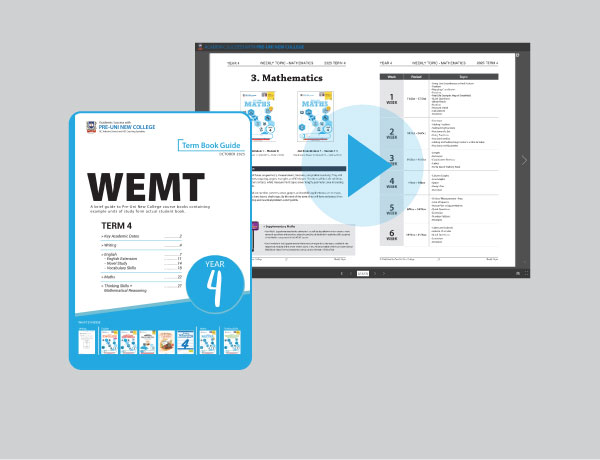
WEMT Course

Embark on a comprehensive learning experience with our signature WEMT course, meticulously designed to encompass the core academic competencies required for scholastic achievement. The WEMT curriculum is an integrated approach to learning that combines Writing, English, Mathematics, and Thinking Skills in a cohesive and engaging manner.

What students will study
icon
WRITING

Providing most efficient skills of organising the structure of the writing. Focus on developing critical thinking and reasoning skills.

icon
ENGLISH

Encourage constant interaction between the student and teacher when reading and answering the questions. Provide learning which focuses on reading skills and practicing reading comprehension, language convention questions.

icon
MATHEMATICS

Essential tuition to completely understand mathematical theories, principle and formulas to solve mathematical problems. Organised materials with a variety of practical questions.

icon
THINKING SKILLS

The Thinking Skills includes challenging problem-solving and critical thinking questions. Students enhance their ability to analyze information, reason logically through arguments, and evaluate assumptions and arguments effectively.

Info course
Face to Face Lesson

Face-to-face lessons offer a dynamic, interactive educational experience, fostering direct engagement with experienced educators and peers. These sessions encourage active participation, critical thinking, and collaborative learning, tailored to nurture each student’s curiosity and academic growth. With a focus on personalized instruction and real-time feedback, our approach enhances understanding, builds confidence.

Info course
Up-to date Resource

Stay ahead of the curve with our up-to-date resouces. The educational landscape is ever-evolving, and so are we.
Our materials are continuously reviewed and updated to align with the latest syllabus changes and educational best practices.

Info course
Managing Student Progress

Track growth and progress with our systematic approach to managing student development Through personalized progress management we ensure that every student receives the support they need to excel.

How our program works?

STEP 1
Lesson
In this initial stage, students attend weekly theory lessons that introduce new concepts and build foundational knowledge. Teachers use lectures, multimedia presentations, and interactive discussions to engage students and motivate them throughout the lesson. Active participation, question-asking, and note-taking are encouraged to enhance understanding of the material.
STEP 2
Complete Weekly Homework and S.O.Q
Following the lesson, students must complete their assigned homework to reinforce their learning. This includes reading assignments, problem-solving tasks, essays, or projects that apply their knowledge. Additionally, students engage with the S.O.Q (Special Online Quiz) to test their comprehension and retention of the material. Emphasis is made on the need to review and memorise new information to solidify learning.
STEP 3
Watch VOD
Students use Video On Demand (VOD) to review the material at their own pace. This enables them to revisit the lesson, clarify doubts, and address any missed content. VOD provides the flexibility to pause, rewind, and rewatch parts of the lesson, ensuring a thorough understanding of complex topics.
STEP 4
Term Progress Test
Students undertake a term test to assess their understanding of the material covered throughout the term. This comprehensive test evaluates topics taught during the term and measures students’ grasp of the subject matter. It serves as a formal assessment of learning progress and identifies areas needing improvement. In turn, it offers valuable feedback on student’s performance and achievement of key learning outcomes.
STEP 5
Review the Term Progress Test
The final step involves a detailed review of the test. Students analyse questions they answered incorrectly to understand their mistakes and refresh on the content. This review is crucial for consolidating knowledge, improving test-taking strategies, and preparing for future assessments. Teachers assist with explanations and additional practice to ensure confidence in the material prior to class commencing the following term.
Year 4 Course Structure
TERM 1
TERM 2
TERM 3
TERM 4
Writing
English
Mathematics
Thinking Skills Mathematical Reasoning
Vocabulary Skills
Module 1
  • Narrative : Nouns
Module 2
  • Narrative : Adjectives I
Module 3
  • Narrative : Adjectives II
Module 4
  • Narrative : Adjectives III
Module 5
  • Narrative : Verbs
Module 6
  • Narrative : Building Sentences
Module 7
  • Module 7 is not available due to the Term Progress Test.
Module 8
  • Narrative – Building A Description
Module 9
  • Narrative : Writing A Narrative (Assessment Task)
Module 10
  • Narrative : Writing A Narrative (Assessment Task)
Module 1
  • Report – Food, Families And Festivals
  • Following Directions
  • Cloze Passage
  • Extract From ‘Walter, The Lazy Mouse’
  • Language Skills

English Extension

  • Theme Of Birthdays – Multiple Matching
  • Main Idea / Summarise

Novel Study

  • Class Activity : Overview of “The Jungle Book”
  • Homework
    – Read The Novel Chapter 1, Part 1
    – Write My Revision of Chapter 1, Part 1
    – Practice Questions of Chapter 1, Part 1
Module 2
  • Why Honey Bees Are Important
  • Extract From ‘The House of Pooh Corner’
  • What Makes a Bird a Bird?
  • Extract From ‘The Orphelines in The Enchanted Castle’
  • Language Skills

English Extension

  • Mowgli’s Brothers – Reading Comprehension
  • Passage Analysis

Novel Study

  • Class Activity : Review Module 1 Homework With Teacher
  • Homework
    – Read The Novel Chapter 1, Part 2
    – Write My Revision of Chapter 1, Part 2
    – Practice Questions of Chapter 1, Part 2
Module 3
  • Explanation – Castles
  • Detecting The Sequence – Fire
  • Cloze – The Circus
  • Extract From ‘Tilly Mint and The Dodo’
  • Language Skills

English Extension

  • Hunting-Song of The Seeonee Pack – Poem
  • Poem Annotation

Novel Study

  • Class Activity : Review Module 2 Homework With Teacher
  • Homework
    – Read The Novel Chapter 2, Part 1
    – Write My Revision of Chapter 2, Part 1
    – Practice Questions of Chapter 2, Part 1
Module 4
  • Plays – The Man, The Boy And The Donkey
  • Cloze – Homework
  • Christmas Celebrations
  • Finding The Great Southern Land
  • Language Skills

English Extension

  • Spiral – Gapped Text
  • Passage Analysis

Novel Study

  • Class Activity : Review Module 3 Homework With Teacher
  • Homework
    – Read The Novel Chapter 2, Part 2
    – Write My Revision of Chapter 2, Part 2
    – Practice Questions of Chapter 2, Part 2
Module 5
  • Information Report – ‘Astronomy’
  • Cloze Exercise
  • Beauty And The Beast
  • Extract From ‘Jim at the Corner’
  • Language Skills

English Extension

  • Theme of Dinosaurs – Multiple Matching
  • Main Idea / Summarise

Novel Study

  • Class Activity : Review Module 4 Homework With Teacher
  • Homework
    – Read The Novel Chapter 3, Part 1
    – Write My Revision of Chapter 3, Part 1
    – Practice Questions of Chapter 3, Part 1
Module 6
  • Profile ‘Winnie The Pooh’
  • Extract From ‘Donkey Boy’
  • Drawing Conclusions
  • Information Report – Emperor Penguin And Emu
  •  Language Skills

English Extension

  • Rikki-Tikki-Tavi – Reading Comprehension
  • Passage Analysis

Novel Study

  • Class Activity : Review Module 5 Homework With Teacher
  • Homework
    – Read The Novel Chapter 3, Part 2
    – Write My Revision of Chapter 3, Part 2
    – Practice Questions of Chapter 3, Part 2
Module 7
  • Rules
    – Kangaroo Club Rules
    – Getting The Main Idea
  • Poem – ‘Flying’
  • Narrative – The Reluctant Dragon
  • Language Skills

English Extension

  • Module 7 is not available due to the Term Progress Test.

Novel Study

  • Class Activity : Review Module 6 Homework With Teacher
  • Homework
    – Read The Novel Chapter 4, Part 1
    – Write My Revision of Chapter 4, Part 1
    – Practice Questions of Chapter 4, Part 1
Module 8
  • Using The Context
  • Narrative
    – Ukrainian Folk Tale
    – Story of Wolfgang Mozart
  • Shakespere – A Midsummer Night’s Dream
  • Language Skills

English Extension

  • Mowgli’S Song – Poem
  • Poem Annotation

Novel Study

  • Class Activity : Review Module 7 Homework With Teacher
  • Homework
    – Read The Novel Chapter 4, Part 2
    – Write My Revision of Chapter 4, Part 2
    – Practice Questions of Chapter 4, Part 2
Module 9
  • Book Review-Bunyip Books Our Children’s Selection for the Month
  • Poem -‘Rainforest’ By Judith Wright
  • Explanation-Know Your Birthstone
  • Fable-The First Book of Tales o Ancient Egypt
  • Language Skills

English Extension

  • Why Did The Dinosaurs Die Out? – Gapped Text
  • Passage Analysis

Novel Study

  • Class Activity : Review Module 8 Homework With Teacher
  • Homework
    – Read The Novel Chapter 5
    – Write My Revision of Chapter 5
    – Practice Questions of Chapter 5
Module 10
  • Information Report – Whales
  • Instructions – Howto Eat a Cream Biscuit
  • Narrative – The Big Goose and a Little White Duck
  • Cloze Passage – Extract From ‘The Secret Garden’
  • Language Skills

English Extension

  • The Velveteen Rabbit: Anxious Times – Reading Comprehension
  • Passage Analysis
  • Shiv and the Grasshopper – Poem
  • Poem Annotation

Novel Study

  • Class Activity : Review Module 9 Homework With Teacher
  • Homework
    – Read The Novel Chapter 6-7
    – Write My Revision of Chapter 6-7
    – Practice Questions of Chapter 6-7
Module 1
  • Numbers to 10000
  • Demicals And Fractions
  • Fractions
Module 2
  • Addition
  • Algorithms – Addition to Tens of Thousands
  • Rounding off
  • Estimation
  • Number Puzzles
  • Missing Digits
  • Travel Map
  • Cubic Centimetres
Module 3
  • Subtraction
  • Algorithms Using Trading
  • Subtraction of 3-Digit Numbers With Trading
  • Number Puzzles
  • Numeration – Multiple Choice
Module 4
  • Multiplication
  • Factors
  • Multiplication and Division Are Related
  • Using Multiplication to Solve Problems
  • Multiplication Algorithms
  • Number Patterns
Module 5
  • Profit
  • Loss
  • Budget
  • Change
Module 6
  • Division
  • Fractions and Division
  • Number Crosses
  • Division Algorithms with Carrying
  • Space 2D
Module 7
  • Rigid And Non-Rigid Shapes
  • Folding and Unfolding
  • Regular and Irregular Shapes
  • What Time Is It?
  • Space
  • Shapes
Module 8
  • Prisms And Pyramids
  • Top View, Front View And Side View
  • Nets
  • Cross – Sections
  • Composite Shapes
  • Sloping Cross-Sections
  • Problems With Fractions
Module 9
  • Perpendicular Lines
  • Parallel Lines
  • Space
Module 10
  • Introduction to Probability
  • Words Describing Probability of an Event
  • Ordering Events From Most Likely to Least Likely
  • Assigning Numerical Values to Probabilities
  • Rolling a Die
Module 1

Thinking Skills

  • Detecting Reasoning Errors: Analysing Arguments
  • Practice Questions
  • Brain Game
  • Homework

Mathematical Reasoning

  • Practice Questions
  • Homework
Module 2

Thinking Skills

  • Identifying Similarity: Arrangement
  • Practice Questions
  • Brain Game
  • Homework

Mathematical Reasoning

  • Practice Questions
  • Homework
Module 3

Thinking Skills

  • Detecting Reasoning Errors: Identifying Arguments
  • Practice Questions
  • Brain Game
  • Homework

Mathematical Reasoning

  • Practice Questions
  • Homework
Module 4

Thinking Skills

  • Identifying Similarity: Table & Graph
  • Practice Questions
  • Brain Game
  • Homework

Mathematical Reasoning

  • Practice Questions
  • Homework
Module 5

Thinking Skills

  • Detecting Reasoning Errors: Identifying Weaknesses
  • Practice Questions
  • Brain Game
  • Homework

Mathematical Reasoning

  • Practice Questions
  • Homework
Module 6

Thinking Skills

  • Identifying Similarity: Making Conclusions
  • Practice Questions
  • Brain Game
  • Homework

Mathematical Reasoning

  • Practice Questions
  • Homework
Module 7

Thinking Skills

  • Detect Reasoning Errors: Insufficient Reasons
  • Practice Questions
  • Brain Game
  • Homework

Mathematical Reasoning

  • Practice Questions
  • Homework
Module 8

Thinking Skills

  • Identifying Similarity: Measurement
  • Practice Questions
  • Brain Game
  • Homework

Mathematical Reasoning

  • Practice Questions
  • Homework
Module 9

Thinking Skills

  • Detecting Reasoning Errors: Making Conclusions
  • Practice Questions
  • Brain Game
  • Homework

Mathematical Reasoning

  • Practice Questions
  • Homework
Module 10

Thinking Skills

  • Relevant Selections: Identifying Relevance
  • Practice Questions
  • Brain Game
  • Homework

Mathematical Reasoning

  • Practice Questions
  • Homework
Module 1
  • Word List
  • ‘Ch’ Family
  • ‘Ch’ Words Using Clues
  • Correct ‘Ch’ Words
  • Put ‘Ch’ In The Correct Place To Make These Words.
  • ‘Ch’ Puzzle
  • Plurals
  • Synonyms
  • Antonyms
  • Rhyming Words
  • Adjectives
  • Classification
  • Idioms
  • Proverb Of The Week
Module 2
  • Word List
  • Silent Letters
  • Using Clues
  • Block Out Puzzle
  • Correct Words
  • Homonyms
  • Synonyms
  • Antonyms
  • Word In A Word
  • Collections
  • Misspelt Words
  • Comparative Adjectives
  • Idioms
  • Proverb Of The Week
Module 3
  • Word List
  • ‘Sh’ Family
  • Using Clues From ‘Sh’ Family
  • Correct Words
  • Put ‘Ch’ In The Correct Place To Make These Words.
  • ‘She’ Puzzle
  • Synonyms
  • Antonyms
  • Confusing Pairs
  • Odd One Out
  • Collective Nouns
  • Adverbs
  • Idioms
  • Proverb Of The Week
Module 4
  • Word List
  • ‘Gh’ Family
  • Using Clues
  • Correct Words
  • Jumbled Words
  • Puzzle
  • Synonyms
  • Antonyms
  • Confusing Pairs
  • Sounds Of Objects
  • Using Better Words
  • Odd One Out
  • Idioms
  • Proverb Of The Week
Module 5
  • Word List
  • ‘Th’ Family
  • Using Clues
  • Making ‘Th’ Words
  • Using Suffixes
  • Plurals
  • Synonyms
  • Antonyms
  • Confusing Pairs
  • Abbreviations
  • Adjective Into Adverbs
  • Idioms
  • Proverb Of The Week
Module 6
  • Word List
  • Ore’ Family
  • Using Clues
  • Rearranged Words
  • Anagrams
  • Using Suffixes
  • Word Knowledge
  • Synonyms
  • Antonyms
  • Confusing Pairs
  • Incorrect Words
  • Idioms
  • Proverb Of The Week
Module 7
  • Word List
  • ‘U-E’ Family
  • Using Clues
  • Rearranged Words
  • Synonyms
  • Antonyms
  • Add A Letter
  • Anagrams
  • Used Long Ago
  • Word Knowledge
  • Confusing Words
  • Odd One Out
  • Idioms
  • Proverb Of The Week
Module 8
  • Word List
  • ‘Tch’ Family
  • Using Clues ‘Tch’ Words
  • Rearranged Words
  • Synonyms
  • Antonyms
  • Words In A Word
  • Removing Letters
  • Word Knowledge
  • Objects That People Use
  • Making Plurals
  • Confusing Pairs
  • Idioms
  • Proverb Of The Week
Module 9
  • Word List
  • ‘Soft C’ Family
  • Using Clues Of ‘Soft C’ Words
  • Rearranged Words
  • Synonyms
  • Antonyms
  • Add A Letter
  • Word Knowledge
  • Verbs
  • People And Their Work
  • Nouns To Adjectives
  • Confusing Pairs
  • Idioms
  • Proverb Of The Week
Module 10
  • Word List
  • Soft G’ Family
  • Using Clues ‘Soft G’ Words
  • Rearranged Words
  • Puzzle
  • Synonyms
  • Antonyms
  • Add A Letter
  • Word Knowledge
  • Adjectives
  • Anagrams
  • Analogies
  • Confusing Pairs
  • Proverb Of The Week
Writing
English
Mathematics
Thinking Skills Mathematical Reasoning
Novel Study
Vocabulary Skills
Module 1
  • Procedures
    – Purpose of the Text 
Module 2
  • Procedures
    – Using Commands
Module 3
  • Procedures
    – Sequence
Module 4
  • Procedures
    – Action verbs
Module 5
  • Procedures
    – Writing Commands
Module 6
  • Procedures
    – Phrases
Module 7
  • Note: There is no Writing in Week 7
Module 8
  • Procedures
    – Time Connectives
Module 9
  • Procedures
    – Assessment
Module 10
  • Procedures
    – Inverting Sentences
Module 11
  • Procedures
    – Final Revision
Module 1
  • The Earth and the Moon’
  • Poem: ‘Witches Spells’
  • Narrative: Extract from ‘Ninety-nine Dragons’
  • Sequence: ‘Raelene Boyle The Water Cycle’
  • Language Skills

English Extension

  • Academics vs Art : Multiple Matching
Module 2
  • Sequencing: ‘Rhymes’
  • Information: ‘Sharks’
  • Cloze Exercise: ‘The Hungry Fox’
  • Narrative: Extract from ‘What the Neighbours Did’
  • Language Skills

English Extension

  • Animal Language : Reading Comprehension
Module 3
  • Extract from ‘Little Old Mrs Pepperpot’
  • Sequencing: ‘A Recipe’
  • Cloze Exercise: ‘The Golden Bird’
  • An Arabian Legend
  • Language Skills
  • Punctuation
  • Vocabulary

English Extension

  • Life Doesn’t Frighten Me : Poem
Module 4
  • ‘Persephone’
  • Comparing Two Poems
  • ‘Vampire Bats’
  • Extract from ‘The Iron Man’
  • Language Skills

English Extension

  • Artificial Intelligence Develops an Ear for Birdsong : Gapped Text
Module 5
  • Information Report: ‘Eruptions’ (Volcanoes)
  • Cloze Exercise: ‘The Day the Ceiling Fell Down’
  • Poem: ‘Roman Wall Blues’
  • Narrative: Extract from ‘The Drummer Boy’
  • Language Skills
  • Grammar

English Extension

  • Breakfast : Multiple Matching
Module 6
  • Cloze Exercise: ‘Small Monkey Tales’
  • Reading a Table
  • Explanation: ‘What Makes Sound’
  • Extract from ‘Stig of the Dump’
  • Language Skills

English Extension

  • The Bridge of Apes : Reading Comprehension
Module 7
  • Factual Writing: ‘Minnows’
  • Fictional Writing: Extract from ‘A Dog So Small’
  • Poem: ‘My Ancestors’
  • Brochure: ‘New South Wales Gold Country’
  • Language Skills

English Extension

  • Note: There is no English Extension in Week 7
Module 8
  • Narrative: Extract from ‘Bottersnikes and Gumbles’
  • Cloze Exercise: ‘Return of the Witch Doctor’
  • Poems: ‘Catherine’ & ‘Chester’s Undoing’
  • Narrative: Extract from ‘Here Be Lions’
  • Language Skills

English Extension

  • On a Night of Snow : Poem
Module 9
  • Getting the Main Idea
  • Narrative: Extract from ‘It Happened One Summer’
  • Narrative: Extract from ‘The Magician Who Kept a Pub’
  • Fable: ‘The Loss of Darkness’
  • Language Skills

English Extension

  • Does Replacing Textbooks with Tablets Impact Student Learning? : Gapped Text
Module 10
  • Aesop’s Fable: ‘The Ant and the Grasshopper’
  • Fun Reading
  • Narrative: Extract from ‘Lucy’
  • Drawing Conclusions Exercises
  • Language Skills

English Extension

  • Theme of Science Fair : Multiple Matching
Module 11
  • Aboriginal Story: ‘Gulaga’
  • Aboriginal Story: ‘Red Waratah’
  • Poetry: ‘Lost…’
  • Poetry: ‘Home Team Hero’
  • Language Skills

English Extension

  • Home Again : Reading Comprehension
Module 12
  • Information: ‘The Blood Moon Eclipse’
  • Narrative: ‘The Night the Moon Turned Red’
  • Sequencing
  • Cloze Exercise: ‘The Moon Turns Red’
  • Language Skills: Time Connectives + Vocabulary

English Extension

  • Instructions for Growing Poetry: Poem
Module 1
  • Perimeter
  • Length
  • Using Decimal Notation
  • Comparing Lengths in Different Units
  • Perimeters of Squares and Rectangles
  • Space 2D – Area
Module 2
  • Tallies, Picture Graphs, Bar Graphs and Column Graphs
  • What is a Key?
Module 3
  • Area
  • More Irregular Shapes
  • Large Areas with Given Dimensions (Width and Length)
  • Area and Perimeter
  • Area and Perimeter – Composite Shapes
  • Mixed Space
Module 4
  • Volume
  • Cuboids and Other Solids
  • Volume of a Cuboid
  • Revision – Symmetry
  • Number Study
  • Column Graph
Module 5
  • Capacity
  • Litres and Millilitres
  • Volume of Water (cm³ or mL)
  • Capacity of a Tank
Module 6
  • Mass
  • Calculations
  • Mark Table
  • Number Puzzle
Module 7
  • Fractions
  • Adding and Subtracting Fractions
  • Fraction Families and Equivalent Fractions
  • Fifths and Tenths
  • Thirds and Sixths
  • Finding Fractions of Quantities or Numbers
Module 8
  • Decimals
  • Decimal Places
  • Numerical Value
  • Adding and Subtracting Decimals
  • Multiplying Decimals by a Whole Number
  • Graphs
  • Money and Decimals
Module 9
  • Fractions
  • Area and Perimeter
  • Space
  • Symmetry
  • Spatial Awareness
  • Logic Problems
Module 10
  • Problem Solving
  • Problems Involving Number Sentences
  • Graph
  • Numeration
Module 11
  • Problem Solving
  • Column Graph
  • Fractions of Whole Numbers
  • Time Problems
Module 12
  • Fractions and Decimals
  • Measurement and Unit Conversion
  • Time and Graphs
  • Area, Perimeter and Volume
  • Spatial Awareness and Logic
  • Problem Solving
Module 1
  • Drawing a Conclusions: Making Conclusions
    – Practice Questions
    – Brain Game

Mathematical Reasoning

  •  Practice Questions
Module 2
  • Drawing a Conclusions: Making Conclusions
    – Practice Questions
    – Brain Game

Mathematical Reasoning

  •  Practice Questions
Module 3
  • Drawing a Conclusion: Similar Premises
    – Practice Questions
    – Brain Game

Mathematical Reasoning

  •  Practice Questions
Module 4
  • Relevant Selection: Number Operations
    – Practice Questions
    – Brain Game

Mathematical Reasoning

  •  Practice Questions
Module 5
  • Identifying Assumptions: Multiple Conclusions
    – Practice Questions
    – Brain Game

Mathematical Reasoning

  •  Practice Questions
Module 6
  • Relevant Selections: Table and Graph
    – Practice Questions
    – Brain Game

Mathematical Reasoning

  •  Practice Questions
Module 7
  • Identifying Assumptions: Recognising Implicit Assumptions
    – Practice Questions
    – Brain Game

Mathematical Reasoning

  •  Practice Questions
Module 8
  • Relevant Selections: Verbal Data Processing
    – Practice Questions
    – Brain Game

Mathematical Reasoning

  •  Practice Questions
Module 9
  • Matching Arguments: Making Conclusions
    – Practice Questions
    – Brain Game

Mathematical Reasoning

  •  Practice Questions
Module 10
  • Hybrid Reasoning: Mixture of Critical Thinking & Problem Solving
    – Practice Questions
    – Brain Game

Mathematical Reasoning

  •  Practice Questions
Module 11
  • Practice Questions
  • Brain Game

Mathematical Reasoning

  •  Practice Questions
Module 12
  • Practice Questions
  • Brain Game

Mathematical Reasoning

  •  Practice Questions
Module 1
  • The Wonderful Wizard of Oz – Chapter 1,2&3
Module 2
  • The Wonderful Wizard of Oz – Chapter 4&5
Module 3
  • The Wonderful Wizard of Oz – Chapter 6&7
Module 4
  • The Wonderful Wizard of Oz – Chapter 8&9
Module 5
  • The Wonderful Wizard of Oz – Chapter 10&11
Module 6
  • The Wonderful Wizard of Oz – Chapter 12&13
Module 7
  • The Wonderful Wizard of Oz – Chapter 14&15
Module 8
  • The Wonderful Wizard of Oz – Chapter 16&17
Module 9
  • The Wonderful Wizard of Oz – Chapter 18&19
Module 10
  • The Wonderful Wizard of Oz – Chapter 20&21
Module 11
  • The Wonderful Wizard of Oz – Chapter 22,23&24
Module 12
  • The Wonderful Wizard of Oz – Summary
Module 1
  • Word List
  • Double consonants – ‘TT’ Family
  • Using Clues
  • Rearranged Words
  • Puzzles
  • Countries
  • Synonyms
  • Antonyms
  • Word knowledge
  • Odd one out
  • Match-A-Word
  • Similes
  • Idioms
  • Proverb
Module 2
  • Word List
  • ‘TCH’ Family
  • Using Clues
  • Rearranged Words
  • Add one letter
  • Birds
  • Synonyms
  • Antonyms
  • Word knowledge
  • Odd one out
  • Match-A-Word
  • Similes
  • Idioms
  • Proverb
Module 3
  • Word List
  • ‘RR’ Family
  • Using Clues
  • Rearranged Words
  • Puzzles
  • What am I?
  • Synonyms
  • Antonyms
  • Word knowledge
  • Adjectives
  • Circle Words
  • WHAT SOUND?
  • Abbreviations
  • Idioms
  • Proverb
Module 4
  • Word List
  • ‘FF’ Family
  • Using Clues
  • Rearranged Words
  • What am I?
  • Block out
  • Puzzle
  • Synonyms
  • Antonyms
  • Word knowledge
  • Categories
  • Which room?
  • Odd one out
  • Anagrams
  • Homophones
  • Idioms
  • Proverb
Module 5
  • Word List
  • ‘RR’ Family
  • Using Clues
  • Rearranged Words
  • Make a word
  • Puzzle
  • Synonyms
  • Antonyms
  • Word knowledge
  • Fruit and vegetables
  • Occupations
  • Odd one out
  • One word for two or more
  • ‘CAP’ Words
  • Idioms
  • Proverb
Module 6
  • Word List
  • ‘TT’ Family
  • Using Clues
  • Rearranged Words
  • Words in a word
  • Find the countries
  • Synonyms
  • Antonyms
  • Word knowledge
  • Collective nouns
  • Kinds of people
  • Odd one out
  • One word for two or more
  • Categories
  • Circle Word
  • Idioms
  • Proverb
Module 7
  • Word List
  • ‘AW’ and ‘AU’ Family
  • Using Clues
  • Rearranged Words
  • Puzzle
  • Missing O’s
  • Synonyms
  • Antonyms
  • Word knowledge
  • Adverbs
  • Word Association
  • One word for two or more
  • Odd one out
  • Confusing Pairs
  • Categories
  • Proverb
Module 8
  • Word List
  • Soft ‘g’ and ‘dge’ Family
  • Using Clues
  • Rearranged Words
  • Puzzle
  • Birds
  • Synonyms
  • Antonyms
  • Word knowledge
  • Adjectives
  • Word Association
  • One word for two or more
  • Odd one out
  • Categories
  • Confusing Pairs
  • Proverb
Module 9
  • Word List
  • ‘scr’ Family
  • Using Clues
  • Rearranged Words
  • Yes or No
  • Puzzle
  • Synonyms
  • Antonyms
  • Word knowledge
  • Abstract nouns
  • Word Association
  • One word for two or more
  • Odd one out
  • Categories
  • Confusing Pairs
  • Idioms
  • Proverb
Module 10
  • Word List
  • ‘PH’ SAYS ‘F’
  • Using Clues
  • Rearranged Words
  • Yes or No
  • Puzzle
  • Better Words for went
  • Synonyms
  • Antonyms
  • Word knowledge
  • Adjectives
  • Word Association
  • Odd one out
  • One word for two or more
  • Occupations
  • Idioms
  • Proverb
Module 11
  • Word List
  • Using Clues
  • Rearranged Words
  • Puzzle
  • Synonyms
  • Antonyms
  • Odd one out
  • Word knowledge
  • Confusing Pairs
  • Idioms
  • Proverb
Writing
English
Mathematics
Thinking Skills Mathematical Reasoning
Novel Study
Vocabulary Skills
Module 1
  • Narrative: Synonyms
Module 2
  • Narrative: Antonyms
Module 3
  • Narrative: Comparisons and Similes
Module 4
  • Narrative: Similes and Imaginative Descriptions
Module 5
  • Narrative: Writing a Narrative
Module 6
  • Narrative: Character Building and Description
Module 1
  • Information Report:
    – ‘Life in Sydney before 1788’
    – ‘Australia Day – The Beginning’
  • Language Skills

English Extension

  • Multiple Matching
    – Examinations
  • Cloze
    – Spotting the Southern Lights
Module 2
  • Information Report: ‘A Great Sailor’
  • Cloze Passage: ‘The Endeavour’
  • Information Report: ‘Australia Day – The First One’
  • Language Skills

English Extension

  •  Reading Comprehension
    – Harry Potter and the Prisoner of Azkaban (1999)
  • Cloze
    – Underwater Gardener: The Green Sea Turtle
Module 3
  • Recount:
    – ‘Penny Pollard’s Diary – Wednesday’
    – ‘Penny Pollard’s Diary – Saturday’
    – ‘Penny Pollard’s Diary – Sunday’
  • Language Skills

English Extension

  • Poem
    – Clarinet
  • Cloze
    – Australia’s Shapes and Spaces
Module 4
  • Diary Entries:
    – ‘Dinotopia’
    – ‘Diary of Adrian Mole’
    – ‘The Diary of Anne Frank’
  • Language Skills

English Extension

  • Gapped Text
    – Miguel de Cervantes
  • Cloze
    – Life in the Ocean’s Garden: Coral Reefs and Sea Creatures
Module 5
  • Information Report:
    – ‘New Zealand – A Pacific Land’
    – ‘Kiwi – Fact Sheet’
  • Language Skills

English Extension

  • Multiple Matching
    – Importance of Family Relationships and the Impact on our Behaviour
  • Cloze
    – Storm Chasers in the Schoolyard
Module 6
  • Myth:
    – ‘Koobor the Drought-Maker’
    – ‘The First Kangaroo’
    – ‘The Two Sisters’
  • Language Skills

English Extension

  • Reading Comprehension
    – Forgotten Tales of Long Ago
  • Cloze
    – Discover Australia: What Makes Australia Unique
Module 7
  • Legends:
    – ‘How Aeneas Escaped from Troy’
    – ‘How Arthur Became King’
    – ‘Atlanta, the Huntress’
  • Language Skills

English Extension

  • There is no English Extension in Module 7
Module 8
  • Realistic Fiction:
    – ‘River Murray Mary’
    – ‘Came Back to Show You I Could Fly’
    – ‘The Last Bus Home’
  • Language Skills

English Extension

  • Poem
    – The Solitary Reaper
  • Cloze
    – A Very Unusual Mammal: The Platypus
Module 9
  • Folk Tales:
    – ‘The Magic Cooking Pot’
    – ‘The King Who Loved Games’
  • Fairy Tale
    – ‘The Three Spinners’
  • Language Skills

English Extension

  • Gapped Text
    – Teenage Circadian Timing System
  • Cloze
    – Solar Power on Australian Roofs
Module 10
  • Information Report
    – ‘Anzac Day’
  • Narrative:
    – ‘Little Brother’
    – ‘The Real ‘Legend’ of the Kokoda Trail’
  • Language Skills

English Extension

  • Multiple Matching
    – Theme of Skiing
  • Cloze
    – Why Recycling Makes a Difference
Module 11
  • Explanations:
    – ‘Why an Iceberg Floats’
    – ‘Icebergs’
    – ‘Thermometers’
  • Narrative
    – ‘To the Lifeboats’
  • Language Skills

English Extension

  • Reading Comprehension
    – Flights to Nowhere (29th September, 2020)
  • Cloze
    – The Australian Gold Rushes
Module 1
  • Base 10 Number System
  • Place Value
  • Multiplying Numbers by 10, 100 or 1 000
  • Rounding Off
  • Expanded Notation Using Indices
Module 2
  • Addition
  • Calculations
  • Finding a Number Halfway Between 2 Numbers
Module 3
  • Subtraction
  • Trading
  • Zeros
  • Algorithms
  • Trading with Zeros
  • Find the Missing Digits
  • Missing Digits with Trading
  • Number Puzzles
Module 4
  • Multiplication
  • Algorithms: Multiplying by Multiples of 10
  • Long Multiplication
  • Graphs
  • Interpreting Information from Graphs
Module 5
  • Division
  • Algorithms
  • Division by Multiples of 10
  • Shaded Fractions
  • Tessellations
Module 6
  • Decimals
  • Algorithms
  • Rounding Off Decimals to 2 Decimal Places
  • Number Patterns
Module 7
  • Decimals
  • Place Value
  • Decimals, Fractions and Percentages
  • Calculations
  • Number Puzzles
Module 8
  • Banknotes
  • Calculations
  • Shopping Lists
  • Prices
  • Coins and Notes
  • Cubic Units
Module 9
  • Financial Literacy – Key Words
  • Real-Life Problems
  • Calculations
  • G.S.T: Goods and Services Tax
  • Space
Module 10
  • Plane Shapes (2D)
  • Polygons
  • Triangles
  • Quadrilaterals
  • Symmetry
Module 11
  • 3D Shapes
  • Isometric Drawing
  • Cubes
  • More Cubes and Isometrics
  • Tetracubes
  • Number Puzzles
  • Fraction and Quantities
Module 1
  • Assessing the Impact of Additional Evidence: Analysing Arguments
  • Practice Questions
  • Brain Game

Mathematical Reasoning

  • Practice Questions 
Module 2
  • Finding Procedures: Mixed Number Operations
  • Practice Questions
  • Brain Game
 

Mathematical Reasoning

  • Practice Questions
Module 3
  • Assessing the Impact of Additional Evidence: Identifying Strengths
  • Practice Questions
  • Brain Game

Mathematical Reasoning

  • Practice Questions
Module 4
  • Finding Procedures: Number Concepts
  • Practice Questions
  • Brain Game

Mathematical Reasoning

  • Practice Questions
Module 5
  • Assessing the Impact of Additional Evidence: Identifying Weaknesses
  • Practice Questions
  • Brain Game

Mathematical Reasoning

  • Practice Questions
Module 6
  • Finding Procedures: Simple Number Operations
  • Practice Questions
  • Brain Game

Mathematical Reasoning

  • Practice Questions
Module 7
  • Drawing a Conclusion: Making Conclusions: clusions
  • Practice Questions
  • Brain Game

Mathematical Reasoning

  • Practice Questions
Module 8
  • Relevant Selections: Making Conclusions
  • Practice Questions
  • Brain Game

Mathematical Reasoning

  • Practice Questions
Module 9
  • Relevant Selections: Similar Premises
  • Practice Questions
  • Brain Game

Mathematical Reasoning

  • Practice Questions
Module 10
  • Finding Procedures: Verbal Data Processing
  • Practice Questions
  • Brain Game

Mathematical Reasoning

  • Practice Questions
Module 11
  • Practice Questions
  • Brain Game

Mathematical Reasoning

  • Practice Questions
Module 1
  • The Wind in the Willows – Chapter 1
Module 2
  • The Wind in the Willows – Chapter 2
Module 3
  • The Wind in the Willows – Chapter 3
Module 4
  • The Wind in the Willows – Chapter 4
Module 5
  • The Wind in the Willows – Chapter 5
Module 6
  • The Wind in the Willows – Chapter 6
Module 7
  • The Wind in the Willows – Chapter 7
Module 8
  • The Wind in the Willows – Chapter 8
Module 9
  • The Wind in the Willows – Chapter 9
Module 10
  • The Wind in the Willows – Chapter 10
Module 11
  • The Wind in the Willows – Chapter 11
Module 7
  • Narrative: Adding Unusual Details
Module 8
  • Narratives: Adding Unusual Details
Module 9
  • Narratives: Using Quotation Marks
Module 10
  • Narratives: Adding Text
Module 11
  • Narrative: Descriptive Writing
Module 1
  • Word List
  • Common Pairs of Words
  • Use Your Dictionary
  • Verbs into Nouns
  • Places
  • Check the Spelling
  • Homophones
  • Idioms
  • Proverb of the Week
Module 2
  • Word List
  • Adjectives
  • Dictionary Skills
  • What kind of Sentence?
  • Objects People Use
  • Antonyms
  • Synonyms
  • Make a Word
  • Using the Prefix ‘Auto’
  • Spelling
  • Proverbs
Module 3
  • Word List
  • Using a Better Word
  • Dictionary Skills
  • Odd One Out
  • Knowledge of Fastenings
  • Antonyms
  • Synonyms
  • Prefixes
  • Rhyming Words
  • Proverbs
Module 4
  • Word List
  • Using Better Words for ‘Nice’
  • Adjectives into Nouns
  • Check the Spelling
  • Synonyms
  • Classification
  • Idioms
  • Proverb of the Week
Module 5
  • Word List
  • Finding the odd Sound
  • Doubles
  • Antonyms
  • Check Your Spelling
  • Classification
  • Idioms
  • Proverb of the Week
Module 6
  • Word List
  • Appropriate Verb
  • Using the Best Adjective
  • Match the Antonyms
  • Abbreviations
  • Places
  • Check your Spelling
  • Word out of Place
  • Idioms
  • Proverb of the Week
Module 7
  • Word List
  • Appropriate Verb
  • Synonyms
  • Using Better Words
  • Proper Nouns
  • Words from Clues
  • Use Your Dictionary
  • Spelling
  • Classification
  • Idioms
  • Proverb of the Week
Module 8
  • Word List
  • Food Words
  • Action Verbs
  • Similes
  • Dictionary Skills
  • Using Better Words
  • Synonyms
  • Odd Sound Out
  • Alphabetical Order
  • Idioms
  • Proverb of the Week
Module 9
  • Word List
  • Fruit and Vegetables
  • Adverbs
  • Word Meanings
  • Alphabetical Order
  • Finding ‘Bat’ Words
  • Incorrect Word
  • Antonyms
  • Odd One Out
  • Idioms
  • Proverb of the Week
Module 10
  • Word List
  • People and Occupations
  • Rhyming Words
  • Synonyms
  • Using Suffixes
  • Using ‘IFY’ Words
  • Word Knowledge
  • Using Fewer and Less
  • Classification
  • Antonyms
  • Cities
  • Idioms
  • Proverb of the Week
Module 11
  • Word List
  • Using One Word for Two or More
  • Collective Nouns
  • Synonyms
  • Classification
  • Antonyms
  • Prefixes to make Opposites
  • Homophones
  • Using Practice and Practise
  • Cross out Puzzle
  • Idioms
  • Proverb of the Week
Writing
English
Mathematics
Thinking Skills Mathematical Reasoning
Novel Study
Vocabulary Skills
Module 1

• Topic Sentences and the Controlling Idea

Module 2

• Descriptive Words And The Controlling Idea

Module 3

• Using Connectives Of Addition

Module 4

• Establishing A Clear And Concise Topic

Module 5

• Introductory Paragraphs

Module 6

• Using Auxiliary Verbs As A Modal

Module 7

• Exposition: Using Connectives

Module 8

• Exposition: Considering Different Viewpoints

Module 9

• Writing Persuasively

Module 10

• Exposition: Writing an Exposition

Module 11

• Note: There is no Writing in Week 11

Module 1

• Explanations: ‘Water’, ‘Fax Facts’, ‘Electric Motors’
• Extract from ‘Space Demons’
• Language Skills

English Extension
• Friendship : Reading Comprehension

Module 2

• Drawing Conclusions: Paragraphs
• Extracts: ‘Looking After Things’ , ‘Finders Keepers’ , ‘Oliver Twist
• Language Skills

English Extension
• The Duck and the Kangaroo : Poem

Module 3

• Descriptive Language in Narratives:
– ‘A Wrinkle in Time’, ‘The Brambly Hedge’, ‘Oliver Twist’
• Language Skills

English Extension
• Daylight Saving Time Helps Trims Energy Use : Gapped Text

Module 4

• Extracts from
: ‘Crocodile Dreaming’, ‘This Summer Last’ , ‘The Snake-stone’
• Language Skills

English Extension
• Henry VIII : Multiple Matching

Module 5

• Sequencing : ‘Albert Namatjira’, ‘William Buckley’,
‘Hume and Hovell find a way south’
• Language Skills

English Extension
• Althea Gibson : Reading Comprehension

Module 6

• Procedures:
– How to make your own hamburger
– Bushman’s Damper
– What Do We Eat?
• Extract: ‘The Dragon of Mith’
• Language Skills

English Extension
• Mi Casa (My Home) : Poem

Module 7

• Exposition:
– ‘Save the Animals’
– ‘The Numbat’
– ‘Sharks’
• Language Skills

English Extension
• A TV for Nemo : Gapped Text

Module 8

• ‘Aboriginal Words and Regional Languages’
• ‘Boomerang Facts’
• Legend: ‘Why the Devil has a White Belly’
• Language Skills

English Extension
• Constellations : Multiple Matching

Module 9

• Extract from Biography: ‘Alone Across the Ocean’ I and II
• The Flying Fool
• Language Skills

English Extension
• Common Land : Reading Comprehension

Module 10

• ‘Myth from China’
• Extract from ‘Red Scarf Girl’
• Poem: ‘Dragon Encounter’
• Factual Report: ‘Dragons’
• Language Skills

English Extension
• Magdalene Walks : Poem

Module 11

• Humorous Poems:
– ‘The Pirate Don Durk of Dowdee’
– ‘Adventures of Isabel’
• Narrative : ‘Death of a Frog’
• Language Skills

English Extension
• There is no English Extension in Week 11

Module 1

• Using Grid Coordinates to Find Position
• Position
• Mapping Coordinates
• Patterns
• Real Life Example: Map of Strathfield
• Quick Questions
• Whale Beach
• Position
• Treasure Island
• Calculations
• Problems

Module 2

• Fractions
• Adding Fractions
• Subtracting Fractions
• Fractions of a Set
• Using Fractions
• Fraction Families
• Adding and Subtracting Fractions within Families
• Fractions and Quantities

Module 3

• Length
• Perimeter
• Coordinates Revision
• Cubes
• Turtle Island Walking Track

Module 4

• Column Graphs
• Line Graphs
• Space
• Kirsty’s Trip
• Direction

Module 5

• Units of Measurement – Area
• Area of Squares
• House Plan in Square Metres
• Quick Questions
• Extension
• Number Patterns
• Problems

Module 6

• Cubes and Cuboids
• Volume of a Cube
• Quick Questions
• Extension
• Problems

Module 7

• Average
• Graphs
• Average Problems (Extension)
• Time Problems(2-part problems)
• Logic Problems

Module 8

• Angles and Triangles
• Measuring Angles
• Angle Sum of a Triangle
• Special Triangles
• Right-angled triangles
• Isosceles and Equilateral Triangles
• Fraction Problems
• Compass Points

Module 9

• 2-Step Problems
• Money Problems
• Space and Measurement
• Ratio Problems
• Further Problems

Module 10

• The Hectare
• Area in Hectares
• Using Decimal Notation
• Hectares and Square Kilometres

Module 11

• 3D Shapes
• Properties of 3D shapes
• Cubes and Composites

Module 1

• Detect Reasoning Errors – Analysing Argument
• Practice Questions
• Brain Game

Mathematical Reasoning
• Practice Questions

Module 2

• Identifying Similarity – Arrangement
• Practice Questions
• Brain Game

Mathematical Reasoning
• Practice Questions

Module 3

• Detect Reasoning Errors – Identifying Arguments
• Practice Questions
• Brain Game

Mathematical Reasoning
• Practice Questions

Module 4

• Identifying Similarity – Tables & Graphs
• Practice Questions
• Brain Game

Mathematical Reasoning
• Practice Questions

Module 5

• Detect Reasoning Errors -Identifying Weaknesses
• Practice Questions
• Brain Game

Mathematical Reasoning
• Practice Questions

Module 6

• Identifying Similarity
– Making Conclusions
• Practice Questions
• Brain Game

Mathematical Reasoning
• Practice Questions

Module 7

• Detect reasoning errors
– Insufficient reasons
• Practice Questions
• Brain Game

Mathematical Reasoning
• Practice Questions

Module 8

• Identifying similarity – Measurement
• Practice Questions
• Brain Game

Mathematical Reasoning
• Practice Questions

Module 9

• Detect reasoning errors
– Making conclusions
• Practice Questions
• Brain Game

Mathematical Reasoning
• Practice Questions

Module 10

• Relevant selections – Identifying relevance
• Practice Questions
• Brain Game

Mathematical Reasoning
• Practice Questions

Module 11

• Practice Questions
• Brain Game

Mathematical Reasoning
• Practice Questions

Module 1

• Overview of “The Railway Children”
• Homework
– Read the Novel Chapter 1
– Write My Revision of Chapter 1
– Practice Questions of Chapter 1

Module 2

• Review Module 1 Homework with Teacher
• Homework
– Read the Novel Chapter 2
– Write My Revision of Chapter 2
– Practice Questions of Chapter 2

Module 3

• Review Module 2 Homework with Teacher
• Homework
– Read the Novel Chapter 3
– Write My Revision of Chapter 3
– Practice Questions of Chapter 3

Module 4

• Review Module 3 Homework with Teacher
• Homework
– Read the Novel Chapter 4
– Write My Revision of Chapter 4
– Practice Questions of Chapter 4

Module 5

• Review Module 4 Homework with Teacher
• Homework
– Read the Novel Chapter 5
– Write My Revision of Chapter 5
– Practice Questions of Chapter 5

Module 6

• Review Module 5 Homework with Teacher
• Homework
– Read the Novel Chapter 6
– Write My Revision of Chapter 6
– Practice Questions of Chapter 6

Module 7

• Review Module 6 Homework with Teacher
• Homework
– Read the Novel Chapter 7
– Write My Revision of Chapter 7
– Practice Questions of Chapter 7

Module 8

• Review Module 7 Homework with Teacher
• Homework
– Read the Novel Chapter 8
– Write My Revision of Chapter 8
– Practice Questions of Chapter 8

Module 9

• Review Module 8 Homework with Teacher
• Homework
– Read the Novel Chapter 9-10
– Write My Revision of Chapter 9-10
– Practice Questions of Chapter 9-10

Module 10

• Review Module 9 Homework with Teacher
• Homework
– Read the Novel Chapter 11-12
– Write My Revision of Chapter 11-12
– Practice Questions of Chapter 11-12

Module 11

• Review Module 10 Homework with Teacher
• Homework
– Read the Novel Chapter 13-14
– Write My Revision of Chapter 13-14
– Practice Questions of Chapter 13-14

Module 1

• Word List
• Synonyms
• Word Association
• Occupations
• Incorrect Words
• Contractions
• Abstract Nouns
• Antonyms
• Word Knowledge
• Ascending Order
• Idioms
• Proverb of the Week

Module 2

• Word List
• Synonyms
• Word Association
• Antonyms
• Use the Best Adverb
• Using the Apostrophe
• Abbreviations
• Less & Fewer
• Similes
• Check Your Spelling
• Idioms
• Proverb of the Week

Module 3

• Word List
• Synonyms
• Word Association
• Antonyms
• Nouns, Verbs, Adjectives & Adverbs
• Collective Nouns
• ‘ER’ Words
• Check Your Spelling
• Similes
• Punctuation
• Idioms
• Proverb of the Week

Module 4

• Word List
• Synonyms
• ‘IFY’ Verbs
• Antonyms
• Homonyms
• Similes
• Collective Nouns
• Nouns, Verbs, Adjectives & Adverbs
• Check Your Spelling
• Please Explain
• Idioms
• Proverb of the Week

Module 5

• Word List
• Synonyms
• Categories
• Antonyms
• Tense of Verbs
• Unusual Plurals
• Words That End in ‘AL’
• Check Your Spelling
• Similes
• One Word for a Phrase
• Idioms
• Proverb of the Week

Module 6

• Word List
• Synonyms
• Antonyms
• Word Association
• ‘RAT’ Words
• Anagrams
• Verbs of Sound
• Rhyming Words
• Buildings
• Plurals of Compound Nouns
• Idioms
• Proverb of the Week

Module 7

• Word List
• Synonyms
• Antonyms
• Classification
• ‘CAT’ Words
• Plurals
• One Word for a Phrase
• ‘ABLE’ Words
• Anagrams
• Proverbs
• Idioms
• Proverb of the Week

Module 8

• Word List
• Synonyms
• Antonyms
• Odd One Out
• Abstract Nouns
• Using a Better Word for ‘SAID’
• Using the Best Verb
• ‘PEN’ Words
• One Word for a Phrase
• Nouns to Adjectives
• Classification
• Idioms
• Proverb of the Week

Module 9

• Word List
• Word Knowledge − Aircraft
• Synonyms
• Antonyms
• Abstract Nouns
• Using a Better Word for ‘WENT’
• Animals
• Classification
• Apostrophe
• Odd One Out
• Idioms
• Proverb of the Week

Module 10

• Word List
• Synonyms
• Antonyms
• Rhyming Words
• Word Knowledge
• Change These to People
• Confusing Pairs
• Change Words
• Sub Words
• Classification
• Idioms
• Proverb of the Week

Module 11

• Word List
• Synonyms
• Antonyms
• One Word for Clause
• Word Knowledge
• Analogies
• Categories
• Dictionary Skills − ‘IBLE’ or ‘ABLE’
• Change to Nouns
• Confusing Pairs
• Idioms
• Proverb of the Week

Pre-Uni New College WEMT Courses: More Than Just a Class –
A Total Learning Solution

icon
Video Lessons (Weekly)

Each question in the main textbook is clearly explained in the accompanying video lessons. These videos provide step-by-step guidance on how to approach and solve each problem, ensuring that students receive thorough and understandable instructions. By presenting the material in this clear and detailed manner, the lessons help to reinforce understanding and facilitate deeper comprehension of the textbook content. This approach allows students to follow along with explicit explanations, ask questions, and engage with the material more effectively, enhancing their overall learning experience.

icon
S.O.Q (Fortnightly)

The S.O.Q. (Special Online Quiz) consists of quizzes designed to test students’ understanding of recent modules in English, mathematics, and thinking skills. Engaging actively with these quizzes is vital, as it provides immediate feedback and highlights areas for improvement. This process helps reinforce learning, track progress, and keep students motivated by ensuring they effectively consolidate their knowledge and prepare for future challenges.

icon
Vocabulary Test (Weekly)

Cyberschool offers a weekly vocabulary test throughout the term to help students strengthen their language skills. These tests assess and reinforce understanding of new vocabulary, allowing students to track progress, identify improvement areas, and expand their word knowledge effectively. Regular participation supports continuous vocabulary development and enhances overall communication skills.

icon
WEMT Homework (Weekly)

WEMT students engage in weekly homework assignments to deepen their practice in mathematical reasoning, thinking skills, novel study, and reading comprehension. Each week, students tackle additional practice questions designed to reinforce and extend their understanding of these key areas. These assignments are crucial for consolidating knowledge and developing problem-solving skills. By consistently working on these questions, students gain valuable experience, improve their proficiency, and prepare more effectively for assessments.

icon
S-Maths Homework Questions (Weekly)

Supplementary Maths (S-Maths) offers an additional resource for students to enhance their maths study at home. Each S-Maths module aligns with the topics covered in the corresponding WEMT maths module, providing targeted practice and reinforcement. Students are encouraged to complete the weekly S-Maths questions and submit them by the end of the next school holiday. The S-Maths homework serves as a valuable tool for deepening their grasp of mathematical concepts and achieving academic success.

icon
Novel Study Homework

In the Year 4 Standard WEMT course, Novel Study involves reading and analysing selected books, often classics, to enhance students’ understanding of literary techniques and themes. This component aims to develop critical thinking and writing skills by exposing students to various writing styles and historical contexts. Available to Year 5 Standard WEMT students until week 8 of the term, Novel Study also provides students with the opportunity to improve their analytical skills and gain a deeper appreciation for literature, enriching their overall writing and comprehension abilities.

icon
Live Zoom Lesson (Tue/Wed/Thu)

Students enrolled in the WEMT course have the valuable opportunity to attend supplementary live Zoom sessions throughout the week until Week 10 of the term. These sessions are designed to provide further support and interaction beyond the regular coursework, offering a platform for students to engage in live discussions, ask questions, and receive additional guidance. To fully benefit from these sessions, students must be self-guided and motivated. Active participation and preparation are crucial for making the most of this resource. By taking the initiative to attend these sessions and applying the insights gained, students can deepen their understanding, clarify any doubts, and enhance their overall learning experience.

icon
Term Progress Test (Week 7)

Students take the Term Progress Test during Week 7 of the term to check their learning progress before the end-of-term assessment. English, Maths, and Thinking Skills tests are taken in class. The Writing test is completed online at home through the student’s account. To take the Writing test, click the ‘My Test’ menu on the navigation bar and go to the ‘Online Test’ page. Parents will receive the Term Progress Test report showing their child’s scores and rank (excluding Writing), along with information about their levels of achievement across specific competencies.

icon
English Extension Homework

In the Year 4 WEMT course, students are expected to complete English Extension tests as part of their homework during weeks 2 to 10. These tests become accessible on Saturdays and remain available until the conclusion of the term.

icon
Term Progress Test Review (1st week of holiday)

Students can revise the maths & thinking skills term progress test questions they answered incorrectly during the first week of the next school holiday period. Students are encouraged to revise all questions it provides and build up a solid foundation before their next term’s studies. The menu will appear under ‘Test Review’ menu of the navigation bar.

icon
My Result (during the term)

Stay updated on your child’s progress by visiting the My Results page throughout the course. Our dynamic reporting structure provides a clear view of your child’s performance on weekly and term tests. This feature allows you to monitor their academic development and identify areas where they may need additional support or practice.

icon
G.A for Scholarship Test (during the term)

The ‘GA Practice for Scholarship Test’ menu is designed for NSW students who want to build a solid foundation for general ability skills, especially for the preparation of the AAS, ACER or Edutest private school scholarship tests. This free course covers both verbal and nonverbal reasoning skills, and each section is categorised into a comprehensive number of question types. Students can access it from ‘My Test’ menu at the navigation bar. This course is available until the next term begins.

icon
Reading 310 (during the term)

Reading 310 is the online self-paced test practice course that is designed for students to help them enhance their reading skill. Each test contains a comprehensive number of reading questions covering inference skills for reading with short passage, true/false, gapped texts etc. Students can attempt up to 10 tests during the term. You can access it from ‘My Test’ menu at the navigation bar. By completing tests, students will be able to do thorough study of important question types and complete a variety of challenging reading skill questions. Students currently taking our regular term course in NSW can take this course for free until the next term begins.

Terms and Conditions

The Extra Service is subject to change at any time without notice. Services may vary depending on the normal term or holiday course, and they are only available during designated periods. Please note that conditions apply.

Our Flexible Learning Method Cyber Course Standard Course
Online On Campus
Live via Zoom Face to Face
Lesson

Lessons are delivered by highly experienced instructors who excel in articulating concepts with clarity and precision, ensuring a comprehensive learning experience.

Home Classroom
VOD Lesson

Each week’s VOD Lesson are uploaded on Saturday and available for the next three weeks. If you missing the lesson you can watch the lesson.

Material

Our materials are continuously reviewed and updated to align with the latest syllabus changes and educational best practices.

Posted to registered address Handed out during class
Online Homework

Weekly homework marking and recording service that provides an opportunity for students to consolidate their learning and address their learning needs.

Quiz

Special Online Quizzes are available.

Module Answer

Weekly module answers are uploaded on Saturday and are available until the end of term.

Term Progress Test

All students are required to complete their term progress test during Week 7.

Online In Class
Term Progress Test Review

Through term progress tests, review and reflect on the content learned over the term.

My Result

Seamless tracking of student progress throughout their learning journey.

Term Year 4 Timetable

Mon

Tue

WEMT
4:30pm – 8:15pm

WEMT
(Zoom lesson)
4:30pm – 8:15pm

OCTTC
5:00pm – 8:10pm

Wed

WEMT
4:30pm – 8:15pm

Writing
5:00pm – 7:40pm

OCTTC
5:00pm – 8:10pm

Thu

WEMT
4:30pm – 8:15pm

Thinking Skills for OC
5:00pm – 7:10pm

Fri

WEMT
4:30pm – 8:15pm

Sat

WEMT
8:45am – 12:30pm

OCTTC
9:00am – 12:10pm

WEMT
1:00pm – 4:45pm

OCTTC
1:00pm – 4:10pm

Sun

WEMT
9:00am – 12:10pm

OCTTC
9:00am – 12:10pm

WEMT
1:00pm – 4:10pm

OCTTC
1:00pm – 4:10pm

WEMT
(Zoom lesson)
1:00pm – 4:45pm

* WEMT : Writing, English, Mathematics and Thinking Skills
* OCTTC : OC Trial Test Course
* NO Parking: Please note that we do not provide parking for parents on our campus, including the Strathfield Head Office, McDonald College, Homebush Boys High School and Strathfield Centre (8 Lyons St. Strathfield).

Mon

Tue

WEMT
4:30pm – 8:15pm

WEMT
(Zoom lesson)
4:30pm – 8:15pm

OCTTC
5:00pm – 8:10pm

Wed

WEMT
4:30pm – 8:15pm

Writing
5:00pm – 7:40pm

OCTTC
5:00pm – 8:10pm

Thu

WEMT
4:30pm – 8:15pm

Thinking Skills for Selective
5:00pm – 7:10pm

Fri

WEMT
4:30pm – 8:15pm

Sat

WEMT
8:45am – 12:30pm

OCTTC
9:00am – 12:10pm

OCTTC
1:00pm – 4:10pm

WEMT
1:00pm – 4:45pm

Sun

WEMT
8:45am – 12:30pm

OCTTC
9:00am – 12:10pm

WEMT
1:00pm – 4:45pm

OCTTC
1:00pm – 4:10pm

WEMT
(Zoom lesson)
1:00pm – 4:45pm

Mon

Tue

WEMT
4:30pm – 8:15pm

WEMT
(Zoom lesson)
4:30pm – 8:15pm

Wed

WEMT
4:30pm – 8:15pm

Writing
5:00pm – 7:40pm

Thu

WEMT
4:30pm – 8:15pm

Thinking Skills for Selecitve
5:00pm – 7:10pm

Fri

WEMT
4:30pm – 8:15pm

Sat

WEMT
8:45am – 12:30pm

WEMT
1:00pm – 4:45pm

Sun

WEMT
9:00am – 12:10pm

WEMT
1:00pm – 4:10pm

WEMT
(Zoom lesson)
1:00pm – 4:45pm

Mon

Tue

WEMT
(Face to face)
4:30pm – 8:15pm

WEMT
(Zoom lesson*)
4:30pm – 8:15pm

Wed

WEMT
(Face to face)
4:30pm – 8:15pm

Writing
5:00pm – 7:40pm

Thu

WEMT
(Face to face)
4:30pm – 8:15pm

Thinking Skills for Selective
(Face to face)
5:00pm – 7:10pm

Thinking Skills for Selective
(Live zoom lesson)
5:00pm – 7:10pm

Fri

WEMT
(Face to face)
4:30pm – 8:15pm

Sat

WEMT
(Face to face)
8:45am – 12:30pm

Thinking Skills for Selective
10:00am – 12:10pm

WEMT
(Face-to-face)
1:00pm – 4:45pm

Thinking Skills for Selective
1:00pm – 3:10pm

Sun

WEMT
(Face to face)
9:00am – 12:10pm

WEMT
(Face-to-face)
1:00pm – 4:10pm

WEMT
(Zoom lesson*)
1:00pm – 4:45pm

* WEMT : Writing, English, Mathematics and Thinking Skills
* Class time and location : Subject to change based on enrolment numbers.
* Parking Restrictions: There is no parking available for students or parents at the Strathfield Head Office (5 The Crescent), McDonald College (17 George St. North Strathfield) and our Strathfield Centre (8 Lyons Street)
* The Annual Scholarship and Sibling Discounts are available until the Term 4 Early Bird Payment deadline date – Monday, 29th September 2025, 5 PM.
* Enrolment Policy: To ensure consistency and uninterrupted learning, students must remain in their enrolled course until completion. Transfers to other branches or course changes are not permitted during the course duration.
Term 3 Academic Key Dates for Year 4

Year 4 WEMT Course Pricing

Year 4
WEMT Course
(Face-to-face learning)
Face-to-face learning with teachers in class & access all Cyberschool services.
$
80
Select start day
Total weeks:
Material fee:
$
965
$
885
Early Bird (E/B) Discount is valid for full term payments by Monday, 6 July 2026, 5 pm.
Full Term (F/T) Discount is valid for full term payments by Friday, 24 July 2026, 5 pm.
Scholarship and Sibling Discounts will be available until Monday, 6 July 2026, 5 pm.
Other Year 4 Courses
THINKING SKILLS
Our program is designed to foster critical and creative thinking in young learners through interactive lessons, engaging problem-solving activities, and stimulating group discussions. By tailoring our approach to their developmental stage, we aim to ignite curiosity and cultivate a deep understanding of how to think critically and creatively.
WRITING
The writing course is designed to assist students in enhancing their writing abilities, preparing them for various written assignments at school and exams such as NAPLAN, ICAS Assessments, and selective high school placement tests. The course will give special attention to fundamental writing skills, including grammar, spelling, and punctuation, which are integral elements of the curriculum.

Our Students & Parents Love Us

avatar
Michelle
Over the past years Pre-Uni New College supported on my selective Journey. Pre-Uni New College helped me, I have achieved many thing after tutoring with Pre-Uni New College. I am happy to be offered a position of m dream school!👍👍👍
quote
avatar
Ryan
😀Thank you Pre-Uni New College for consistently pushing me forward with WEMG course, STTC and ASAT. An these have helped a lot to me and has helped me get in to my first choice school. I will never forget how much effort.
quote
avatar
Christie
👏👏👏Thank you Pre-Uni New College for allowing me to manage my time efficiently and overcome my examination nerves😨😨 in the Selective Placement test. You made sure of my success and I got in to the school I wanted to go to.
quote
avatar
Helena
🤓 I would like to thank Pre-Uni New College for assisting me through primary school. With their help, I was able to make it in to my dream OC and Selective Schools.
quote
avatar
Austin
I have learnt a lot form your wonderful classes. 👾👾👾 It has given me a lot of motivation to keep learning. Pre-Uni New College also gives encouragement in which I really appreciate, Thank you. 🙌🙌🙌🙌🙌🙌
quote
avatar
Mchiael
Thank you Pre-Uni New College for creating tests for me to do in every STTC. STTC, WEMT, ASAT, FWTT and more have helped me achieve. This selective school. Thank you very much, I would have not achieved my selective school without you.
quote
avatar
Kevin
Thank you Pre-Uni New College for your dedication toward us students. Over my past foru years at Pre-Uni New College, I’ve been shown what a good tuition company really is, with execellent and well made questions from STTC and well made text books from WEMT. North Sydney boys High School would’ve been impossible for me without Pre-Uni New College.
quote
avatar
Eric
Thanks for helping me study for Selective. From Pre-Uni New College, I learnt many formulas, strategies and tips. All of which helped me in the test. Without Pre-Uni’s help I probably wouldn’t have succeeded. Once again Thank you!
quote
avatar
David
Thank you Pre-Uni New College for providing good teachers and resources that have helped me achieve my goal.
quote
avatar
Lucas
Thank you Pre-Uni New College for organizing every lesson I attended. Every teacher had their own unique way of explaining questions and organising scheduels. I deeply remember a few years ago when I was a kid, coming to Pre-Uni New College, I never thought that one day I’d be here celebrating my success. But i done it. -with the help of the wonderful teachers and staff here at Pre-Uni New College. I feel that I have a long, happy journey ahead of me.
quote
avatar
Nathan
Thank you for a great STTC course, which has played a huge part in my high selective test result. Please keep up the good wok.
quote
avatar
Victor
Thank you for helping me improve my studies so much and teaching me all the different topics that were in the test. You really made me learn more things and I am really appreciative of how you taught me.
quote
avatar
Xin Yi
I was so lucky enugh to go to Pre-Uni New College. I learned a lot of knowledge to improve me.
quote
avatar
Parhit
If you have any worries or subjects you are struggling with , don’t be afraid to ask. During your time at class don’t try to complete the work but try to learn and improve spend your time wisely. That is the key to success.
quote
avatar
Medha
You have helped me throughout the year, not only for Selective High School Placement Test. But you have helped me gain confidence and courage. Pre-Uni New College helped me strive for success no matter how much I wanted to give up and ho many setbacks there.
quote
avatar
Ashvin
I would like to thanks Pre-Uni New College and all my teachers for guiding me through the whole process! Special thanks to Ms. Sue who my English teacher. 😍 Ms. Sue taught me useful strategies for both comprehension and writing!
quote

Frequently Asked Questions

What is Cyberschool?

The online educational platform, Cyberschool (www.cyberschool.com.au), is tailored for Pre-Uni New College primary students enrolled in foundation courses. This resource serves as a means for students to obtain supplementary assistance with their homework and review their prior classroom materials. The lessons are delivered by experienced and skilled teachers who have collaborated to design engaging, activity-oriented sessions for your child’s enjoyment. Access to the Cyberschool website is entirely complimentary for students currently enrolled at Pre-Uni New College.

What is S.O.Q?

S.O.Q (Special Online Quiz) comprises a set of review questions strategically created to motivate our students to revisit fundamental principles covered in earlier modules. Cyberschool offers four online quizzes during weeks 2, 4, 6, and 8 of the course. This is only available for students enrolled in a foundation course.

Will students see their teachers during online lessons?

Since teachers possess authority over their live online sessions, they will activate their cameras and be clearly visible to students throughout the virtual class. Additionally, teachers will have access to the screen-sharing feature, enabling students to observe content presented by the teacher during the sessions.

Since classes are online, is it possible to join other online classes outside a student’s scheduled class?

Due to a restricted capacity for each class, it is necessary for students to participate in their assigned session.

How do teachers ensure that kids are focused whilst learning?

Educators utilise various methods to captivate students and guarantee their focus during online video lessons. For instance, numerous video classes incorporate interactive learning exercises that prompt students to tackle questions in real time. Nevertheless, it’s vital to acknowledge that the Cyberschool video lessons are designed for self-directed learning. As a result, parental support and guidance are essential.

I’m not able to travel to the branch (or live outside NSW), is there an option of remote learning?

We provide remote or online alternatives based on the specific requirements of our students. Our regular foundation courses are conducted through live online sessions using platforms like Zoom, while our Cyber Course is accessible through our Cyberschool platform.

My child is enrolled in WEMT. What is the recommended online learning routine my child should follow?

Throughout the week, students are anticipated to finalise all the questions within the modules. If they feel the need for additional module clarification, they can utilise the Cyberschool video lessons to revisit module concepts and questions.

See more

Subscribe To Our Newsletter

Stay up to date with our lastest news and college information.