
A Rational Look at Test Difficulty
“That test was too hard or too easy!”
Oct 21 2025

It’s something we often hear among parents.
Some say one tutoring centre’s test is too easy, another’s too hard, or that a certain one feels closest to the real exam.
But if we look closer, most of these judgments come from our own child’s experience.
And that’s where a common thinking trap appears — the “hasty generalisation fallacy.”
Feelings vs Facts
At Pre-Uni New College — and indeed, at any well-established education institution — this isn’t new information.
We all know that test difficulty can’t be measured purely by how students feel.
Since the Department of Education doesn’t release raw scores or official averages,
what we’re left with are individual impressions — valuable, but not objective.
The truth is, difficulty is relative.
Just like 20°C feels warm after 10°C but cool after 30°C,
the same test can feel completely different depending on a student’s ability or condition on the day.
And even more importantly —
the same test can produce different averages depending on when it’s taken (timing)
and where each question is placed (sequence or position).
These subtle design factors can influence how easy or difficult a test feels overall.
Reflecting on the Nature of Exams
Among our parent community, some were born and educated here in Australia, while others migrated from different countries.
Let’s take a moment to think back to our own school days — there are essentially two kinds of exams:
● Knowledge-based tests (for example, a driver’s licence theory test)
● Ranking-based tests (for example, entrance or selection exams)
The OC and Selective High School Tests clearly belong to the second type.
In other words, they’re not about simply “passing a fixed score threshold”,
but about “ranking students relative to one another.”
Pre-Uni New College’s Philosophy
At Pre-Uni New College, we don’t rely solely on students’ feelings.
We base everything on data and accumulated experience.
While we cannot speak for how other academies design their tests,
our approach is grounded in what we have consistently learned over many years —
that a well-balanced and data-informed system is the fairest way to measure true performance.
From years of testing and analysis, we’ve found that the ideal average score for a well-calibrated test sits around 60% ±10.
● Above 70% → the test was relatively easy
● Below 50% → the test was relatively hard
Then some parents may ask — why 60?
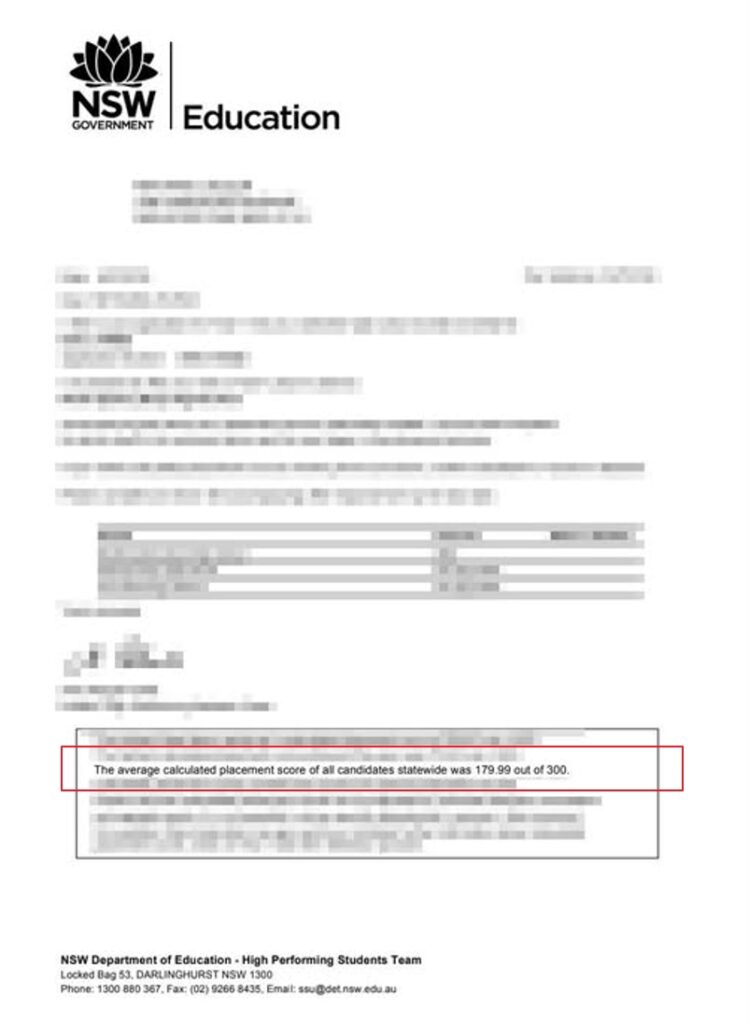
Historically, the NSW Department of Education’s official placement data showed an average calculated placement score of 179.99 out of 300(60%),
which aligns closely with an overall average of about 60 per cent statewide.
This became the benchmark for what a fair and balanced test should look like.
Of course, averages can vary depending on the group of students being measured.
Fortunately, thanks to the strong support from our parents and students,
Pre-Uni New College now has a large and diverse enough sample size to serve as a reliable and representative reference for meaningful data analysis.
So rather than focusing on raw marks alone,
what really matters is your child’s position compared to the average — their ranking.
Every parent understands this in principle, but it’s easy to forget when looking at our own child’s score.
Data Is Powerful — But Context Matters
The only reason we’re able to analyse data this accurately is because parents continue to trust and support Pre-Uni New College.
Without that participation, we wouldn’t have a large enough sample size to produce reliable insights.
That said, everything in education is case by case — and this doesn’t just apply to test results.
There are many other factors at play, such as school choice, the Equity Placement Model, and the newly introduced Gender Parity Model.
All of these create additional variables that can influence outcomes in different ways.
As with any large data set, there will always be noise and outliers — cases that don’t fit perfectly within the overall trend.
And sometimes, that “outlier” might be your child’s case.
It doesn’t mean the data is wrong; it simply reminds us that every student’s journey is unique.
No Magic — Just Experience and Data
At the end of the day, Pre-Uni New College doesn’t perform miracles — we simply guide parents based on data and long-standing experience. That’s really all we can (and should) do. And to be fair, it’s the same for every coaching college. It’s just common sense.
So we don’t over-emphasise it.
It’s not that we can’t build or won’t release something more complex — it’s that doing so doesn’t add real value and may only confuse parents unnecessarily.
And honestly, creating an easier test is never the hard part. What truly requires skill — and what we work hardest to achieve — is maintaining that average-score balance around 60 ± 10 per cent. Only those who’ve tried designing such tests know how difficult it actually is.

A Thought to Reflect On
Just as property prices vary from suburb to suburb,
even identical tests can feel different depending on timing, question order, or the group of students sitting them.
That’s why objective data matters far more than personal impressions.
Our aim is never to make tests simply “hard” or “easy”.
It is to design fair, accurate, and meaningful assessments that genuinely measure learning progress.
This message isn’t about persuasion — it’s simply a reminder
of something we all already know:
education works best when guided by reason, data, and fairness.
At Pre-Uni New College, we sincerely thank all parents for your ongoing trust and partnership.
Your commitment, understanding, and support inspire us every day to keep improving what we do.
Together, we share the same goal — helping every student reach their full potential through thoughtful, evidence-based education.
With appreciation,
Pre-Uni New College
© Pre-Uni New College Head Office. All rights reserved. If you would like to share this article, please use the official article link rather than reproducing its content.


More articles