On Campus

Year 2 Courses

WEMT

In Year 2 WEMT, students fortify their fundamental skills in Writing, English, Mathematics, and Thinking Skills, setting the stage for the heightened challenges they will encounter in Year 3. This program is particularly well-suited for Year 2 students as they transition to a more rigorous Year 3 curriculum.

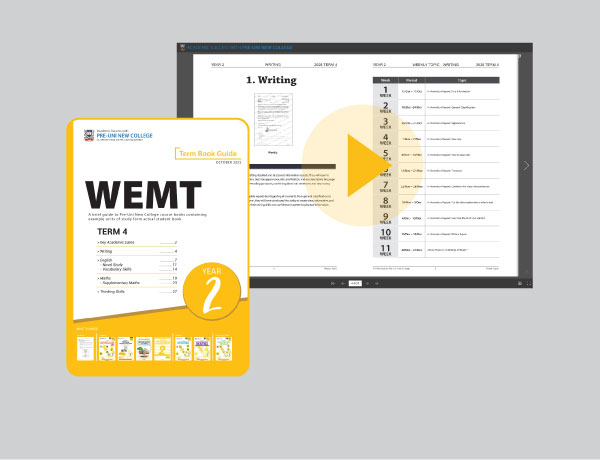
WEMT Course

Embark on a comprehensive learning experience with our signature WEMT course, meticulously designed to encompass the core academic competencies required for scholastic achievement. The WEMT curriculum is an integrated approach to learning that combines Writing, English, Mathematics, and Thinking Skills in a cohesive and engaging manner.

icon
WRITING

The writing module of the course emphasizes organizing writing structures and enhancing critical thinking and reasoning skills.

icon
ENGLISH

The English lessons focus on improving reading skills, with an emphasis on practicing reading comprehension and answering multiple-choice questions.

icon
MATHEMATICS

Mathematics lessons are crucial in helping students thoroughly understand mathematical theories, principles, and formulas to solve problems

icon
THINKING SKILLS

Challenge yourself with engaging exercises to enhance critical thinking and problem-solving abilities.

Info course
Face to Face Lesson

Face-to-face lessons offer a dynamic, interactive educational experience, fostering direct engagement with experienced educators and peers. These sessions encourage active participation, critical thinking, and collaborative learning, tailored to nurture each student’s curiosity and academic growth. With a focus on personalized instruction and real-time feedback, our approach enhances understanding, builds confidence.

Info course
Up-to date Resource

Stay ahead of the curve with our up-to-date resouces. The educational landscape is ever-evolving, and so are we.
Our materials are continuously reviewed and updated to align with the latest syllabus changes and educational best practices.

Info course
Managing Student Progress

Track growth and progress with our systematic approach to managing student development Through personalized progress management we ensure that every student receives the support they need to excel.

How our on-campus program works?

STEP 1
Lesson
In this initial stage, students attend weekly theory lessons that introduce new concepts and build foundational knowledge. Teachers use lectures, multimedia presentations, and interactive discussions to engage students and motivate them throughout the lesson. Active participation, question-asking, and note-taking are encouraged to enhance understanding of the material.
STEP 2
Complete Weekly Homework and S.O.Q
Following the lesson, students must complete their assigned homework to reinforce their learning. This includes reading assignments, problem-solving tasks, essays, or projects that apply their knowledge. Additionally, students engage with the S.O.Q (Special Online Quiz) to test their comprehension and retention of the material. Emphasis is made on the need to review and memorise new information to solidify learning.
STEP 3
Watch VOD
Students use Video On Demand (VOD) to review the material at their own pace. This enables them to revisit the lesson, clarify doubts, and address any missed content. VOD provides the flexibility to pause, rewind, and rewatch parts of the lesson, ensuring a thorough understanding of complex topics.
STEP 4
Term Progress Test
Students undertake a term test to assess their understanding of the material covered throughout the term. This comprehensive test evaluates topics taught during the term and measures students’ grasp of the subject matter. It serves as a formal assessment of learning progress and identifies areas needing improvement. In turn, it offers valuable feedback on student’s performance and achievement of key learning outcomes.
STEP 5
Review the Term Progress Test
The final step involves a detailed review of the test. Students analyse questions they answered incorrectly to understand their mistakes and refresh on the content. This review is crucial for consolidating knowledge, improving test-taking strategies, and preparing for future assessments. Teachers assist with explanations and additional practice to ensure confidence in the material prior to class commencing the following term.
Year 2 Course Structure
TERM 1
TERM 2
TERM 3
TERM 4
Writing
English
Mathematics
Thinking Skills Mathematics Reasoning
Novel Study
Vocabulary Skills
Module 1
  • Exposition (Opinions)
Module 2
  • Exposition (Language Features)
Module 3
  • Exposition (Structure of Arguments)
Module 4
  • Exposition (Modality)
Module 5
  • Exposition (Points of View)
Module 6
  • Exposition (Structure of arguments)
Module 7
  • Note: There is no Writing in Week 7
Module 8
  • Exposition (Advertisements)
Module 9
  • Exposition (Speeches)
Module 10
  • Exposition (Editorials)
Module 11
  • Exposition (Persuasive Letters)
Module 12
  • Note: There is no Writing in Week 12
Module 1
  • Cartoon: ‘The Hare and the Tortoise’
    – Sentence Completion
    – True or False
    – Main Idea

  • Cartoon: ‘The Lion and the Mouse’
    – Sentence Completion
    – True or False
    – Main Idea

  • Grammar
  • Word knowledge
  • Punctuation
  • Vocabulary
  • Antonyms (Opposite meanings)
  • Synonyms (Same meanings)
  • Contractions
  • Well Known Rhymes
Module 2
  • Report: ‘Seasons’
    – Getting the Facts
    – Identifying Inferences
    – Drawing Conclusions

  • Report: ‘The Weather’
    – Getting the Facts
    – Identifying Inferences
    – Drawing Conclusions

  • Grammar
  • Punctuation
  • Word knowledge
  • Vocabulary
  • Wood
  • Similes
  • Idioms
  • Proverb
Module 3
  • Cloze: ‘Paddington’s New Room’
  • Cloze: ‘King Ferdi and His Dragon’
  • Grammar
  • Punctuation
  • Word knowledge
  • Homophones
  • Antonyms
  • Vocabulary
  • Idioms
  • Odd Word Out
  • Proverb
Module 4
  • Factual Text – ‘Reptiles’
    – Getting the Facts
    – Identifying Inferences
    – Drawing Conclusions

  • Factual Text – ‘Reptiles’ (additional)
    – Getting the Facts
    – Identifying Inferences
    – Drawing Conclusions

  • Grammar
  • Word knowledge
  • Punctuation
  • Vocabulary
  • Homonyms
  • Idioms
  • Proverb
Module 5
  • Recount: ‘Camping’
    – Sequencing
    – Getting the Facts
    – Drawing Conclusions

  • Recount: ‘A Trip to the Snow’
    – Sequencing
    – Getting the Facts
    – Drawing Conclusions

  • Grammar
  • Adjectives
  • Word knowledge
  • Vocabulary
  • Homophones
  • Animal Groups
  • Idioms
  • Proverb
Module 6
  • Play: ‘Brer Fox and the Tar Baby’ – Scene 1
    – Getting the Facts
    – Identifying Inferences
    – Drawing Conclusions

  • Play: ‘Brer Fox and the Tar Baby’ – Scene 2
    – Getting the Facts
    – Identifying Inferences
    – Drawing Conclusions

  • Grammar
  • Verbs
  • Word knowledge
  • Vocabulary Ending ‘er’
  • Homophones
  • Idioms
  • Proverb
Module 7
  • Narrative: ‘Why the Echidna has Spikes’
    – Getting the Facts
    – Identifying Inferences
    – Drawing Conclusions

  • Narrative: ‘The Cross Country’
    – Getting the Facts
    – Identifying Inferences
    – Map Reading

  • Grammar
  • Word knowledge
  • Vocabulary
  • Alphabetical Order
  • Dictionary
  • Idioms
  • Proverb
Module 8
  • Narrative: ‘Famous Monkey’s Last Words’
    – Getting the Facts
    – Identifying Inferences
    – Drawing Conclusions

  • Narrative: ‘Maggie and the Pirate’
    – Getting the Facts
    – Identifying Inferences
    – Drawing Conclusions

  • Grammar
  • Editing
  • Word knowledge
  • Vocabulary – ‘Family Words’
  • Homophone
  • Idioms
  • Proverb
Module 9
  • Explanation: ‘Leaves’
    – Getting the Facts
    – Identifying Inferences
    – Drawing Conclusions

  • Explanation: ‘More about Leaves’
    – Getting the Facts
    – Identifying Inferences
    – Drawing Conclusions

  • Adverbs
  • More Adverbs
  • Punctuation
  • Plurals
  • Opposites
  • Muddled Sentences
  • Contractions
  • Vocabulary – ‘Sounds’
  • Leaves
  • Containers
  • Idioms
  • Proverb
Module 10
  • Poetry: ‘Living in the Outback’
    – Getting the Facts
    – Identifying Inferences
    – Drawing Conclusions

  • Poetry: ‘Space’
    – Getting the Facts
    – Identifying Inferences
    – Drawing Conclusions

  • Grammar
  • Word knowledge
  • Correct Word
  • Spelling-Editing
  • Adding ‘ing’ and ‘ed’
  • Dictionary Work
  • Homonyms
  • Alphabetical Order
  • Muddled Sentences
  • Idioms
  • Proverb
Module 11
  • Procedure: ‘How to Fold a Paper Airplane’
    – Getting the Facts
    – Identifying Inferences
    – Drawing Conclusions

  • Procedure: ‘How to Make Hot Chocolate’
    – Getting the Facts
    – Identifying Inferences
    – Drawing Conclusions

  • Grammar
  • Word knowledge
  • Correct Word
  • Spelling-Editing
  • Adding ‘ing’ and ‘ed’
  • Dictionary Work
  • Homonyms
  • Alphabetical Order
  • Muddled Sentences
  • Idioms
  • Proverb
Module 12
  • Factual Text: ‘The Moon’
    – Getting the Facts
    – Identifying Inferences
    – Drawing Conclusions

  • Factual Text: ‘The Night Sky’
    – Getting the Facts
    – Identifying Inferences
    – Drawing Conclusions

  • Grammar
  • Word Knowledge
  • Punctuation – Editing
  • Dictionary Work
  • Homophones
  • Alphabetical Order
  • Muddled Sentences
  • Idioms
Module 1
  • Addition
  • Subtraction
  • Time – Telling the Time
  • Symmetry
  • Addition Wheels
  • 3D Shapes
Module 2
  • Addition
  • Subtraction
  • Money with Fractions
  • Fractions
  • Money
  • Place Value
  • Reading a Calendar
  • Coordinate Graphs
Module 3
  • Addition
  • Subtraction
  • Patterns
  • Reading a Calendar
  • Multiplying by Two
  • Bar Graphs
  • Geometry – Flip, Turn & Slide
  • Measurement – Reading a Thermometer
Module 4
  • Addition
  • Subtraction
  • Reading Pictographs
  • Comparing Metric Units of Mass: Grams and Kilograms
  • Time
  • Reading Maps – Map of Joytown
  • Reading Graphs
Module 5
  • Addition
  • Subtraction
  • Reading Schedules
  • Probability and Statistics
  • How Many Squares?
  • Patterns
  • Reading Minutes
  • Money
Module 6
  • Addition
  • Subtraction
  • Nets of 3D Shapes
  • Calculating the Perimeter of a Shape
  • Comparing Groups
  • Multiplication
  • Time
Module 7
  • Multiplication
  • Reading Price Lists
  • Ordering Fractions
  • 2D Shapes
  • Telling the Time
Module 8
  • Multiplication
  • Money – Do You Have Enough?
  • Column Graphs
  • What Day of the Week?
  • Find the Temperature
  • 3D Shapes
  • Temperature
Module 9
  • Multiplication
  • Numbers
  • Fractions
  • Money
  • Space – Triangle
  • Number Sequences
  • Elapsed Time – How Much Time Has Passed?
Module 10
  • Division
  • Odd one out
  • Rounding Numbers to the Nearest Five Cents
  • Three Time Tables
  • 3D Shapes
Module 11
  • Addition
  • Subtraction
  • Reading Graphs
  • Using a Calendar
Module 12
  • Time and Routines
  • Money and Shopping
  • Fractions in Sharing
  • Maps and Graphs
  • Shapes Around Us
  • Measuring and Comparing
  • Multiplication and Division
  • Real-Life Problems
  • Extension Problems
Module 1
  • 1788: Arrival of the First Fleet from Britain
    Practice Question
    Vocabulary
Module 2
  • 1851: The Australian Gold Rush
    – Practice Question
    – Vocabulary
Module 3
  • 1901: The Formation of the Australian Federation
    – Practice Question
    – Vocabulary
Module 4
  • 1915: The Battle of Gallipoli
    – Practice Question
    – Vocabulary
Module 5
  • 1932: The Opening of the Sydney Harbour Bridge
    – Practice Question
    – Vocabulary


Module 6
  • 1967: Indigenous Australians Gain Voting Rights
    – Practice Question
    – Vocabulary


Module 7
  • 1973: The Opening of the Sydney Opera House
    – Practice Question
    – Vocabulary
Module 8
  • 1983: Australia II Wins the America’s Cup
    Practice Question
    Vocabulary
Module 9
  • 2000: Sydney Olympics
    – Practice Question
    – Vocabulary
Module 10
  • 2008: Apology to the Indigenous Australians
    – Practice Question
    – Vocabulary
Module 11
  • 2019-2020: Australian Bushfires
    – Practice Question
    – Vocabulary
Module 12
  • Kalgoorlie’s History
    – Practice Question
    – Vocabulary
Module 1
  • Dot and the Kangaroo – Chapter 1
    – Comprehension
    – Language and Vocabulary
    – Quotes
    – Verbal Reasoning
Module 2
  • Dot and the Kangaroo – Chapter 2
    – Comprehension
    – Language and Vocabulary
    – Quotes
    – Verbal Reasoning
Module 3
  • Dot and the Kangaroo – Chapter 3
    – Comprehension
    – Language and Vocabulary
    – Quotes
    – Verbal Reasoning
Module 4
  • Dot and the Kangaroo – Chapter 4
    – Comprehension
    – Language and Vocabulary
    – Quotes
    – Verbal Reasoning
Module 5
  • Dot and the Kangaroo – Chapter 5
    – Comprehension
    – Language and Vocabulary
    – Quotes
    – Verbal Reasoning
Module 6
  • Dot and the Kangaroo – Chapter 6
    – Comprehension
    – Language and Vocabulary
    – Quotes
    – Verbal Reasoning
Module 7
  • Dot and the Kangaroo – Chapter 7
    – Comprehension
    – Language and Vocabulary
    – Quotes
    – Verbal Reasoning
Module 8
  • Dot and the Kangaroo – Chapter 8
    – Comprehension
    – Language and Vocabulary
    – Quotes
    – Verbal Reasoning
Module 9
  • Dot and the Kangaroo – Chapter 9
    – Comprehension
    – Language and Vocabulary
    – Quotes
    – Verbal Reasoning
Module 10
  • Dot and the Kangaroo – Chapter 10
    – Comprehension
    – Language and Vocabulary
    – Quotes
    – Verbal Reasoning
Module 11
  • Dot and the Kangaroo – Chapter 11
    – Comprehension
    – Language and Vocabulary
    – Quotes
    – Verbal Reasoning
Module 1
  • Word List
  • Double Consonants
  • Using Clues
  • Draw These
  • Circle Words
  • Jumbled Words
  • Odd One Out
  • What Am I Doing? (‘Ing’ Words)
  • Matching The Same (Synonyms)
  • Matching Opposites (Antonyms)
  • Yes or No?
  • Making Plurals
  • Furniture or Clothes?
  • Idioms of the Week
  • Proverb of the Week
Module 2
  • Word List
  • Double Consonants
  • Using Clues
  • Circle Words
  • Draw These
  • Jumbled Words
  • Find A Word
  • Odd One Out
  • Matching The Same (Synonyms)
  • Match Opposites (Antonyms)
  • What Am I?
  • Yes or No?
  • Music or Game?
  • Making Plurals
  • Idioms of the Week
  • Proverb of the Week
Module 3
  • Word List
  • Revision: Family Words
  • Using Clues
  • Circle Words
  • Draw These
  • Jumbled Words
  • Odd One Out
  • Matching The Same (Synonyms)
  • Match Opposites (Antonyms)
  • What Am I?
  • Yes or No?
  • What Sounds Do They Make?
  • Compound Words
  • Similes
  • Idioms of the Week
  • Proverb of the Week
Module 4
  • Word List
  • Family Words ‘AY’
  • Using Clues
  • Circle Words
  • Draw These
  • What Am I?
  • Jumbled Words
  • Odd One Out
  • Matching The Same (Synonyms)
  • Matching Opposites (Antonyms)
  • Yes or No?
  • Similes
  • Idioms of the Week
  • Proverb of the Week
Module 5
  • Word List
  • Family Words ‘OO’
  • Using Clues
  • Circle Words
  • Draw These
  • Jumbled Words
  • What Am I?
  • Odd One Out
  • Matching The Same (Synonyms)
  • Matching Opposites (Antonyms)
  • Yes or No?
  • One Word For Two Or More
  • Analogies
  • Idioms of the Week
  • Proverb of the Week
Module 6
  • Word List
  • Family Words ‘OI’ and ‘OY’
  • Using Clues
  • Circle Words
  • Draw These
  • Yes or No?
  • What Am I?
  • Matching The Same (Synonyms)
  • Matching Opposites
  • Odd One Out
  • Order of Size
  • One Word for Two or More
  • Crossword Puzzle
  • Idioms of the Week
  • Proverb of the Week
Module 7
  • Word List
  • Family Words ‘OO’
  • Using Clues
  • Jumbled Words
  • Draw These
  • Yes or No?
  • Which One?
  • Matching The Same (Synonyms)
  • Matching Opposites (Antonyms)
  • Odd One Out
  • Match The Sounds
  • One Word for Two or More
  • Idioms of the Week
  • Proverb of the Week
Module 8
  • Word List
  • Family Words ‘Ew’
  • Using Clues
  • Jumbled Words
  • Draw These
  • Yes or No?
  • Which One?
  • Matching The Same (Synonyms)
  • Matching Opposites (Antonyms)
  • Odd One Out
  • Match The Sounds
  • One Word for Two or More
  • Idioms of the Week
  • Proverb of the Week
Module 9
  • Word List
  • Long ‘Y’ Says ‘I’
  • Using Clues
  • Jumbled Words
  • Draw These
  • Yes or No?
  • Where Are These?
  • Matching The Same (Synonyms)
  • Matching Opposites (Antonyms)
  • Odd One Out
  • Who Am I?
  • Full Stops and Capital Letters
  • Best Words
  • Idioms of the Week
  • Proverb of the Week
Module 10
  • Word List
  • Family Words ‘SS’
  • Using Clues
  • Jumbled Words
  • Draw These
  • Yes or No?
  • Odd One Out
  • Where Are These?
  • Matching The Same (Synonyms)
  • Matching Opposites (Antonyms)
  • What Am I?
  • Full Stops and Capital Letters
  • Best Words
  • Idioms of the Week
  • Proverb of the Week
Module 11
  • Word List
  • ‘AI’ And ‘A-E’ Family
  • Using Clues
  • Yes or No?
  • Where Are These?
  • Matching The Same (Synonyms)
  • Matching Opposites (Antonyms)
  • What Am I?
  • Idioms
  • Proverb
Module 12
  • Note: There is no Vocabulary Skills in Week 12
Writing
English
Mathematics
Thinking Skills
Novel Study
Vocabulary Skills
Module 1
  • Exposition (Opinions)
Module 2
  • Exposition (Language Features)
Module 3
  • Exposition (Structure of Arguments)
Module 4
  • Exposition (Modality)
Module 5
  • Exposition (Points of View)
Module 6
  • Exposition (Structure of arguments)
Module 7
  • Note: There is no Writing in Week 7
Module 8
  • Exposition (Advertisements)
Module 9
  • Exposition (Speeches)
Module 10
  • Exposition (Editorials)
Module 11
  • Exposition (Persuasive Letters)
Module 1
  • Cartoon: ‘The Hare and the Tortoise’
    – Sentence Completion
    – True or False
    – Main Idea

  • Cartoon: ‘The Lion and the Mouse’
    – Sentence Completion
    – True or False
    – Main Idea

  • Grammar
  • Word knowledge
  • Punctuation
  • Vocabulary
  • Antonyms (Opposite meanings)
  • Synonyms (Same meanings)
  • Contractions
  • Well Known Rhymes
Module 2
  • Report: ‘Seasons’
    – Getting the Facts
    – Identifying Inferences
    – Drawing Conclusions

  • Report: ‘The Weather’
    – Getting the Facts
    – Identifying Inferences
    – Drawing Conclusions

  • Grammar
  • Punctuation
  • Word knowledge
  • Vocabulary
  • Wood
  • Similes
  • Idioms
  • Proverb
Module 3
  • Cloze: ‘Paddington’s New Room’
  • Cloze: ‘King Ferdi and His Dragon’
  • Grammar
  • Punctuation
  • Word knowledge
  • Homophones
  • Antonyms
  • Vocabulary
  • Idioms
  • Odd Word Out
  • Proverb
Module 4
  • Factual Text – ‘Reptiles’
    – Getting the Facts
    – Identifying Inferences
    – Drawing Conclusions

  • Factual Text – ‘Reptiles’ (additional)
    – Getting the Facts
    – Identifying Inferences
    – Drawing Conclusions

  • Grammar
  • Word knowledge
  • Punctuation
  • Vocabulary
  • Homonyms
  • Idioms
  • Proverb
Module 5
  • Recount: ‘Camping’
    – Sequencing
    – Getting the Facts
    – Drawing Conclusions

  • Recount: ‘A Trip to the Snow’
    – Sequencing
    – Getting the Facts
    – Drawing Conclusions

  • Grammar
  • Adjectives
  • Word knowledge
  • Vocabulary
  • Homophones
  • Animal Groups
  • Idioms
  • Proverb
Module 6
  • Play: ‘Brer Fox and the Tar Baby’ – Scene 1
    – Getting the Facts
    – Identifying Inferences
    – Drawing Conclusions

  • Play: ‘Brer Fox and the Tar Baby’ – Scene 2
    – Getting the Facts
    – Identifying Inferences
    – Drawing Conclusions

  • Grammar
  • Verbs
  • Word knowledge
  • Vocabulary Ending ‘er’
  • Homophones
  • Idioms
  • Proverb
Module 7
  • Narrative: ‘Why the Echidna has Spikes’
    – Getting the Facts
    – Identifying Inferences
    – Drawing Conclusions

  • Narrative: ‘The Cross Country’
    – Getting the Facts
    – Identifying Inferences
    – Map Reading

  • Grammar
  • Word knowledge
  • Vocabulary
  • Alphabetical Order
  • Dictionary
  • Idioms
  • Proverb
Module 8
  • Narrative: ‘Famous Monkey’s Last Words’
    – Getting the Facts
    – Identifying Inferences
    – Drawing Conclusions

  • Narrative: ‘Maggie and the Pirate’
    – Getting the Facts
    – Identifying Inferences
    – Drawing Conclusions

  • Grammar
  • Editing
  • Word knowledge
  • Vocabulary – ‘Family Words’
  • Homophone
  • Idioms
  • Proverb
Module 9
  • Explanation: ‘Leaves’
    – Getting the Facts
    – Identifying Inferences
    – Drawing Conclusions

  • Explanation: ‘More about Leaves’
    – Getting the Facts
    – Identifying Inferences
    – Drawing Conclusions

  • Adverbs
  • More Adverbs
  • Punctuation
  • Plurals
  • Opposites
  • Muddled Sentences
  • Contractions
  • Vocabulary – ‘Sounds’
  • Leaves
  • Containers
  • Idioms
  • Proverb
Module 10
  • Poetry: ‘Living in the Outback’
    – Getting the Facts
    – Identifying Inferences
    – Drawing Conclusions

  • Poetry: ‘Space’
    – Getting the Facts
    – Identifying Inferences
    – Drawing Conclusions

  • Grammar
  • Word knowledge
  • Correct Word
  • Spelling-Editing
  • Adding ‘ing’ and ‘ed’
  • Dictionary Work
  • Homonyms
  • Alphabetical Order
  • Muddled Sentences
  • Idioms
  • Proverb
Module 11
  • Procedure: ‘How to Fold a Paper Airplane’
    – Getting the Facts
    – Identifying Inferences
    – Drawing Conclusions

  • Procedure: ‘How to Make Hot Chocolate’
    – Getting the Facts
    – Identifying Inferences
    – Drawing Conclusions

  • Grammar
  • Word knowledge
  • Correct Word
  • Spelling-Editing
  • Adding ‘ing’ and ‘ed’
  • Dictionary Work
  • Homonyms
  • Alphabetical Order
  • Muddled Sentences
  • Idioms
  • Proverb
Module 12
  • Factual Text: ‘The Moon’
    – Getting the Facts
    – Identifying Inferences
    – Drawing Conclusions

  • Factual Text: ‘The Night Sky’
    – Getting the Facts
    – Identifying Inferences
    – Drawing Conclusions

  • Grammar
  • Word Knowledge
  • Punctuation – Editing
  • Dictionary Work
  • Homophones
  • Alphabetical Order
  • Muddled Sentences
  • Idioms
Module 1
  • Addition
  • Subtraction
  • Time – Telling the Time
  • Symmetry
  • Addition Wheels
  • 3D Shapes
Module 2
  • Addition
  • Subtraction
  • Money with Fractions
  • Fractions
  • Money
  • Place Value
  • Reading a Calendar
  • Coordinate Graphs
Module 3
  • Addition
  • Subtraction
  • Patterns
  • Reading a Calendar
  • Multiplying by Two
  • Bar Graphs
  • Geometry – Flip, Turn & Slide
  • Measurement – Reading a Thermometer
Module 4
  • Addition
  • Subtraction
  • Reading Pictographs
  • Comparing Metric Units of Mass: Grams and Kilograms
  • Time
  • Reading Maps – Map of Joytown
  • Reading Graphs
Module 5
  • Addition
  • Subtraction
  • Reading Schedules
  • Probability and Statistics
  • How Many Squares?
  • Patterns
  • Reading Minutes
  • Money
Module 6
  • Addition
  • Subtraction
  • Nets of 3D Shapes
  • Calculating the Perimeter of a Shape
  • Comparing Groups
  • Multiplication
  • Time
Module 7
  • Multiplication
  • Reading Price Lists
  • Ordering Fractions
  • 2D Shapes
  • Telling the Time
Module 8
  • Multiplication
  • Money – Do You Have Enough?
  • Column Graphs
  • What Day of the Week?
  • Find the Temperature
  • 3D Shapes
  • Temperature
Module 9
  • Multiplication
  • Numbers
  • Fractions
  • Money
  • Space – Triangle
  • Number Sequences
  • Elapsed Time – How Much Time Has Passed?
Module 10
  • Division
  • Odd one out
  • Rounding Numbers to the Nearest Five Cents
  • Three Time Tables
  • 3D Shapes
Module 11
  • Addition
  • Subtraction
  • Reading Graphs
  • Using a Calendar
Module 12
  • Time and Routines
  • Money and Shopping
  • Fractions in Sharing
  • Maps and Graphs
  • Shapes Around Us
  • Measuring and Comparing
  • Multiplication and Division
  • Real-Life Problems
  • Extension Problems
Module 1
  • 1788: Arrival of the First Fleet from Britain
    – Practice Question
    – Vocabulary
Module 2
  • 1851: The Australian Gold Rush
    – Practice Question
    – Vocabulary
Module 3
  • 1901: The Formation of the Australian Federation
    – Practice Question
    – Vocabulary
Module 4
  • 1915: The Battle of Gallipoli
    – Practice Question
    – Vocabulary
Module 5
  • 1932: The Opening of the Sydney Harbour Bridge
    – Practice Question
    – Vocabulary


Module 6
  • 1967: Indigenous Australians Gain Voting Rights
    – Practice Question
    – Vocabulary


Module 7
  • 1973: The Opening of the Sydney Opera House
    – Practice Question
    – Vocabulary
Module 8
  • 1983: Australia II Wins the America’s Cup
    – Practice Question
    – Vocabulary
Module 9
  • 2000: Sydney Olympics
    – Practice Question
    – Vocabulary
Module 10
  • 2008: Apology to the Indigenous Australians
    – Practice Question
    – Vocabulary
Module 11
  • 2019-2020: Australian Bushfires
    – Practice Question
    – Vocabulary
Module 12
  • Kalgoorlie’s History
    – Practice Question
    – Vocabulary
Module 1
  • Dot and the Kangaroo – Chapter 1
    – Comprehension
    – Language and Vocabulary
    – Quotes
    – Verbal Reasoning
Module 2
  • Dot and the Kangaroo – Chapter 2
    – Comprehension
    – Language and Vocabulary
    – Quotes
    – Verbal Reasoning
Module 3
  • Dot and the Kangaroo – Chapter 3
    – Comprehension
    – Language and Vocabulary
    – Quotes
    – Verbal Reasoning
Module 4
  • Dot and the Kangaroo – Chapter 4
    – Comprehension
    – Language and Vocabulary
    – Quotes
    – Verbal Reasoning
Module 5
  • Dot and the Kangaroo – Chapter 5
    – Comprehension
    – Language and Vocabulary
    – Quotes
    – Verbal Reasoning
Module 6
  • Dot and the Kangaroo – Chapter 6
    – Comprehension
    – Language and Vocabulary
    – Quotes
    – Verbal Reasoning
Module 7
  • Dot and the Kangaroo – Chapter 7
    – Comprehension
    – Language and Vocabulary
    – Quotes
    – Verbal Reasoning
Module 8
  • Dot and the Kangaroo – Chapter 8
    – Comprehension
    – Language and Vocabulary
    – Quotes
    – Verbal Reasoning
Module 9
  • Dot and the Kangaroo – Chapter 9
    – Comprehension
    – Language and Vocabulary
    – Quotes
    – Verbal Reasoning
Module 10
  • Dot and the Kangaroo – Chapter 10
    – Comprehension
    – Language and Vocabulary
    – Quotes
    – Verbal Reasoning
Module 11
  • Dot and the Kangaroo – Chapter 11
    – Comprehension
    – Language and Vocabulary
    – Quotes
    – Verbal Reasoning
Module 12
  • Dot and the Kangaroo – Chapter 12
    – Summary
Module 1
  • Word List
  • Double Consonants
  • Using Clues
  • Draw These
  • Circle Words
  • Jumbled Words
  • Odd One Out
  • What Am I Doing? (‘Ing’ Words)
  • Matching The Same (Synonyms)
  • Matching Opposites (Antonyms)
  • Yes or No?
  • Making Plurals
  • Furniture or Clothes?
  • Idioms of the Week
  • Proverb of the Week
Module 2
  • Word List
  • Double Consonants
  • Using Clues
  • Circle Words
  • Draw These
  • Jumbled Words
  • Find A Word
  • Odd One Out
  • Matching The Same (Synonyms)
  • Match Opposites (Antonyms)
  • What Am I?
  • Yes or No?
  • Music or Game?
  • Making Plurals
  • Idioms of the Week
  • Proverb of the Week
Module 3
  • Word List
  • Revision: Family Words
  • Using Clues
  • Circle Words
  • Draw These
  • Jumbled Words
  • Odd One Out
  • Matching The Same (Synonyms)
  • Match Opposites (Antonyms)
  • What Am I?
  • Yes or No?
  • What Sounds Do They Make?
  • Compound Words
  • Similes
  • Idioms of the Week
  • Proverb of the Week
Module 4
  • Word List
  • Family Words ‘AY’
  • Using Clues
  • Circle Words
  • Draw These
  • What Am I?
  • Jumbled Words
  • Odd One Out
  • Matching The Same (Synonyms)
  • Matching Opposites (Antonyms)
  • Yes or No?
  • Similes
  • Idioms of the Week
  • Proverb of the Week
Module 5
  • Word List
  • Family Words ‘OO’
  • Using Clues
  • Circle Words
  • Draw These
  • Jumbled Words
  • What Am I?
  • Odd One Out
  • Matching The Same (Synonyms)
  • Matching Opposites (Antonyms)
  • Yes or No?
  • One Word For Two Or More
  • Analogies
  • Idioms of the Week
  • Proverb of the Week
Module 6
  • Word List
  • Family Words ‘OI’ and ‘OY’
  • Using Clues
  • Circle Words
  • Draw These
  • Yes or No?
  • What Am I?
  • Matching The Same (Synonyms)
  • Matching Opposites
  • Odd One Out
  • Order of Size
  • One Word for Two or More
  • Crossword Puzzle
  • Idioms of the Week
  • Proverb of the Week
Module 7
  • Word List
  • Family Words ‘OO’
  • Using Clues
  • Jumbled Words
  • Draw These
  • Yes or No?
  • Which One?
  • Matching The Same (Synonyms)
  • Matching Opposites (Antonyms)
  • Odd One Out
  • Match The Sounds
  • One Word for Two or More
  • Idioms of the Week
  • Proverb of the Week
Module 8
  • Word List
  • Family Words ‘Ew’
  • Using Clues
  • Jumbled Words
  • Draw These
  • Yes or No?
  • Which One?
  • Matching The Same (Synonyms)
  • Matching Opposites (Antonyms)
  • Odd One Out
  • Match The Sounds
  • One Word for Two or More
  • Idioms of the Week
  • Proverb of the Week
Module 9
  • Word List
  • Long ‘Y’ Says ‘I’
  • Using Clues
  • Jumbled Words
  • Draw These
  • Yes or No?
  • Where Are These?
  • Matching The Same (Synonyms)
  • Matching Opposites (Antonyms)
  • Odd One Out
  • Who Am I?
  • Full Stops and Capital Letters
  • Best Words
  • Idioms of the Week
  • Proverb of the Week
Module 10
  • Word List
  • Family Words ‘SS’
  • Using Clues
  • Jumbled Words
  • Draw These
  • Yes or No?
  • Odd One Out
  • Where Are These?
  • Matching The Same (Synonyms)
  • Matching Opposites (Antonyms)
  • What Am I?
  • Full Stops and Capital Letters
  • Best Words
  • Idioms of the Week
  • Proverb of the Week
Module 11
  • Word List
  • ‘AI’ And ‘A-E’ Family
  • Using Clues
  • Yes or No?
  • Where Are These?
  • Matching The Same (Synonyms)
  • Matching Opposites (Antonyms)
  • What Am I?
  • Idioms
  • Proverb
Writing
English
Mathematics
Thinking Skills Mathematics Reasoning
Novel Study
Vocabulary Skills
Module 1
  • Exposition (Opinions)
Module 2
  • Exposition (Language Features)
Module 3
  • Exposition (Structure of Arguments)
Module 4
  • Exposition (Modality)
Module 5
  • Exposition (Points of View)
Module 6
  • Exposition (Structure of arguments)
Module 7
  • Note: There is no Writing in Week 7
Module 8
  • Exposition (Advertisements)
Module 9
  • Exposition (Speeches)
Module 10
  • Exposition (Editorials)
Module 11
  • Exposition (Persuasive Letters)
Module 12
  • Note: There is no Writing in Week 12
Module 1
  • Cartoon: ‘The Hare and the Tortoise’
    – Sentence Completion
    – True or False
    – Main Idea

  • Cartoon: ‘The Lion and the Mouse’
    – Sentence Completion
    – True or False
    – Main Idea

  • Grammar
  • Word knowledge
  • Punctuation
  • Vocabulary
  • Antonyms (Opposite meanings)
  • Synonyms (Same meanings)
  • Contractions
  • Well Known Rhymes
Module 2
  • Report: ‘Seasons’
    – Getting the Facts
    – Identifying Inferences
    – Drawing Conclusions

  • Report: ‘The Weather’
    – Getting the Facts
    – Identifying Inferences
    – Drawing Conclusions

  • Grammar
  • Punctuation
  • Word knowledge
  • Vocabulary
  • Wood
  • Similes
  • Idioms
  • Proverb
Module 3
  • Cloze: ‘Paddington’s New Room’
  • Cloze: ‘King Ferdi and His Dragon’
  • Grammar
  • Punctuation
  • Word knowledge
  • Homophones
  • Antonyms
  • Vocabulary
  • Idioms
  • Odd Word Out
  • Proverb
Module 4
  • Factual Text – ‘Reptiles’
    – Getting the Facts
    – Identifying Inferences
    – Drawing Conclusions

  • Factual Text – ‘Reptiles’ (additional)
    – Getting the Facts
    – Identifying Inferences
    – Drawing Conclusions

  • Grammar
  • Word knowledge
  • Punctuation
  • Vocabulary
  • Homonyms
  • Idioms
  • Proverb
Module 5
  • Recount: ‘Camping’
    – Sequencing
    – Getting the Facts
    – Drawing Conclusions

  • Recount: ‘A Trip to the Snow’
    – Sequencing
    – Getting the Facts
    – Drawing Conclusions

  • Grammar
  • Adjectives
  • Word knowledge
  • Vocabulary
  • Homophones
  • Animal Groups
  • Idioms
  • Proverb
Module 6
  • Play: ‘Brer Fox and the Tar Baby’ – Scene 1
    – Getting the Facts
    – Identifying Inferences
    – Drawing Conclusions

  • Play: ‘Brer Fox and the Tar Baby’ – Scene 2
    – Getting the Facts
    – Identifying Inferences
    – Drawing Conclusions

  • Grammar
  • Verbs
  • Word knowledge
  • Vocabulary Ending ‘er’
  • Homophones
  • Idioms
  • Proverb
Module 7
  • Narrative: ‘Why the Echidna has Spikes’
    – Getting the Facts
    – Identifying Inferences
    – Drawing Conclusions

  • Narrative: ‘The Cross Country’
    – Getting the Facts
    – Identifying Inferences
    – Map Reading

  • Grammar
  • Word knowledge
  • Vocabulary
  • Alphabetical Order
  • Dictionary
  • Idioms
  • Proverb
Module 8
  • Narrative: ‘Famous Monkey’s Last Words’
    – Getting the Facts
    – Identifying Inferences
    – Drawing Conclusions

  • Narrative: ‘Maggie and the Pirate’
    – Getting the Facts
    – Identifying Inferences
    – Drawing Conclusions

  • Grammar
  • Editing
  • Word knowledge
  • Vocabulary – ‘Family Words’
  • Homophone
  • Idioms
  • Proverb
Module 9
  • Explanation: ‘Leaves’
    – Getting the Facts
    – Identifying Inferences
    – Drawing Conclusions

  • Explanation: ‘More about Leaves’
    – Getting the Facts
    – Identifying Inferences
    – Drawing Conclusions

  • Adverbs
  • More Adverbs
  • Punctuation
  • Plurals
  • Opposites
  • Muddled Sentences
  • Contractions
  • Vocabulary – ‘Sounds’
  • Leaves
  • Containers
  • Idioms
  • Proverb
Module 10
  • Poetry: ‘Living in the Outback’
    – Getting the Facts
    – Identifying Inferences
    – Drawing Conclusions

  • Poetry: ‘Space’
    – Getting the Facts
    – Identifying Inferences
    – Drawing Conclusions

  • Grammar
  • Word knowledge
  • Correct Word
  • Spelling-Editing
  • Adding ‘ing’ and ‘ed’
  • Dictionary Work
  • Homonyms
  • Alphabetical Order
  • Muddled Sentences
  • Idioms
  • Proverb
Module 11
  • Procedure: ‘How to Fold a Paper Airplane’
    – Getting the Facts
    – Identifying Inferences
    – Drawing Conclusions

  • Procedure: ‘How to Make Hot Chocolate’
    – Getting the Facts
    – Identifying Inferences
    – Drawing Conclusions

  • Grammar
  • Word knowledge
  • Correct Word
  • Spelling-Editing
  • Adding ‘ing’ and ‘ed’
  • Dictionary Work
  • Homonyms
  • Alphabetical Order
  • Muddled Sentences
  • Idioms
  • Proverb
Module 12
  • Factual Text: ‘The Moon’
    – Getting the Facts
    – Identifying Inferences
    – Drawing Conclusions

  • Factual Text: ‘The Night Sky’
    – Getting the Facts
    – Identifying Inferences
    – Drawing Conclusions

  • Grammar
  • Word Knowledge
  • Punctuation – Editing
  • Dictionary Work
  • Homophones
  • Alphabetical Order
  • Muddled Sentences
  • Idioms
Module 1
  • Addition
  • Subtraction
  • Time – Telling the Time
  • Symmetry
  • Addition Wheels
  • 3D Shapes
Module 2
  • Addition
  • Subtraction
  • Money with Fractions
  • Fractions
  • Money
  • Place Value
  • Reading a Calendar
  • Coordinate Graphs
Module 3
  • Addition
  • Subtraction
  • Patterns
  • Reading a Calendar
  • Multiplying by Two
  • Bar Graphs
  • Geometry – Flip, Turn & Slide
  • Measurement – Reading a Thermometer
Module 4
  • Addition
  • Subtraction
  • Reading Pictographs
  • Comparing Metric Units of Mass: Grams and Kilograms
  • Time
  • Reading Maps – Map of Joytown
  • Reading Graphs
Module 5
  • Addition
  • Subtraction
  • Reading Schedules
  • Probability and Statistics
  • How Many Squares?
  • Patterns
  • Reading Minutes
  • Money
Module 6
  • Addition
  • Subtraction
  • Nets of 3D Shapes
  • Calculating the Perimeter of a Shape
  • Comparing Groups
  • Multiplication
  • Time
Module 7
  • Multiplication
  • Reading Price Lists
  • Ordering Fractions
  • 2D Shapes
  • Telling the Time
Module 8
  • Multiplication
  • Money – Do You Have Enough?
  • Column Graphs
  • What Day of the Week?
  • Find the Temperature
  • 3D Shapes
  • Temperature
Module 9
  • Multiplication
  • Numbers
  • Fractions
  • Money
  • Space – Triangle
  • Number Sequences
  • Elapsed Time – How Much Time Has Passed?
Module 10
  • Division
  • Odd one out
  • Rounding Numbers to the Nearest Five Cents
  • Three Time Tables
  • 3D Shapes
Module 11
  • Addition
  • Subtraction
  • Reading Graphs
  • Using a Calendar
Module 12
  • Time and Routines
  • Money and Shopping
  • Fractions in Sharing
  • Maps and Graphs
  • Shapes Around Us
  • Measuring and Comparing
  • Multiplication and Division
  • Real-Life Problems
  • Extension Problems
Module 1
  • 1788: Arrival of the First Fleet from Britain
    Practice Question
    Vocabulary
Module 2
  • 1851: The Australian Gold Rush
    – Practice Question
    – Vocabulary
Module 3
  • 1901: The Formation of the Australian Federation
    – Practice Question
    – Vocabulary
Module 4
  • 1915: The Battle of Gallipoli
    – Practice Question
    – Vocabulary
Module 5
  • 1932: The Opening of the Sydney Harbour Bridge
    – Practice Question
    – Vocabulary


Module 6
  • 1967: Indigenous Australians Gain Voting Rights
    – Practice Question
    – Vocabulary


Module 7
  • 1973: The Opening of the Sydney Opera House
    – Practice Question
    – Vocabulary
Module 8
  • 1983: Australia II Wins the America’s Cup
    Practice Question
    Vocabulary
Module 9
  • 2000: Sydney Olympics
    – Practice Question
    – Vocabulary
Module 10
  • 2008: Apology to the Indigenous Australians
    – Practice Question
    – Vocabulary
Module 11
  • 2019-2020: Australian Bushfires
    – Practice Question
    – Vocabulary
Module 12
  • Kalgoorlie’s History
    – Practice Question
    – Vocabulary
Module 1
  • Dot and the Kangaroo – Chapter 1
    – Comprehension
    – Language and Vocabulary
    – Quotes
    – Verbal Reasoning
Module 2
  • Dot and the Kangaroo – Chapter 2
    – Comprehension
    – Language and Vocabulary
    – Quotes
    – Verbal Reasoning
Module 3
  • Dot and the Kangaroo – Chapter 3
    – Comprehension
    – Language and Vocabulary
    – Quotes
    – Verbal Reasoning
Module 4
  • Dot and the Kangaroo – Chapter 4
    – Comprehension
    – Language and Vocabulary
    – Quotes
    – Verbal Reasoning
Module 5
  • Dot and the Kangaroo – Chapter 5
    – Comprehension
    – Language and Vocabulary
    – Quotes
    – Verbal Reasoning
Module 6
  • Dot and the Kangaroo – Chapter 6
    – Comprehension
    – Language and Vocabulary
    – Quotes
    – Verbal Reasoning
Module 7
  • Dot and the Kangaroo – Chapter 7
    – Comprehension
    – Language and Vocabulary
    – Quotes
    – Verbal Reasoning
Module 8
  • Dot and the Kangaroo – Chapter 8
    – Comprehension
    – Language and Vocabulary
    – Quotes
    – Verbal Reasoning
Module 9
  • Dot and the Kangaroo – Chapter 9
    – Comprehension
    – Language and Vocabulary
    – Quotes
    – Verbal Reasoning
Module 10
  • Dot and the Kangaroo – Chapter 10
    – Comprehension
    – Language and Vocabulary
    – Quotes
    – Verbal Reasoning
Module 11
  • Dot and the Kangaroo – Chapter 11
    – Comprehension
    – Language and Vocabulary
    – Quotes
    – Verbal Reasoning
Module 1
  • Word List
  • Double Consonants
  • Using Clues
  • Draw These
  • Circle Words
  • Jumbled Words
  • Odd One Out
  • What Am I Doing? (‘Ing’ Words)
  • Matching The Same (Synonyms)
  • Matching Opposites (Antonyms)
  • Yes or No?
  • Making Plurals
  • Furniture or Clothes?
  • Idioms of the Week
  • Proverb of the Week
Module 2
  • Word List
  • Double Consonants
  • Using Clues
  • Circle Words
  • Draw These
  • Jumbled Words
  • Find A Word
  • Odd One Out
  • Matching The Same (Synonyms)
  • Match Opposites (Antonyms)
  • What Am I?
  • Yes or No?
  • Music or Game?
  • Making Plurals
  • Idioms of the Week
  • Proverb of the Week
Module 3
  • Word List
  • Revision: Family Words
  • Using Clues
  • Circle Words
  • Draw These
  • Jumbled Words
  • Odd One Out
  • Matching The Same (Synonyms)
  • Match Opposites (Antonyms)
  • What Am I?
  • Yes or No?
  • What Sounds Do They Make?
  • Compound Words
  • Similes
  • Idioms of the Week
  • Proverb of the Week
Module 4
  • Word List
  • Family Words ‘AY’
  • Using Clues
  • Circle Words
  • Draw These
  • What Am I?
  • Jumbled Words
  • Odd One Out
  • Matching The Same (Synonyms)
  • Matching Opposites (Antonyms)
  • Yes or No?
  • Similes
  • Idioms of the Week
  • Proverb of the Week
Module 5
  • Word List
  • Family Words ‘OO’
  • Using Clues
  • Circle Words
  • Draw These
  • Jumbled Words
  • What Am I?
  • Odd One Out
  • Matching The Same (Synonyms)
  • Matching Opposites (Antonyms)
  • Yes or No?
  • One Word For Two Or More
  • Analogies
  • Idioms of the Week
  • Proverb of the Week
Module 6
  • Word List
  • Family Words ‘OI’ and ‘OY’
  • Using Clues
  • Circle Words
  • Draw These
  • Yes or No?
  • What Am I?
  • Matching The Same (Synonyms)
  • Matching Opposites
  • Odd One Out
  • Order of Size
  • One Word for Two or More
  • Crossword Puzzle
  • Idioms of the Week
  • Proverb of the Week
Module 7
  • Word List
  • Family Words ‘OO’
  • Using Clues
  • Jumbled Words
  • Draw These
  • Yes or No?
  • Which One?
  • Matching The Same (Synonyms)
  • Matching Opposites (Antonyms)
  • Odd One Out
  • Match The Sounds
  • One Word for Two or More
  • Idioms of the Week
  • Proverb of the Week
Module 8
  • Word List
  • Family Words ‘Ew’
  • Using Clues
  • Jumbled Words
  • Draw These
  • Yes or No?
  • Which One?
  • Matching The Same (Synonyms)
  • Matching Opposites (Antonyms)
  • Odd One Out
  • Match The Sounds
  • One Word for Two or More
  • Idioms of the Week
  • Proverb of the Week
Module 9
  • Word List
  • Long ‘Y’ Says ‘I’
  • Using Clues
  • Jumbled Words
  • Draw These
  • Yes or No?
  • Where Are These?
  • Matching The Same (Synonyms)
  • Matching Opposites (Antonyms)
  • Odd One Out
  • Who Am I?
  • Full Stops and Capital Letters
  • Best Words
  • Idioms of the Week
  • Proverb of the Week
Module 10
  • Word List
  • Family Words ‘SS’
  • Using Clues
  • Jumbled Words
  • Draw These
  • Yes or No?
  • Odd One Out
  • Where Are These?
  • Matching The Same (Synonyms)
  • Matching Opposites (Antonyms)
  • What Am I?
  • Full Stops and Capital Letters
  • Best Words
  • Idioms of the Week
  • Proverb of the Week
Module 11
  • Word List
  • ‘AI’ And ‘A-E’ Family
  • Using Clues
  • Yes or No?
  • Where Are These?
  • Matching The Same (Synonyms)
  • Matching Opposites (Antonyms)
  • What Am I?
  • Idioms
  • Proverb
Module 12
  • Note: There is no Vocabulary Skills in Week 12
Writing
English
Mathematics
Thinking Skills Mathematics Reasoning
Novel Study
Vocabulary Skills
Module 1
  • Exposition (Opinions)
Module 2
  • Exposition (Language Features)
Module 3
  • Exposition (Structure of Arguments)
Module 4
  • Exposition (Modality)
Module 5
  • Exposition (Points of View)
Module 6
  • Exposition (Structure of arguments)
Module 7
  • Note: There is no Writing in Week 7
Module 8
  • Exposition (Advertisements)
Module 9
  • Exposition (Speeches)
Module 10
  • Exposition (Editorials)
Module 11
  • Exposition (Persuasive Letters)
Module 12
  • Note: There is no Writing in Week 12
Module 1
  • Cartoon: ‘The Hare and the Tortoise’
    – Sentence Completion
    – True or False
    – Main Idea

  • Cartoon: ‘The Lion and the Mouse’
    – Sentence Completion
    – True or False
    – Main Idea

  • Grammar
  • Word knowledge
  • Punctuation
  • Vocabulary
  • Antonyms (Opposite meanings)
  • Synonyms (Same meanings)
  • Contractions
  • Well Known Rhymes
Module 2
  • Report: ‘Seasons’
    – Getting the Facts
    – Identifying Inferences
    – Drawing Conclusions

  • Report: ‘The Weather’
    – Getting the Facts
    – Identifying Inferences
    – Drawing Conclusions

  • Grammar
  • Punctuation
  • Word knowledge
  • Vocabulary
  • Wood
  • Similes
  • Idioms
  • Proverb
Module 3
  • Cloze: ‘Paddington’s New Room’
  • Cloze: ‘King Ferdi and His Dragon’
  • Grammar
  • Punctuation
  • Word knowledge
  • Homophones
  • Antonyms
  • Vocabulary
  • Idioms
  • Odd Word Out
  • Proverb
Module 4
  • Factual Text – ‘Reptiles’
    – Getting the Facts
    – Identifying Inferences
    – Drawing Conclusions

  • Factual Text – ‘Reptiles’ (additional)
    – Getting the Facts
    – Identifying Inferences
    – Drawing Conclusions

  • Grammar
  • Word knowledge
  • Punctuation
  • Vocabulary
  • Homonyms
  • Idioms
  • Proverb
Module 5
  • Recount: ‘Camping’
    – Sequencing
    – Getting the Facts
    – Drawing Conclusions

  • Recount: ‘A Trip to the Snow’
    – Sequencing
    – Getting the Facts
    – Drawing Conclusions

  • Grammar
  • Adjectives
  • Word knowledge
  • Vocabulary
  • Homophones
  • Animal Groups
  • Idioms
  • Proverb
Module 6
  • Play: ‘Brer Fox and the Tar Baby’ – Scene 1
    – Getting the Facts
    – Identifying Inferences
    – Drawing Conclusions

  • Play: ‘Brer Fox and the Tar Baby’ – Scene 2
    – Getting the Facts
    – Identifying Inferences
    – Drawing Conclusions

  • Grammar
  • Verbs
  • Word knowledge
  • Vocabulary Ending ‘er’
  • Homophones
  • Idioms
  • Proverb
Module 7
  • Narrative: ‘Why the Echidna has Spikes’
    – Getting the Facts
    – Identifying Inferences
    – Drawing Conclusions

  • Narrative: ‘The Cross Country’
    – Getting the Facts
    – Identifying Inferences
    – Map Reading

  • Grammar
  • Word knowledge
  • Vocabulary
  • Alphabetical Order
  • Dictionary
  • Idioms
  • Proverb
Module 8
  • Narrative: ‘Famous Monkey’s Last Words’
    – Getting the Facts
    – Identifying Inferences
    – Drawing Conclusions

  • Narrative: ‘Maggie and the Pirate’
    – Getting the Facts
    – Identifying Inferences
    – Drawing Conclusions

  • Grammar
  • Editing
  • Word knowledge
  • Vocabulary – ‘Family Words’
  • Homophone
  • Idioms
  • Proverb
Module 9
  • Explanation: ‘Leaves’
    – Getting the Facts
    – Identifying Inferences
    – Drawing Conclusions

  • Explanation: ‘More about Leaves’
    – Getting the Facts
    – Identifying Inferences
    – Drawing Conclusions

  • Adverbs
  • More Adverbs
  • Punctuation
  • Plurals
  • Opposites
  • Muddled Sentences
  • Contractions
  • Vocabulary – ‘Sounds’
  • Leaves
  • Containers
  • Idioms
  • Proverb
Module 10
  • Poetry: ‘Living in the Outback’
    – Getting the Facts
    – Identifying Inferences
    – Drawing Conclusions

  • Poetry: ‘Space’
    – Getting the Facts
    – Identifying Inferences
    – Drawing Conclusions

  • Grammar
  • Word knowledge
  • Correct Word
  • Spelling-Editing
  • Adding ‘ing’ and ‘ed’
  • Dictionary Work
  • Homonyms
  • Alphabetical Order
  • Muddled Sentences
  • Idioms
  • Proverb
Module 11
  • Procedure: ‘How to Fold a Paper Airplane’
    – Getting the Facts
    – Identifying Inferences
    – Drawing Conclusions

  • Procedure: ‘How to Make Hot Chocolate’
    – Getting the Facts
    – Identifying Inferences
    – Drawing Conclusions

  • Grammar
  • Word knowledge
  • Correct Word
  • Spelling-Editing
  • Adding ‘ing’ and ‘ed’
  • Dictionary Work
  • Homonyms
  • Alphabetical Order
  • Muddled Sentences
  • Idioms
  • Proverb
Module 12
  • Factual Text: ‘The Moon’
    – Getting the Facts
    – Identifying Inferences
    – Drawing Conclusions

  • Factual Text: ‘The Night Sky’
    – Getting the Facts
    – Identifying Inferences
    – Drawing Conclusions

  • Grammar
  • Word Knowledge
  • Punctuation – Editing
  • Dictionary Work
  • Homophones
  • Alphabetical Order
  • Muddled Sentences
  • Idioms
Module 1
  • Addition
  • Subtraction
  • Time – Telling the Time
  • Symmetry
  • Addition Wheels
  • 3D Shapes
Module 2
  • Addition
  • Subtraction
  • Money with Fractions
  • Fractions
  • Money
  • Place Value
  • Reading a Calendar
  • Coordinate Graphs
Module 3
  • Addition
  • Subtraction
  • Patterns
  • Reading a Calendar
  • Multiplying by Two
  • Bar Graphs
  • Geometry – Flip, Turn & Slide
  • Measurement – Reading a Thermometer
Module 4
  • Addition
  • Subtraction
  • Reading Pictographs
  • Comparing Metric Units of Mass: Grams and Kilograms
  • Time
  • Reading Maps – Map of Joytown
  • Reading Graphs
Module 5
  • Addition
  • Subtraction
  • Reading Schedules
  • Probability and Statistics
  • How Many Squares?
  • Patterns
  • Reading Minutes
  • Money
Module 6
  • Addition
  • Subtraction
  • Nets of 3D Shapes
  • Calculating the Perimeter of a Shape
  • Comparing Groups
  • Multiplication
  • Time
Module 7
  • Multiplication
  • Reading Price Lists
  • Ordering Fractions
  • 2D Shapes
  • Telling the Time
Module 8
  • Multiplication
  • Money – Do You Have Enough?
  • Column Graphs
  • What Day of the Week?
  • Find the Temperature
  • 3D Shapes
  • Temperature
Module 9
  • Multiplication
  • Numbers
  • Fractions
  • Money
  • Space – Triangle
  • Number Sequences
  • Elapsed Time – How Much Time Has Passed?
Module 10
  • Division
  • Odd one out
  • Rounding Numbers to the Nearest Five Cents
  • Three Time Tables
  • 3D Shapes
Module 11
  • Addition
  • Subtraction
  • Reading Graphs
  • Using a Calendar
Module 12
  • Time and Routines
  • Money and Shopping
  • Fractions in Sharing
  • Maps and Graphs
  • Shapes Around Us
  • Measuring and Comparing
  • Multiplication and Division
  • Real-Life Problems
  • Extension Problems
Module 1
  • 1788: Arrival of the First Fleet from Britain
    Practice Question
    Vocabulary
Module 2
  • 1851: The Australian Gold Rush
    – Practice Question
    – Vocabulary
Module 3
  • 1901: The Formation of the Australian Federation
    – Practice Question
    – Vocabulary
Module 4
  • 1915: The Battle of Gallipoli
    – Practice Question
    – Vocabulary
Module 5
  • 1932: The Opening of the Sydney Harbour Bridge
    – Practice Question
    – Vocabulary


Module 6
  • 1967: Indigenous Australians Gain Voting Rights
    – Practice Question
    – Vocabulary


Module 7
  • 1973: The Opening of the Sydney Opera House
    – Practice Question
    – Vocabulary
Module 8
  • 1983: Australia II Wins the America’s Cup
    Practice Question
    Vocabulary
Module 9
  • 2000: Sydney Olympics
    – Practice Question
    – Vocabulary
Module 10
  • 2008: Apology to the Indigenous Australians
    – Practice Question
    – Vocabulary
Module 11
  • 2019-2020: Australian Bushfires
    – Practice Question
    – Vocabulary
Module 12
  • Kalgoorlie’s History
    – Practice Question
    – Vocabulary
Module 1
  • Dot and the Kangaroo – Chapter 1
    – Comprehension
    – Language and Vocabulary
    – Quotes
    – Verbal Reasoning
Module 2
  • Dot and the Kangaroo – Chapter 2
    – Comprehension
    – Language and Vocabulary
    – Quotes
    – Verbal Reasoning
Module 3
  • Dot and the Kangaroo – Chapter 3
    – Comprehension
    – Language and Vocabulary
    – Quotes
    – Verbal Reasoning
Module 4
  • Dot and the Kangaroo – Chapter 4
    – Comprehension
    – Language and Vocabulary
    – Quotes
    – Verbal Reasoning
Module 5
  • Dot and the Kangaroo – Chapter 5
    – Comprehension
    – Language and Vocabulary
    – Quotes
    – Verbal Reasoning
Module 6
  • Dot and the Kangaroo – Chapter 6
    – Comprehension
    – Language and Vocabulary
    – Quotes
    – Verbal Reasoning
Module 7
  • Dot and the Kangaroo – Chapter 7
    – Comprehension
    – Language and Vocabulary
    – Quotes
    – Verbal Reasoning
Module 8
  • Dot and the Kangaroo – Chapter 8
    – Comprehension
    – Language and Vocabulary
    – Quotes
    – Verbal Reasoning
Module 9
  • Dot and the Kangaroo – Chapter 9
    – Comprehension
    – Language and Vocabulary
    – Quotes
    – Verbal Reasoning
Module 10
  • Dot and the Kangaroo – Chapter 10
    – Comprehension
    – Language and Vocabulary
    – Quotes
    – Verbal Reasoning
Module 11
  • Dot and the Kangaroo – Chapter 11
    – Comprehension
    – Language and Vocabulary
    – Quotes
    – Verbal Reasoning
Module 1
  • Word List
  • Double Consonants
  • Using Clues
  • Draw These
  • Circle Words
  • Jumbled Words
  • Odd One Out
  • What Am I Doing? (‘Ing’ Words)
  • Matching The Same (Synonyms)
  • Matching Opposites (Antonyms)
  • Yes or No?
  • Making Plurals
  • Furniture or Clothes?
  • Idioms of the Week
  • Proverb of the Week
Module 2
  • Word List
  • Double Consonants
  • Using Clues
  • Circle Words
  • Draw These
  • Jumbled Words
  • Find A Word
  • Odd One Out
  • Matching The Same (Synonyms)
  • Match Opposites (Antonyms)
  • What Am I?
  • Yes or No?
  • Music or Game?
  • Making Plurals
  • Idioms of the Week
  • Proverb of the Week
Module 3
  • Word List
  • Revision: Family Words
  • Using Clues
  • Circle Words
  • Draw These
  • Jumbled Words
  • Odd One Out
  • Matching The Same (Synonyms)
  • Match Opposites (Antonyms)
  • What Am I?
  • Yes or No?
  • What Sounds Do They Make?
  • Compound Words
  • Similes
  • Idioms of the Week
  • Proverb of the Week
Module 4
  • Word List
  • Family Words ‘AY’
  • Using Clues
  • Circle Words
  • Draw These
  • What Am I?
  • Jumbled Words
  • Odd One Out
  • Matching The Same (Synonyms)
  • Matching Opposites (Antonyms)
  • Yes or No?
  • Similes
  • Idioms of the Week
  • Proverb of the Week
Module 5
  • Word List
  • Family Words ‘OO’
  • Using Clues
  • Circle Words
  • Draw These
  • Jumbled Words
  • What Am I?
  • Odd One Out
  • Matching The Same (Synonyms)
  • Matching Opposites (Antonyms)
  • Yes or No?
  • One Word For Two Or More
  • Analogies
  • Idioms of the Week
  • Proverb of the Week
Module 6
  • Word List
  • Family Words ‘OI’ and ‘OY’
  • Using Clues
  • Circle Words
  • Draw These
  • Yes or No?
  • What Am I?
  • Matching The Same (Synonyms)
  • Matching Opposites
  • Odd One Out
  • Order of Size
  • One Word for Two or More
  • Crossword Puzzle
  • Idioms of the Week
  • Proverb of the Week
Module 7
  • Word List
  • Family Words ‘OO’
  • Using Clues
  • Jumbled Words
  • Draw These
  • Yes or No?
  • Which One?
  • Matching The Same (Synonyms)
  • Matching Opposites (Antonyms)
  • Odd One Out
  • Match The Sounds
  • One Word for Two or More
  • Idioms of the Week
  • Proverb of the Week
Module 8
  • Word List
  • Family Words ‘Ew’
  • Using Clues
  • Jumbled Words
  • Draw These
  • Yes or No?
  • Which One?
  • Matching The Same (Synonyms)
  • Matching Opposites (Antonyms)
  • Odd One Out
  • Match The Sounds
  • One Word for Two or More
  • Idioms of the Week
  • Proverb of the Week
Module 9
  • Word List
  • Long ‘Y’ Says ‘I’
  • Using Clues
  • Jumbled Words
  • Draw These
  • Yes or No?
  • Where Are These?
  • Matching The Same (Synonyms)
  • Matching Opposites (Antonyms)
  • Odd One Out
  • Who Am I?
  • Full Stops and Capital Letters
  • Best Words
  • Idioms of the Week
  • Proverb of the Week
Module 10
  • Word List
  • Family Words ‘SS’
  • Using Clues
  • Jumbled Words
  • Draw These
  • Yes or No?
  • Odd One Out
  • Where Are These?
  • Matching The Same (Synonyms)
  • Matching Opposites (Antonyms)
  • What Am I?
  • Full Stops and Capital Letters
  • Best Words
  • Idioms of the Week
  • Proverb of the Week
Module 11
  • Word List
  • ‘AI’ And ‘A-E’ Family
  • Using Clues
  • Yes or No?
  • Where Are These?
  • Matching The Same (Synonyms)
  • Matching Opposites (Antonyms)
  • What Am I?
  • Idioms
  • Proverb
Module 12
  • Note: There is no Vocabulary Skills in Week 12

Pre-Uni New College WEMT Courses: More Than Just a Class –
A Total Learning Solution

icon
Video Lessons (Weekly)

Each question in the main textbook is clearly explained in the accompanying video lessons. These videos provide step-by-step guidance on how to approach and solve each problem, ensuring that students receive thorough and understandable instructions. By presenting the material in this clear and detailed manner, the lessons help to reinforce understanding and facilitate deeper comprehension of the textbook content. This approach allows students to follow along with explicit explanations, ask questions, and engage with the material more effectively, enhancing their overall learning experience.

icon
S.O.Q (Fortnightly)

The S.O.Q. (Special Online Quiz) consists of quizzes designed to test students’ understanding of recent modules in English, mathematics, and thinking skills. Engaging actively with these quizzes is vital, as it provides immediate feedback and highlights areas for improvement. This process helps reinforce learning, track progress, and keep students motivated by ensuring they effectively consolidate their knowledge and prepare for future challenges.

icon
Vocabulary Test (Weekly)

Cyberschool offers a weekly vocabulary test throughout the term to help students strengthen their language skills. These tests assess and reinforce understanding of new vocabulary, allowing students to track progress, identify improvement areas, and expand their word knowledge effectively. Regular participation supports continuous vocabulary development and enhances overall communication skills.

icon
WEMT Homework (Weekly)

WEMT students engage in weekly homework assignments to deepen their practice in mathematical reasoning, thinking skills, novel study, and reading comprehension. Each week, students tackle additional practice questions designed to reinforce and extend their understanding of these key areas. These assignments are crucial for consolidating knowledge and developing problem-solving skills. By consistently working on these questions, students gain valuable experience, improve their proficiency, and prepare more effectively for assessments.

icon
S-Maths Homework Questions (Weekly)

Supplementary Maths (S-Maths) offers an additional resource for students to enhance their maths study at home. Each S-Maths module aligns with the topics covered in the corresponding WEMT maths module, providing targeted practice and reinforcement. Students are encouraged to complete the weekly S-Maths questions and submit them by the end of the next school holiday. The S-Maths homework serves as a valuable tool for deepening their grasp of mathematical concepts and achieving academic success.

icon
Term Progress Test (Week 7)

Students take the Term Progress Test during Week 7 of the term to check their learning progress before the end-of-term assessment. English, Maths, and Thinking Skills tests are taken in class. The Writing test is completed online at home through the student’s account. To take the Writing test, click the ‘My Test’ menu on the navigation bar and go to the ‘Online Test’ page. Parents will receive the Term Progress Test report showing their child’s scores and rank (excluding Writing), along with information about their levels of achievement across specific competencies.

icon
Term Progress Test Review (1st week of holiday)

Students can revise the maths & thinking skills term test questions they answered incorrectly during the first week of the next school holiday period. Students are encouraged to revise all questions it provides and build up a solid foundation before their next term’s studies. The menu will appear under ‘Test Review’ menu of the navigation bar.

icon
My Result (during the term)

Stay updated on your child’s progress by visiting the My Results page throughout the course. Our dynamic reporting structure provides a clear view of your child’s performance on weekly and term tests. This feature allows you to monitor their academic development and identify areas where they may need additional support or practice.

icon
G.A for Scholarship Test (during the term)

The ‘GA Practice for Scholarship Test’ menu is designed for students who want to build a solid foundation for general ability skills, especially for the preparation of the AAS, ACER or Edutest private school scholarship tests. You can access it from ‘My Test’ menu at the navigation bar. The course covers both verbal and non-verbal reasoning skills, and each section is categorised into a comprehensive number of question types. By taking this course, students can study of almost all possible question types and complete a variety of practical, challenging and mind-stimulating questions. Students currently taking our regular term course in NSW can take this course for free until the next term begins.

icon
Reading 310 (during the term)

Reading 310 is the online self-paced test practice course that is designed for students to help them enhance their reading skill. Each test contains a comprehensive number of reading questions covering inference skills for reading with short passage, true/false, gapped texts etc. Students can attempt up to 10 tests during the term. You can access it from ‘My Test’ menu at the navigation bar. By completing tests, students will be able to do thorough study of important question types and complete a variety of challenging reading skill questions. Students currently taking our regular term course in NSW can take this course for free until the next term begins.

Terms and Conditions

The Extra Service is subject to change at any time without notice. Services may vary depending on the normal term or holiday course, and they are only available during designated periods. Please note that conditions apply.

Our Flexible Learning Method Cyber Course Standard Course
Online On Campus
Live via Zoom Face to Face
Lesson

Lessons are delivered by highly experienced instructors who excel in articulating concepts with clarity and precision, ensuring a comprehensive learning experience.

Classroom
VOD Lesson

Each week’s VOD Lesson are uploaded on Saturday and available for the next three weeks. If you missing the lesson you can watch the lesson.

Material

Our materials are continuously reviewed and updated to align with the latest syllabus changes and educational best practices.

Handed out during class
Online Homework

Weekly homework marking and recording service that provides an opportunity for students to consolidate their learning and address their learning needs.

Quiz

Special Online Quizzes are available.

Module Answer

Weekly module answers are uploaded on Saturday and are available until the end of term.

Term Progress Test

All students are required to complete their term progress test during Week 7.

Online In Class
Term Progress Test Review

Through term progress tests, review and reflect on the content learned over the term.

My Result

Seamless tracking of student progress throughout their learning journey.

Term Year 2 Timetable

Mon

Tue

Wed

Thu

Fri

WEMT
4:30pm – 8:00pm

Sat

WEMT
9:00am – 12:30pm

WEMT
1:00pm – 4:30pm

Sun

* WEMT : Writing, English, Mathematics and Thinking Skills
* NO Parking: Please note that we do not provide parking for parents on our campus, including the Strathfield Head Office, McDonald College, Homebush Boys High School and Strathfield Centre (8 Lyons St. Strathfield).

Mon

Tue

Wed

Writing

5:00pm – 7:40pm

Thu

WEMT

4:30pm – 8:00pm

Fri

WEMT
4:30pm – 8:00pm

Sat

WEMT
9:00am – 12:30pm

WEMT
1:00pm – 4:30pm

Sun

Mon

Tue

Wed

Writing

5:00pm – 7:40pm

Thu

WEMT

4:30pm – 8:00pm

Fri

WEMT
4:30pm – 8:00pm

Sat

WEMT
9:00am – 12:30pm

WEMT
1:00pm – 4:30pm

Sun

* WEMT : Writing, English, Mathematics and Thinking Skills
* Class location : Subject to change based on enrolment numbers.
* Parking Restrictions: There is no parking available for students or parents at the Strathfield Head Office (5 The Crescent), McDonald College (17 George St. North Strathfield) and our Strathfield Centre (8 Lyons Street)
* Enrolment Policy: To ensure consistency and uninterrupted learning, students must remain in their enrolled course until completion. Transfers to other branches or course changes are not permitted during the course duration.
* Sibling Discounts are available until the Early Bird Payment due date – Monday, 8th July 2024, 5 PM.

Mon

Tue

Wed

Writing

5:00pm – 7:40pm

Thu

WEMT

4:30pm – 8:00pm

Fri

WEMT
4:30pm – 8:00pm

Sat

WEMT
9:00am – 12:30pm

WEMT
1:00pm – 4:30pm

Sun

* WEMT : Writing, English, Mathematics and Thinking Skills
* Class location : Subject to change based on enrolment numbers.
* Parking Restrictions: There is no parking available for students or parents at the Strathfield Head Office (5 The Crescent), McDonald College (17 George St. North Strathfield) and our Strathfield Centre (8 Lyons Street)
* Enrolment Policy: To ensure consistency and uninterrupted learning, students must remain in their enrolled course until completion. Transfers to other branches or course changes are not permitted during the course duration.
* Early Bird Payment & Sibling Discounts: Don’t miss out! These discounts are available until Monday, 29th September, 5 PM.
Term 2 Academic Key Dates for Year 2

Year 2 WEMT Course Pricing

Year 2
WEMT Course
Face-to-face learning with teachers in class & access all Cyberschool services.
$
75
Select start day
Total weeks:
Material fee:
$
985
$
910
Early Bird (E/B) Discount is valid for full term payments by Tuesday, 7 April 2026, 5 pm.
Sibling discounts are available until Tuesday, 7 April 2026, 5 pm.
Full Term (F/T) Discount is valid for full term payments by Friday, 24 April 2026, 5 pm.
Anzac Day: Year 2 Saturday classes will be conducted as normal on 25 April 2026.
Other Year 2 Course
WRITING
Our fun and engaging Year 2 Writing Course, starting in Term 2, will help them build strong technical and creative writing skills.

Frequently Asked Questions

What is Cyberschool?

The online educational platform, Cyberschool (www.cyberschool.com.au), is tailored for Pre-Uni New College primary students enrolled in foundation courses. This resource serves as a means for students to obtain supplementary assistance with their homework and review their prior classroom materials. The lessons are delivered by experienced and skilled teachers who have collaborated to design engaging, activity-oriented sessions for your child’s enjoyment. Access to the Cyberschool website is entirely complimentary for students currently enrolled at Pre-Uni New College.

What is S.O.Q?

S.O.Q (Special Online Quiz) comprises a set of review questions strategically created to motivate our students to revisit fundamental principles covered in earlier modules. Cyberschool offers four online quizzes during weeks 2, 4, 6, and 8 of the course. This is only available for students enrolled in a foundation course.

Will students see their teachers during online lessons?

Since teachers possess authority over their live online sessions, they will activate their cameras and be clearly visible to students throughout the virtual class. Additionally, teachers will have access to the screen-sharing feature, enabling students to observe content presented by the teacher during the sessions.

Since classes are online, is it possible to join other online classes outside a student’s scheduled class?

Due to a restricted capacity for each class, it is necessary for students to participate in their assigned session.

How do teachers ensure that kids are focused whilst learning?

Educators utilise various methods to captivate students and guarantee their focus during online video lessons. For instance, numerous video classes incorporate interactive learning exercises that prompt students to tackle questions in real time. Nevertheless, it’s vital to acknowledge that the Cyberschool video lessons are designed for self-directed learning. As a result, parental support and guidance are essential.

I’m not able to travel to the branch (or live outside NSW), is there an option of remote learning?

We provide remote or online alternatives based on the specific requirements of our students. Our regular foundation courses are conducted through live online sessions using platforms like Zoom, while our Cyber Course is accessible through our Cyberschool platform.

My child is enrolled in WEMT. What is the recommended online learning routine my child should follow?

Throughout the week, students are anticipated to finalise all the questions within the modules. If they feel the need for additional module clarification, they can utilise the Cyberschool video lessons to revisit module concepts and questions.

See more

Subscribe To Our Newsletter

Stay up to date with our lastest news and college information.
On Campus

Year 3 Courses

WEMT

Elevate your child’s learning with our updated Year 3 WEMT course. This program strengthens reading, writing, maths, and critical thinking skills through engaging lessons, building exam readiness and confidence while making learning enjoyable.

WEMT Course

Embark on a comprehensive learning experience with our signature WEMT course, meticulously designed to encompass the core academic competencies required for scholastic achievement. The WEMT curriculum is an integrated approach to learning that combines Writing, English, Mathematics, and Thinking Skills in a cohesive and engaging manner.

What students will study
icon
WRITING

The writing module will delve into the most effective methods for organising writing structure, with an emphasis on cultivating critical thinking and reasoning abilities.

icon
ENGLISH

The English component will concentrate on reading proficiency, offering opportunities for practicing reading comprehension and answering multiple-choice questions.

icon
MATHEMATICS

Mathematics lessons will provide students with a comprehensive understanding of mathematical theories, principles, and formulas to tackle problems with confidence.

icon
THINKING SKILLS

The Thinking Skills includes challenging problem-solving and critical thinking questions. Students enhance their ability to analyse information, reason logically through arguments, and evaluate assumptions and arguments effectively.

Info course
Face to Face Lesson

Face-to-face lessons offer a dynamic, interactive educational experience, fostering direct engagement with experienced educators and peers. These sessions encourage active participation, critical thinking, and collaborative learning, tailored to nurture each student’s curiosity and academic growth. With a focus on personalized instruction and real-time feedback, our approach enhances understanding, builds confidence.

Info course
Up-to date Resource

Stay ahead of the curve with our up-to-date resouces. The educational landscape is ever-evolving, and so are we.
Our materials are continuously reviewed and updated to align with the latest syllabus changes and educational best practices.

Info course
Managing Student Progress

Track growth and progress with our systematic approach to managing student development Through personalized progress management we ensure that every student receives the support they need to excel.

How our on-campus program works?

STEP 1
Lesson
In this initial stage, students attend weekly theory lessons that introduce new concepts and build foundational knowledge. Teachers use lectures, multimedia presentations, and interactive discussions to engage students and motivate them throughout the lesson. Active participation, question-asking, and note-taking are encouraged to enhance understanding of the material.
STEP 2
Complete Weekly Homework and S.O.Q
Following the lesson, students must complete their assigned homework to reinforce their learning. This includes reading assignments, problem-solving tasks, essays, or projects that apply their knowledge. Additionally, students engage with the S.O.Q (Special Online Quiz) to test their comprehension and retention of the material. Emphasis is made on the need to review and memorise new information to solidify learning.
STEP 3
Watch VOD
Students use Video On Demand (VOD) to review the material at their own pace. This enables them to revisit the lesson, clarify doubts, and address any missed content. VOD provides the flexibility to pause, rewind, and rewatch parts of the lesson, ensuring a thorough understanding of complex topics.
STEP 4
Term Progress Test
Students undertake a term test to assess their understanding of the material covered throughout the term. This comprehensive test evaluates topics taught during the term and measures students’ grasp of the subject matter. It serves as a formal assessment of learning progress and identifies areas needing improvement. In turn, it offers valuable feedback on student’s performance and achievement of key learning outcomes.
STEP 5
Review the Term Progress Test
The final step involves a detailed review of the test. Students analyse questions they answered incorrectly to understand their mistakes and refresh on the content. This review is crucial for consolidating knowledge, improving test-taking strategies, and preparing for future assessments. Teachers assist with explanations and additional practice to ensure confidence in the material prior to class commencing the following term.
Year 3 Course Structure
TERM 1
TERM 2
TERM 3
TERM 4
Writing
English
Mathematics
Thinking Skills Mathematics reasoning
Vocabulary Skills
Module 1
  • Persuasive Writing : An Introduction to Persuasive Writing
Module 2
  • Persuasive Writing : Planning
Module 3
  • Persuasive Writing : Text Structure
Module 4
  • Persuasive Writing : Exposition
Module 5
  • Persuasive Writing : Discussion
Module 6
  • Persuasive Writing : Essential Skills
Module 7
  • Module 7 is not available due to the Term Progress Test.
Module 8
  • Persuasive Writing – Tone Of Language
Module 9
  • Persuasive Writing – Applying Your Knowledge
Module 10
  • Persuasive Writing : Conjunctions and Connectives
Module 1
  • Explanation:
    – Why Leaves Are Green
    – What Leaves Do
    – Why Leaves Change Colour In Autumn
  • Part Ii ‘The Sea Tiger’
  • Language Skills

Novel Study

  • Novel Study (1) – ‘Bowser The Hound’ : Chapters 1-4
Module 2
  • Narrative – Gregory the Terrible Eater (Part I and II )
  • Poem – Sarah Cynthia Sylvia Stout
  • Language Skills

Novel Study

  • Novel Study (2) – ‘Bowser The Hound’ : Chapters 5-8
Module 3
  • Narrative
    – A School Bully (Part l and II)
    – The Last Coconut Biscuit
  • Language Skills

Novel Study

  • Novel Study (3) – ‘Bowser The Hound’ : Chapters 9-12
Module 4
  • Serialisation – Chameleon Was a Spy (Chapter One)
  • Narrative – The Fishing Competitlon
  • Language Skils

Novel Study

  • Novel Study (4) – ‘Bowser The Hound’ : Chapters 13-16
Module 5
  • Serialisation – Chameleon Was a Spy (Chapter Two)
  • Narrative – Hubert and The Whistler
  • Language Skills

Novel Study

  • Novel Study (5) – ‘Bowser The Hound’ : Chapters 17-20
Module 6
  • Serialisation:
    – ‘Chameleon Was A Spy’ (Chapter Three)
  • Extract From ‘George Speaks’
  • Language Skills

Novel Study

  • Novel Study (6) – ‘Bowser The Hound’ : Chapters 21-24
Module 7
  • Exposition
    – We Should Look After Our Trees
    – Saving Water
  • Narrative – Pancake Olympics
  • Language Skills

Novel Study

  • Novel Study (7) – ‘Bowser The Hound’ : Chapters 25-28
Module 8
  • Narrative:
    – The Toffee Mouse (Part 1 And 2)
    – The Doll
  • Language Skills

Novel Study

  • Novel Study (8) – ‘Bowser The Hound’ : Chapters 29-31
Module 9
  • Recount:
    – Biography Of Jack Brabham
    – Biography Of May Gibbs
  • Narrative:
    – The Spirit Of The Sal Tree
  • Language Skills

Novel Study

  • Novel Study (9) – ‘Bowser The Hound’ : Chapters 32-35
Module 10
  • Recount
    – A Letter Home
    – The Top Of The World
  • Narrative
    – A Lazy Day
  • Language Skills

Novel Study

  • Novel Study (10) – ‘Bowser The Hound’ : Chapters 36-39
  • Novel Study (11) – ‘Bowser The Hound’ : Chapters 40-42
Module 1
  • Numbers To 9999
  • Numbers And Words
  • Place Value
  • Comparing Numbers
  • Odd Or Even, Small Or Large
  • Shape Patterns
  • Graph
Module 2
  • Addition
  • Addition of Units and Tens with Trading
  • 3 Column Addition
  • Number Sentences
  • Addition Puzzles
  • Patterns
  • Angles and Sides
Module 3
  • Subtraction
  • Addition and Subtraction are Related
  • Subtraction Less than 100
  • More or Less
  • Algorithms
  • Patterns
  • Algorithms
  • Graph
Module 4
  • Multiplication
  • 8 Times Tables
  • 7 Times Tables
  • Mini-Problems with Number Sentences
  • Algorithms
  • Algorithms with ‘Carrying’
Module 5
  • Division
  • Remainders
  • Algorithms
  • Time
  • Algorithms with ‘Carrying’
  • Bar Graph
Module 6
  • Picture Graphs and Bar Graphs
  • Algorithms
Module 7
  • Numbers patterns from Addition and Subtraction
  • Numbers Patterns Using Diagrams
  • Even or Odd Numbers
Module 8
  • Money – Revision
  • Change From $2
  • Coins
  • Finding The Right Money
  • Shopping
  • Bank Notes
Module 9
  • Understanding Fractions
  • Whole, Halves And Quarters
  • Fraction Of A Shape
  • Equivalent Fractions
  • Ordering Fractions
Module 10
  • Recount
    – A Letter Home
    – The Top Of The World
  • Narrative
    – A Lazy Day
  • Language Skills
Module 1

Thinking Skills

  • Assessing The Impact Of Additional Evidence: Analysing Arguments
    : Analyzing Arguments
  • Practice Questions
  • Brain Game
  • Homework

Mathematical Reasoning

  • Practice Questions
  • Homework
Module 2

Thinking Skills

  • Finding Procedures: Mixed Number Operations
  • Practice Questions
  • Brain Game
  • Homework

Mathematical Reasoning

  • Practice Questions
  • Homework
Module 3

Thinking Skills

  • Assessing The Impact of Additional Evidence: Identifying Strengths
  • Practice Questions
  • Brain Game
  • Homework

Mathematical Reasoning

  • Practice Questions
  • Homework
Module 4

Thinking Skills

  • Finding Procedures: Number Concepts
  • Practice Questions
  • Brain Game
  • Homework

Mathematical Reasoning

  • Practice Questions
  • Homework
Module 5

Thinking Skills

  • Assessing The Impact Of Additional Evidence: Identifying Weaknesses
  • Practice Questions
  • Brain Game
  • Homework

Mathematical Reasoning

  • Practice Questions
  • Homework
Module 6

Thinking Skills

  • Finding Procedures: Simple Number Operations
  • Practice Questions
  • Brain Game
  • Homework

Mathematical Reasoning

  • Practice Questions
  • Homework
Module 7

Thinking Skills

  • Assessing The Impact Of Additional Evidence: Relevance
  • Practice Questions
  • Brain Game
  • Homework

Mathematical Reasoning

  • Practice Questions
  • Homework
Module 8

Thinking Skills

  • Finding Procedures: Table & Graph
  • Practice Questions
  • Brain Game
  • Homework

Mathematical Reasoning

  • Practice Questions
  • Homework
Module 9

Thinking Skills

  • Detecting Reasoning Errors: Analogies And Anecdotes
  • Practice Questions
  • Brain Game
  • Homework

Mathematical Reasoning

  • Practice Questions
  • Homework
Module 10

Thinking Skills

  • Finding Procedures: Verbal Data Processing
  • Practice Questions
  • Brain Game
  • Homework

Mathematical Reasoning

  • Practice Questions
  • Homework
Module 1
  • Word List
  • ‘OU’ Family
  • Using Clues
  • Draw These
  • Opposites
  • Adverbs
  • Prepositions
  • Odd one Out
  • Synonyms
  • Antonyms
  • Similes
  • Animals and Their Babies
  • Idioms
  • Proverb of the Week
Module 2
  • Word List
  • ‘WH’ Family
  • Using Clues
  • Word Knowledge
  • Adjectives (describe nouns)
  • Antonyms
  • Plurals
  • Puzzle
  • Compound Words
  • Homophones
  • Well Known Rhymes
  • Proverb of the Week
Module 3
  • Word List
  • ‘SH’ Family
  • Using Clues from the ‘SH’ family
  • Puzzle
  • Word Knowledge
  • Ther Words for ‘NICE’
  • Synonyms
  • Antonyms
  • Homophones (same sound different meaning)
  • What sound do they make?
  • Idioms of the Week
  • Proverb of the Week
Module 4
  • Word List
  • ‘OI’ Family
  • Using Clues from the ‘OI’ family
  • Build a Word
  • Word Knowledge
  • Better Word for ‘GOT’
  • Synonyms
  • Antonyms
  • Confusing Pairs
  • Verbs
  • Idioms of the Week
  • Proverb of the Week
Module 5
  • Word List
  • ‘EY’ Family
  • Using Clues from the ‘EY’ family
  • Puzzle− Add a letter
  • Word Knowledge
  • Use Your Dictionary
  • Synonyms
  • Antonyms
  • Confusing Pairs
  • Using Verbs
  • Suffixes
  • Babies
  • Odd one Out
  • Proverb of the Week
Module 6
  • Word List
  • ‘EA’ (SAY EE) Family
  • Using Clues From the ‘EA’ Family
  • Draw These
  • Jumbled Words
  • Word Knowledge
  • ‘SEA’ Words
  • Synonyms
  • Confusing Pairs
  • Suffixes
  • Contractions
  • Idioms of the Week
  • Proverb of the Week
Module 7
  • Word List
  • More ‘EE’ Family
  • Using Clues
  • Missing Letters
  • Jumbled Words
  • Word Knowledge
  • Synonyms
  • Antonyms
  • Adverbs
  • Sounds
  • Confusing Pairs
  • Similes
  • Proverb of the Week
Module 8
  • Word List
  • ‘LE’ Family
  • Using Clues
  • Draw These
  • Jumbled Words
  • Word Knowledge
  • Other Words for Nice
  • Synonyms
  • Antonyms
  • Confusing Pairs
  • Prefixes
  • Plurals
  • Idioms of the Week
  • Proverb of the Week
Module 9
  • Word List
  • Silent ‘W’ Before ‘R’
  • Using Clues
  • Circle Words
  • Draw These
  • YES or NO
  • WHAT AM I ?
  • Odd one Out
  • Synonyms
  • Antonyms
  • One Word for Two of More
  • Categories/Collections
  • Puzzle
  • Confusing Pairs
  • Idioms of the Week
  • Proverb of the Week
Module 10
  • Word List
  • ‘EAR’ Family
  • Using Clues
  • Draw These
  • Replacing Words
  • Word Knowledge
  • Name
  • Synonyms
  • Antonyms
  • Confusing Pairs
  • Using Adverbs
  • Prefixes
  • Idioms of the Week
  • Proverb of the Week
Writing
English
Mathematics
Thinking Skills Mathematical Reasoning
Novel Study
Vocabulary Skills
Module 1
  • Persuasive Writing
    – Revision I
Module 2
  • Persuasive Writing
    – Revision II
Module 3
  • Procedures
    – Specifying Information
Module 4
  • Procedures
    – Sequence
Module 5
  • Procedures
    – Verbs
Module 6
  • Procedures
    – Adverbs
Module 7
  • Note: There is no Writing in Week 7
Module 8
  • Procedures
    – Phrases
Module 9
  •  Procedures
    – Using Phrases in commands
Module 10
  • Procedures
    – Unambiguous Commands
Module 11
  • Procedures
    – Assessment
Module 1
  • Recount: ‘Raelene Boyle : A biography’
  • Poetry: ‘The Ants at the Olympics’
  • Article: ‘The Greatest Race of All Time’
  • Narrative: ‘A Good Knight for Dragons’ (Part 1)
  • Language Skills
Module 2
  • Fairytale: ‘The Frog Prince’ (Part 1 and Part 2)
  • Fairytale: ‘A Good Knight for Dragons’ (Part 2)
  • Language Skills
Module 3
  • Fantasy: ‘The Fierce Little Woman and the Wicked Pirate’ (Part 1 and Part 2)
  • Narrative: ‘My Best Friend’
  • Language Skills
Module 4
  • Narrative Poem: ‘Carrie Hepple’s Garden’
  • Narrative: Extract from ‘Hide Till Day Time’
  • Poem: ‘The English Language’
  • Language Skills
Module 5
  • Information Report: AustralianAborigines (Part 1, Part 2 and Part 3)
  • Language Skills
Module 6
  • Narrative: ‘The Snow Queen’
  • Narrative: ‘Rabbit and Elephant’
  • Poem: ‘Custard the Dragon’
  • Language Skills
Module 7
  • Narrative: Extract from ‘Lisbet and the Pea‘
  • Narrative: ‘The Six Bullerby Children’
  • Narrative: ‘The Queen’s Necklace’
  • Language Skills
Module 8
  • Narrative: Extract from ‘Ngalindi – The Moon’
  • Narrative: Extract from ‘Pippi Longstocking’
  • Narrative: Extract from ‘Charlie and the Chocolate Factory – The Oopma-Loompas’
  • Language Skills
Module 9
  • Poetry: ‘Bad Sir Brian Botany’
  • Narrative: Extract from ‘Sadako and the Thousand Paper Cranes’
  • Narrative: Extract from ‘A Warning Voice’
  • Language Skills
Module 10
  • Narrative: Extract from ‘Charlotte’s Web’
  • Narrative: Extract from ‘Ringtail the Possum’
  • Factual Recount ‘Shipwreck’
  • Language Skills
Module 11
  • Review: ‘The Princess Bride’
  • Review: ‘The Bridge to Terabithia’
  • Poetry: ‘The Story of Fidgety Phillip’
  • Language Skills
Module 12
  • Review: ‘Demon Hunters’
  • Review: ‘Big Jim Believes (Dog Man #14)’
  • Song Lyrics: ‘Golden’
  • Language Skills
Module 1
  • Position
  • Direction – Mapping
Module 2
  • Temperature
  • Measurement – Length
Module 3
  • Time and the Clock Face
  • Time – Hours and Minutes
  • A.M and P.M
  • Number Puzzles
Module 4
  • Problems and Puzzles
  • Fraction Problems
Module 5
  • How Big is a Square Metre?
  • Surface Area
  • Time for Revision!
  • Multiplication and Division Problems
Module 6
  • Area
  • Perimeter
  • Area and Perimeter
  • Area of a Rectangle
  • Digits and Numbers
Module 7
  • Fractions
  • Equivalent Fractions
  • Finding Fractions of Quantities
Module 8
  • Geometry – Angles
  • Right Angles
  • Angles are Measured in Degrees
  • All the Way Around to a Full Turn
Module 9
  • Fractions
  • Measurement – Length
  • Time
  • Mass
  • Angles
  • Graphs
  • Space
Module 10
  • Problem Solving
  • Angles
  • Space and Measurement
Module 11
  • Mass
  • Measuring on Scales
  • Grams and Kilograms
  • Perimeter
Module 12
  • Using Maths in Real Life
  • Maps and Directions
  • Time in Daily Life
  • Sharing and Fractions
  • Measuring and Comparing
  • Area and Perimeter Around Us
  • Turns, Shapes and Space
Module 1
  • Detecting Reasoning Errors: Analysing Arguments
    – Practice Questions
    – Brain Game

Mathematical Reasoning

  • Practice Questions
Module 2
  • Identifying Similarity: Arrangement
    – Practice Questions
    – Brain Game

Mathematical Reasoning

  • Practice Questions
Module 3
  • Detecting Reasoning Errors: Identifying Arguments
    – Practice Questions
    – Brain Game

Mathematical Reasoning

  • Practice Questions
Module 4
  • Identifying Similarity: Table & Graph
    – Practice Questions
    – Brain Game

Mathematical Reasoning

  • Practice Questions
Module 5
  • Detecting Reasoning Errors: Identifying Weaknesses
    – Practice Questions
    – Brain Game

Mathematical Reasoning

  • Practice Questions
Module 6
  • Identifying Similarity: Making Conclusions
    – Practice Questions
    – Brain Game

Mathematical Reasoning

  • Practice Questions
Module 7
  • Detecting Reasoning Errors: Insufficient Reasons
    – Practice Questions
    – Brain Game

Mathematical Reasoning

  • Practice Questions
Module 8
  • Identifying Similarity: Measurement
    – Practice Questions
    – Brain Game

Mathematical Reasoning

  • Practice Questions
Module 9
  • Detecting Reasoning Errors: Making Conclusions
    – Practice Questions
    – Brain Game

Mathematical Reasoning

  • Practice Questions
Module 10
  • Relevant Selections: Identifying Relevance
    – Practice Questions
    – Brain Game

Mathematical Reasoning

  • Practice Questions
Module 11
  • Practice Questions
  • Brain Game

Mathematical Reasoning

  • Practice Questions
Module 12
  • Practice Questions
  • Brain Game

Mathematical Reasoning

  • Practice Questions
Module 1
  • The Story of Doctor Dolittle – Chapter 1
Module 2
  • The Story of Doctor Dolittle – Chapter 2&3
Module 3
  • The Story of Doctor Dolittle – Chapter 4&5
Module 4
  • The Story of Doctor Dolittle – Chapter 6&7
Module 5
  • The Story of Doctor Dolittle – Chapter 8&9
Module 6
  • The Story of Doctor Dolittle – Chapter 10&11
Module 7
  • The Story of Doctor Dolittle – Chapter 12&13
Module 8
  • The Story of Doctor Dolittle – Chapter 14&15
Module 9
  • The Story of Doctor Dolittle – Chapter 16&17
Module 10
  • The Story of Doctor Dolittle – Chapter 18&19
Module 11
  • The Story of Doctor Dolittle – Chapter 20&21
Module 12
  • Doctor Dolittle – Summary
Module 1
  • Word List
  • ‘OI’ and ‘OY’ Family
  • Clues
  • True or False
  • Draw These
  • Jumbled Words
  • Word Knowledge
  • Synonyms
  • Antonyms
  • Compound Words
  • Odd One Out
  • ‘THREE’ Words
  • Homophones
  • Idioms
  • Proverb
Module 2
  • Word List
  • ‘OU’ and ‘OW’ Families
  • Clues
  • True or False
  • Draw These
  • Word Match
  • Synonyms
  • Antonyms
  • Odd One Out
  • Compound Words
  • Plurals
  • One Word for Two or More
  • Idioms
  • Proverb
Module 3
  • Word List
  • Short ‘A’ Families
  • Clues
  • True or False
  • Draw These
  • Sentences
  • Find-a-Word
  • Word Match
  • Synonyms
  • Antonyms
  • Odd One Out
  • Group Words
  • Homophones
  • Idioms
  • Proverb
Module 4
  • Word List
  • ‘Y’ Family
  • Clues
  • Unjumble These Words
  • True or False
  • Circle Words
  • Draw These
  • ‘CAN’ Words
  • Odd One Out
  • Synonyms
  • Antonyms
  • Word Match
  • Plurals
  • Homophones
  • Proverb
Module 5
  • Word List
  • ‘LL’ Family
  • Clues
  • Jumbled Words
  • Draw These
  • True or False
  • Yes or No
  • Circle Words
  • Odd One Out
  • Synonyms
  • Antonyms
  • Word Match
  • ‘FAIRY’ Words
  • Idioms
  • Proverb
Module 6
  • Word List
  • ‘IGHT’ Family
  • Clues
  • Jumbled Words
  • Draw These
  • Yes or No
  • Circle Words
  • What Am I?
  • Odd One Out
  • Synonyms
  • Antonyms
  • Anagrams
  • Plurals
  • Homophones
  • Idioms
  • Proverb
Module 7
  • Word List
  • ‘SS’ Family
  • Clues
  • Add ‘SS’
  • Draw These
  • Yes or No
  • What Am I?
  • Odd One Out
  • Synonyms
  • Antonyms
  • Smaller Words
  • Follow the Pattern
  • Confusing Pairs
  • Colours
  • Idioms
  • Proverb
Module 8
  • Word List
  • More ‘CH’ Family
  • Clues
  • Circle Words
  • Yes or No
  • Odd One Out
  • Draw These
  • Synonyms
  • Antonyms
  • Change a Letter
  • Verbs
  • An ‘H’ Puzzle
  • Confusing Pairs
  • Doubles
  • Idioms
  • Proverb
Module 9
  • Word List
  • Silent ‘K’ Family
  • Clues
  • Circle the Correct Words
  • Draw These
  • Yes or No
  • Odd One Out
  • Synonyms
  • Antonyms
  • One Word for Two or More
  • Using a Better Word
  • Puzzle
  • Confusing Pairs
  • Idioms
  • Similes
  • Proverb
Module 10
  • Word List
  • ‘Sp-’ Family
  • Clues
  • Unjumbled Words
  • Yes or No
  • Odd One Out
  • Draw These
  • Synonyms
  • Antonyms
  • Similes
  • Plurals
  • Confusing Pairs
  • Idioms
Module 11
  • Word List
  • Clues
  • Unjumbled These Words
  • True or False
  • Odd One Out
  • Confusing Pairs
  • Similes
  • Synonyms
  • Antonyms
  • Idioms
  • Proverb
Writing
English
Mathematics
Thinking Skills Mathematical Reasoning
Novel Study
Module 1

Descriptive Writing: Adverbs
Students will learn how to use adverbs to describe verbs and develop more descriptive writing skills.

Module 2

Descriptive Writing: Adverbial Phrases I
Students will learn how to incorporate adverbial phrases into their sentences and differentiate between an adverb and an adverbial phrase.

Module 3

Descriptive Writing: Adverbial Phrases II
This module will continue from work covered in Week 2 on adverbial phrases. Students will construct full sentences using adverbial phrases.

Module 4

Descriptive Writing: Place Settings
Students will learn the importance of a setting in their descriptive writing. They will learn how to describe a setting using adverbial phrases.

Module 5

Descriptive Writing: Assessment
This module will be an assessment task on what students have learnt in the course so far. It will assess their ability to use adverbs, adverbial phrases and place settings to create a piece of descriptive writing

Module 6

Descriptive Writing: Relative Pronouns

Students will learn how to correctly use relative pronouns when writing sentences.

Module 7

Descriptive Writing: Lengthening Sentences
In our last lesson we learned about relative pronouns, with which we shall continue
this week.
We learned that you could use a relative pronoun to begin a special group of
words, called a CLAUSE, to add more information to your text

Module 8

Descriptive Writing: Speech Punctuation
In this lesson, we will be looking at how to include speech in your writing.
By including WHAT a person says you make your
writing more realistic and interesting.
Quotation marks are used to show that people are speaking.

Module 9

Descriptive Writing- Adding Detail

Module 10

Descriptive Writing- Dialogue
As we should all know by now, descriptive writing is another way of painting a
picture by words. Last lesson we focused on quotation marks and how they are
included in writing. In today’s lesson, we will be concentrating on Dialogue.

Module 11

There is no Writing in Week 11

Module 1
  • Factual Text:
    • Energy
    • Wind Energy
  • Narrative
    • Problems with a Windmill
  • Language Skills
Module 2
  • Factual Text:
    • Living Things
    • Emus
    • Emperor Penguins
  • Extract from ‘Pippa, the Fairy Penguin’
  • Language Skills
Module 3
  • Factual Recount:
    • James Ruse, an Early Farmer
    • Early Food Gatherers
  • Poem: ‘The Flattered Flying Fish’
  • Language Skills
Module 4
  • Personal Recount
  • Extract from ‘Piranha’
  • Poem: ‘Daddy Fell into the Pond’
  • Language Skills
Module 5
  • Narrative:
    • Three Extracts from Charlotte’s Web
  • Language Skills
Module 6
  • Factual Text: Possums
  • Extract from ‘Little Pip’
  • Poem: ‘Benjamin Bandicoot’
  • Information Report: Marsupials
  • Language Skills
Module 7
  • Extracts from:
    • ‘Blinky Bill’
    • ‘Pippi Longstocking’
    • ‘Miss Pickerell Goes to Mars’
  • Poem: ‘Mulga Bill’s Bicycle’
  • Language Skills
Module 8
  • Extract from a Fairytale: ‘Rapunzel’
  • Fable: ‘The Crow and the Swan’
  • Extract from: ‘Pinocchio’
  • Folk Tale: ‘Lusmore’
  • Language Skills
Module 9
  • Extracts from:
    • ‘All about Aldo’
    • ‘The Lost Fishhook’
    • ‘The Princess and the Glass Mountain’
  • Factual Text: ‘The Alarm Clock’
  • Language Skills
Module 10
  • Extract from: ‘The Wizard of Jenolan’
  • Factual text: ‘Bridges’
  • Extracts from:
    • Jack, the Giant Killer’
    • ‘The Summer I was Twelve’
  • Language Skills
Module 11
  • Information Report: The Giant Panda
  • Extract from ‘Rowan of Rin’
  • Factual Text: ‘Movie Writers’
  • Extract from : ‘A Dream of Seas’
  • Language Skills
Module 1
  • 4-Digit Numbers
  • Numbers with Zeros (0)
  • Digit Value
  • Expanding Numbers
  • Comparing Numbers
Module 2
  • Addition
  • Exercises Involving Numbers to 100
  • Number Riddles
Module 3
  • Subtraction
  • Algorithms
  • Algorithms Using Thousand – No Trading
  • Puzzles and Patterns
  • Numeration
Module 4
  • Factors
  • Multiples
  • Square Numbers
Module 5
  • Division
  • Division and Multiplication
  • Remainder
  • Algorithms
Module 6
  • Fractions and Decimals: Tenths
  • Space: Symmetry
Module 7
  • Writing Dollars and Cents
  • Rounding
  • Bargains and Specials
  • Number Patterns
  • Clocks and Time
Module 8
  • Pyramids
  • 3D Revision
  • Fraction Problems
  • Space
Module 9
  • Tangrams
  • Area: Square Centimetres
  • Angles
  • Shading a Fraction of a Shape
  • Fraction Word Problems
  • Position
Module 10
  • Rows and Columns
  • Left and Right
  • Distance on a Map
  • Adding Information to a Map
  • Directions
  • Fractions
  • Time
Module 11
  • Numeration
  • Algorithms
  • Products and Factors
  • Fractions and Decimals
  • Solids: 3D Shapes
  • Angles
  • Position and Direction
Module 1
  • Thinking Skills
    • Drawing a Conclusion:
      • Making Conclusions
    • clusions
    • Practice Questions
    • Brain Game
  • Mathematical Reasoning
    • 10 Practice Questions
Module 2
  • Thinking Skills
    • Relevant Selections
      • Making Conclusions
    • Practice Questions
    • Brain Game
  • Mathematical Reasoning
    • 10 Practice Questions
Module 3
  • Thinking Skills
    • Relevant Selections
      • Similar Premises
    • Practice Questions
    • Brain Game
  • Mathematical Reasoning
    • 10 Practice Questions
Module 4
  • Thinking Skills
    • Relevant Selections
      • Number Operations
    • Practice Questions
    • Brain Game
  • Mathematical Reasoning
    • 10 Practice Questions
Module 5
  • Thinking Skills
    • Relevant Selections
      • Multiple Conclusions
    • Practice Questions
    • Brain Game
  • Mathematical Reasoning
    • 10 Practice Questions
Module 6
  • Thinking Skills
    • Relevant Selections
      • Table & Graph
    • Practice Questions
    • Brain Game
  • Mathematical Reasoning
    • 10 Practice Questions
Module 7
  • Thinking Skills
    • Identifying an Assumption:
      • Recognising Implicit Assumption
    • clusions
    • Practice Questions
    • Brain Game
  • Mathematical Reasoning
    • 10 Practice Questions
Module 8
  • Thinking Skills
    • Relevant Selections
      • Verbal Data Processing
    • Practice Questions
    • Brain Game
  • Mathematical Reasoning
    • 10 Practice Questions
Module 9
  • Thinking Skills
    • Matching Arguments
      • Making Conclusions
    • Practice Questions
    • Brain Game
  • Mathematical Reasoning
    • 10 Practice Questions
Module 10
  • Thinking Skills
    • Hybrid Reasoning
      • Mixture of Critical Thinking & Problem Solving
    • Practice Questions
    • Brain Game
  • Mathematical Reasoning
    • 10 Practice Questions
Module 11
  • Thinking Skills
    • Practice Questions
    • Brain Game
  • Mathematical Reasoning
    • 10 Practice Questions
Module 1

Hans Christian Andersen Fairy Tales
Chapter 1 – The Silver Shilling

Module 2

Hans Christian Andersen Fairy Tales

Chapter 2- The Steadfast Tin Soldier

Module 3

Hans Christian Andersen Fairy Tales

Chapter 3- Everything in its Right Place

Module 4

Hans Christian Andersen Fairy Tales

Chapter 4 – Little Tuk

Module 5

Hans Christian Andersen Fairy Tales

Chapter 5 – The Snowman

Module 6

Hans Christian Andersen Fairy Tales

Chapter 6- The Eldertree Mother

Module 7

Hans Christian Andersen Fairy Tales

Chapter 7 – The Emperor’s New Clothes

Module 8

Hans Christian Andersen Fairy Tales

Chapter 8 – The Nightingale

Module 9

Hans Christian Andersen Fairy Tales

Chapter 9 – Thumbelina

Module 10

Hans Christian Andersen Fairy Tales

Chapter 10 – The Ugly Duckling

Module 11

Hans Christian Andersen Fairy Tales

Chapter 11 – The True Story of My Life: Chapter 1

Writing
English
Mathematics
Thinking Skills Mathematics reasoning
Novel Study
Module 1

• Report: Specifying Information

Module 2

• Report: Structure of a Report

Module 3

• Report: Using Auxiliary Verbs

Module 4

• Report: Connectives of Contrast and Similarity

Module 5

• Report: Mid-term Test

Module 6

• Report: Writing Effective Descriptions


Module 7

• Report: Using Adverbial Phrases

Module 8

• Report: Bundling Information in a Report

Module 9

• Categorising information

Module 10

• Writing a report

Module 11

• Note: There is no Writing in Week 11

Module 1

• Descriptive Passage: ‘All About Aldo’
• Cloze Passage: ‘Platypus’
• Poem: ‘Duck’s Ditty’
• Extract: ‘Featherbys’
• Language Skills

Module 2

• Procedure: ‘Home-made Baked Beans’
• Main Idea: Paragraphs
• Extract: ‘The Legend of Sleepy Hollow’
• Poem: ‘The Song of Hiawatha’
• Language Skills

Module 3

• Cloze Passage: ‘The Ghost Wagon Mystery’
• Main Idea: Paragraphs
• Explanation: ‘Helicopters’
• Extract: ‘Blueback’
• Language Skills

Module 4

• Extract: ‘Astrid, the Mind-reading Chook’
• Procedure: Experiments
• Cloze Passage: ‘The Secret Pony’
• Factual Text: ‘Sport’
• Language Skills

Module 5

• Letter: Informal
• Drawing Conclusions: Paragraphs
• Extract: ‘Toby Tries Tailoring’
• Description: ‘The Mantis: A Very Special Insect’
• Language Skills

Module 6

• Extract: ‘Tilly Mint and Dodo’
• Sequence: ‘Mickey Mouse’
• Extract: ‘Piccolo’
• Poem: ‘Lone Dog’
• Language Skills

Module 7

• A Play: ‘Breakfast’
• Poem: ‘The Tenth Good Thing about Barney’
• Extract: ‘Ben’s Expedition’
• A Report: ‘The Travels of an Olympic Mascot’
• Language Skills

Module 8

• Extract: ‘How I Got To Blow Up Our House’
• Procedures
• Japanese Legend: ‘The Lost Fishhook’
• Information Report: ‘Measurement’
• Language Skills

Module 9

• Vocabulary using Context
• Procedure: ‘Stuffed Peppers’
• Fable: ‘The Fox and the Crow’
• Extract: ‘Travellers by Night’
• Language Skills

Module 10

• Advertisement
• Locating Information
• Extract from ‘Pinocchio’
• Extract: ‘Life on Land and Sea’
• Language Skills

Module 11

• Cloze Passage
• Information report: ‘Frogs and Amphibians’
• Legend from ‘The Legends of Mooni Jarl’
• Extract from ‘Anna and the Bear
• Language Skills

Module 1

• Drawing Graphs from Tallies
• Interpreting Graphs
• Counting by Two on Graphs
• Drawing Graphs from Information
• Interpreting Graphs

Module 2

• Metric Units of Measurement
• Converting Between Different Units of Measurement
• Comparing Heights, Lengths and Distances
• Using a Ruler
• Perimeter
• Perpendicular and Parallel Lines

Module 3

• Area
• Areas Drawn to Scale
• Areas on Grids
• Area Calculations
• Area Involving a Fraction of 1cm2
• Area Approximations
• Finding the Area of Familiar Items
• Area and Perimeter

Module 4

• Units of Measurement Mass
• Using Scales
• Conversions – Grams and Kilograms
• Comparing and Estimating Masses
• Graphs
• Containers and Mass

Module 5

• Units of Measurement for Time
• Reading and Writing the Time
• Adding, Subtracting and Comparing Times
• Graphs Involving Time
• Longer Periods of Time
• Clocks
• Calculations Involving Time

Module 6

• Temperature Scales
• Temperature Gauges
• The Celsius Scale
• Reading and Recording Temperatures
• Temperature Ranges

Module 7

• Strategies
• Extension Gold – Space
• Extension Gold – Graph

Module 8

• Division with ‘Carrying’
• Graded Examples
• Finding a Fraction of a Number
• Quotient
• Revision Fractions
• Extension Gold – Solids
• Extension Gold – Maze

Module 9

• Fractions
• Finding a Fraction of a Quantity

Module 10

• Decimals
• More than One
• Hundredths
• Place Value of Whole Number and Decimals
• Adding and Subtracting Decimals
• Extension Gold – Subtraction

Module 11

• Numeracy and the Four Operations
• Graphs
• Time
• Measurement
• Length
• Perimeter and Area

Module 1

• Assessing The Impact of Additional Evidence
– Analysing Arguments
• Practice Questions
• Brain Game

Mathematical Reasoning
• Practice Questions

Module 2

• Finding Procedures : Mixed Number Operations
• Practice Questions
• Brain Game

Mathematical Reasoning
• Practice Questions

Module 3

• Assessing The Impact of Additional Evidence
– Identifying Strengths
• Practice Questions
• Brain Game

Mathematical Reasoning
• Practice Questions

Module 4

• Finding Procedures : Number Concepts
• Practice Questions
• Brain Game

Mathematical Reasoning
• Practice Questions

Module 5

• Assessing The Impact of Additional Evidence
– Identifying Weaknesses
• Practice Questions
• Brain Game

Mathematical Reasoning
• Practice Questions

Module 6

• Finding Procedures : Simple Number Operations
• Practice Questions
• Brain Game

Mathematical Reasoning
• Practice Questions

Module 7

• Assessing the impact of additional evidence : Relevance
• Practice Questions
• Brain Game

Mathematical Reasoning
• Practice Questions

Module 8

• Finding procedures : Table & Graph
• Practice Questions
• Brain Game

Mathematical Reasoning
• Practice Questions

Module 9

• Detect reasoning errors : Analogies and Anecdotes
• Practice Questions
• Brain Game

Mathematical Reasoning
• Practice Questions

Module 10

• Finding procedures : Verbal data processing
• Practice Questions
• Brain Game

Mathematical Reasoning
• Practice Questions

Module 11

• Practice Questions
• Brain Game

Mathematical Reasoning
• Practice Questions

Module 1

• ‘King Arthur’s Knights’ : Module 1 – Geraint and Enid, Part 1

Module 2

• ‘King Arthur’s Knights’ : Module 2 – Geraint and Enid, Part 2

Module 3

• ‘King Arthur’s Knights’ : Module 3 – Lancelot and Elaine, Part 1

Module 4

• ‘King Arthur’s Knights’ : Module 4 – Lancelot and Elaine, Part 2

Module 5

• ‘King Arthur’s Knights’ : Module 5 – Pelleas and Ettarde, Part 1

Module 6

• ‘King Arthur’s Knights’ : Module 6 – Pelleas and Ettarde, Part 2

Module 7

• ‘King Arthur’s Knights’ : Module 7 – Gareth and Lynette, Part 1

Module 8

• ‘King Arthur’s Knights’ : Module 8 – Gareth and Lynette, Part 2

Module 9

• ‘King Arthur’s Knights’ : Module 9 – Sir Galahad and the Holy Grail, Part 1

Module 10

• ‘King Arthur’s Knights’ : Module 10 – Sir Galahad and the Holy Grail, Part 2

Module 11

• ‘King Arthur’s Knights’ : Module 11 – The Death of King Arthur

Pre-Uni New College WEMT Courses: More Than Just a Class –
A Total Learning Solution

icon
Video Lessons (Weekly)

Every question in the main textbook is explained audibly in the video lessons. Click ‘Video Lesson’ menu at the top navigation bar and watch the lessons to review recent modules and reinforce concepts. Please note that each video lesson is available for the next three (3) weeks from Saturday.

icon
S.O.Q (Fortnightly)

The S.O.Q (Special Online Quiz) is a series of quiz to measure students’ understanding of the previous modules in English, maths and thinking skills. Go to S.O.Q under ‘My Test’ menu at the top navigation bar. Four (4) quizzes open in Week 2, 4, 6 and 8 of the term. Each subject contains 10 questions. It will be available until the end of the term.

icon
Vocabulary Test (Weekly)

Cyberschool is offering the weekly vocabulary test until the end of the term. To take the test, click ‘My Test’ menu at the navigation bar and go to ‘Online Test’ page. Click on ‘Vocabulary Test’ tab. Strong vocabulary skill is critical as it improves all areas of communication, leading to high scores in reading and writing tests.

icon
MR/TS Homework (Weekly)

For more practice on mathematical reasoning and thinking skills, WEMT students attempt extra 5 maths and 5 thinking skills questions every week until the end of the term. Go to ‘My Test’ menu at the navigation bar and go to ‘Online Test’ page. Click on the ‘MR&TS Homework’ tab.

icon
S-Maths Homework Questions (Weekly)

Supplementary Maths (S-Maths) is provided as an extra resource for maths study at home. Each module corresponds to the topics in the respective WEMT maths module. Students are encouraged to complete weekly S-Maths module questions by the end of the next school holiday. To attempt the questions, click ‘My Test’ menu at the navigation bar. Go to ‘Online Test’ page and click on ‘S-Maths’ tab.

icon
Term Progress Test (Week 7)

Students take the Term Progress Test during Week 7 of the term to check their learning progress before the end-of-term assessment. English, Maths, and Thinking Skills tests are taken in class. The Writing test is completed online at home through the student’s account. To take the Writing test, click the ‘My Test’ menu on the navigation bar and go to the ‘Online Test’ page. Parents will receive the Term Progress Test report showing their child’s scores and rank (excluding Writing), along with information about their levels of achievement across specific competencies.

icon
Term Progress Test Review (1st week of holiday)

Students can revise the maths and thinking skills term progress test questions they answered incorrectly during the first week of the next school holiday period. Students are encouraged to revise all questions it provides and build up a solid foundation before their next term’s studies. The menu will appear under ‘Test Review’ menu of the navigation bar.

icon
My Result (during the term)

All your test results including term tests and weekly tests are available to check from the My result page under ‘My Page’ menu during the course period. Click on your scores to access the detailed test reports. Click on the correct answer to review the question.

icon
G.A for Scholarship Test (during the term)

The ‘GA Practice for Scholarship Test’ menu is designed for students who want to build a solid foundation for general ability skills, especially for the preparation of the AAS, ACER or Edutest private school scholarship tests. You can access it from ‘My Test’ menu at the navigation bar. The course covers both verbal and non-verbal reasoning skills, and each section is categorised into a comprehensive number of question types. By taking this course, students can study of almost all possible question types and complete a variety of practical, challenging and mind-stimulating questions. Students currently taking our regular term course in NSW can take this course for free until the next term begins.

Terms and Conditions

The Extra Service is subject to change at any time without notice. Services may vary depending on the normal term or holiday course, and they are only available during designated periods. Please note that conditions apply.

Our Flexible Learning Method Cyber Course Standard Course
Online On Campus
Live via Zoom Face to Face
Lesson

Lessons are delivered by highly experienced instructors who excel in articulating concepts with clarity and precision, ensuring a comprehensive learning experience.

Classroom
VOD Lesson

Each week’s VOD Lesson are uploaded on Saturday and available for the next three weeks. If you missing the lesson you can watch the lesson.

Material

Our materials are continuously reviewed and updated to align with the latest syllabus changes and educational best practices.

Handed out during class
Online Homework

Weekly homework marking and recording service that provides an opportunity for students to consolidate their learning and address their learning needs.

Quiz

Special Online Quizzes are available.

Module Answer

Weekly module answers are uploaded on Saturday and are available until the end of term.

Term Progress Test

All students are required to complete their term progress test during Week 7.

Online In Class
Term Progress Test Review

Through term progress tests, review and reflect on the content learned over the term.

My Result

Seamless tracking of student progress throughout their learning journey.

Term Year 3 Timetable

Mon

Tue

Wed

Writing
5:00pm – 7:40pm

Thu

WEMT
4:30pm – 8:00pm

Fri

WEMT
4:30pm – 8:00pm

Sat

WEMT
8:30am – 12:00pm

NTTC
9:00am – 12:10pm

WEMT
12:45pm – 4:15pm

NTTC
1:00pm – 4:10pm

Sun

* WEMT : Writing, English, Mathematics and Thinking Skills
* NTTC : NAPLAN Trial Test Course
* NO Parking: Please note that we do not provide parking for parents on our campus, including the Strathfield Head Office, McDonald College, Homebush Boys High School and Strathfield Centre (8 Lyons St. Strathfield).

Mon

Tue

WEMT
(Zoom lesson)
4:30pm – 8:00pm

OCFC
5:00pm – 8:10pm

Wed

Writing
5:00pm – 7:40pm

OCFC
5:00pm – 8:10pm

Thu

WEMT
4:30pm – 8:00pm

Fri

WEMT
4:30pm – 8:00pm

Sat

WEMT
8:30am – 12:00pm

OCFC
9:00am – 12:10pm

WEMT
12:45pm – 4:15pm

OCFC
1:00pm – 4:10pm

Sun

OCFC
9:00am – 12:10pm

WEMT
9:00am – 12:30pm

OCFC
1:00pm – 4:10pm

WEMT
(Zoom lesson)
1:00pm – 4:30pm

WEMT
1:00pm – 4:30pm

Mon

Tue

WEMT
(Zoom lesson*)

4:30pm – 8:00pm

OCTTC
5:00pm – 8:10pm

Wed

Writing
5:00pm – 7:40pm

OCTTC
5:00pm – 8:10pm

Thu

WEMT
(Face to face)
4:30pm – 8:00pm

Fri

WEMT
(Face to face)
4:30pm – 8:00pm

Sat

WEMT
(Face to face)
8:30am – 12:00pm

OCTTC
9:00am – 12:10pm

WEMT
(Face to face)
12:45pm – 4:15pm

OCTTC
1:00pm – 4:10pm

Sun

OCTTC
9:00am – 12:10pm

WEMT
(Face to face)

9:00am – 12:30pm


OCTTC
1:00pm – 4:10pm

WEMT
(Zoom lesson*)

1:00pm – 4:30pm

WEMT
(Face to face)

1:00pm – 4:30pm

* WEMT : Writing, English, Mathematics and Thinking Skills
* OCTTC : OC Trial Test Course
* Class time and location : Subject to change based on enrolment numbers.
* Parking Restrictions: There is no parking available for students or parents at the Strathfield Head Office (5 The Crescent), McDonald College (17 George St. North Strathfield) and our Strathfield Centre (8 Lyons Street) * WEMT : Writing, English, Mathematics and Thinking Skills
* The Annual Scholarship & Sibling Discounts: Available until Monday, 7th July 2025, 5 PM, the deadline for the Term 3 Early Bird Payment Discount.
* Enrolment Policy: To ensure consistency and uninterrupted learning, students must remain in their enrolled course until completion. Transfers to other branches or course changes are not permitted during the course duration.

Mon

Tue

WEMT
(Zoom lesson*)

4:30pm – 8:00pm

OCTTC
5:00pm – 8:10pm

Wed

Writing
5:00pm – 7:50pm

OCTTC
5:00pm – 8:10pm

Thu

WEMT
(Face to face)
4:30pm – 8:00pm

Thinking Skills for OC
5:00pm – 7:10pm

Fri

WEMT
(Face to face)
4:30pm – 8:00pm

Sat

WEMT
(Face to face)
8:30am – 12:00pm

OCTTC
9:00am – 12:10pm

WEMT
(Face to face)
12:45pm – 4:15pm

OCTTC
1:00pm – 4:10pm

Thinking Skills for OC
10:00am – 12:10pm

Thinking Skills for OC
1:00pm – 3:10pm

Sun

OCTTC
9:00am – 12:10pm

WEMT
(Face to face)

9:00am – 12:30pm


OCTTC
1:00pm – 4:10pm

WEMT
(Zoom lesson*)

1:00pm – 4:30pm

WEMT
(Face to face)

1:00pm – 4:30pm

* WEMT : Writing, English, Mathematics and Thinking Skills
* OCTTC : OC Trial Test Course
* Class time and location : Subject to change based on enrolment numbers.
* Parking Restrictions: There is no parking available for students or parents at the Strathfield Head Office (5 The Crescent), McDonald College (17 George St. North Strathfield) and our Strathfield Centre (8 Lyons Street)
* The Annual Scholarship and Sibling Discounts are available until the Term 4 Early Bird Payment deadline date – Monday, 29th September 2025, 5 PM.
* Enrolment Policy: To ensure consistency and uninterrupted learning, students must remain in their enrolled course until completion. Transfers to other branches or course changes are not permitted during the course duration.
Term 2 Academic Key Dates for Year 3

Year 3 WEMT Course Pricing

Year 3
WEMT Course
(Face-to-face learning)
Face-to-face learning with teachers in class & access all Cyberschool services.
$
75
Select start day
Total weeks:
Material fee:
$
985
$
910
Early Bird (E/B) Discount is valid for full term payments by Tuesday, 7 April 2026, 5 pm.
Full Term (F/T) Discount is valid for full term payments by Friday, 24 April 2026, 5 pm.
Scholarship and Sibling Discounts will be available until Tuesday, 7 April 2026, 5 pm.
Materials distribution: WEMT course materials will be handed out in class on the first day of their class. Students enrolled in the Zoom WEMT course will receive their materials via postal delivery.
Anzac Day: Year 3 Saturday classes will be conducted as normal on 25 April 2026.
Other Year 3 Course
OCFC
Students will alternate between working on workbook lessons and practicing exam-style questions from the OC placement test.
WRITING
The course will help students unlock their inner storyteller and encourage them to express themselves uniquely. It aims to build a strong foundation in essential writing skills like grammar, punctuation, and spelling.

Our Students & Parents Love Us

avatar
Michelle
Over the past years Pre-Uni New College supported on my selective Journey. Pre-Uni New College helped me, I have achieved many thing after tutoring with Pre-Uni New College. I am happy to be offered a position of m dream school!👍👍👍
quote
avatar
Ryan
😀Thank you Pre-Uni New College for consistently pushing me forward with WEMG course, STTC and ASAT. An these have helped a lot to me and has helped me get in to my first choice school. I will never forget how much effort.
quote
avatar
Christie
👏👏👏Thank you Pre-Uni New College for allowing me to manage my time efficiently and overcome my examination nerves😨😨 in the Selective Placement test. You made sure of my success and I got in to the school I wanted to go to.
quote
avatar
Helena
🤓 I would like to thank Pre-Uni New College for assisting me through primary school. With their help, I was able to make it in to my dream OC and Selective Schools.
quote
avatar
Austin
I have learnt a lot form your wonderful classes. 👾👾👾 It has given me a lot of motivation to keep learning. Pre-Uni New College also gives encouragement in which I really appreciate, Thank you. 🙌🙌🙌🙌🙌🙌
quote
avatar
Mchiael
Thank you Pre-Uni New College for creating tests for me to do in every STTC. STTC, WEMT, ASAT, FWTT and more have helped me achieve. This selective school. Thank you very much, I would have not achieved my selective school without you.
quote
avatar
Kevin
Thank you Pre-Uni New College for your dedication toward us students. Over my past foru years at Pre-Uni New College, I’ve been shown what a good tuition company really is, with execellent and well made questions from STTC and well made text books from WEMT. North Sydney boys High School would’ve been impossible for me without Pre-Uni New College.
quote
avatar
Eric
Thanks for helping me study for Selective. From Pre-Uni New College, I learnt many formulas, strategies and tips. All of which helped me in the test. Without Pre-Uni’s help I probably wouldn’t have succeeded. Once again Thank you!
quote
avatar
David
Thank you Pre-Uni New College for providing good teachers and resources that have helped me achieve my goal.
quote
avatar
Lucas
Thank you Pre-Uni New College for organizing every lesson I attended. Every teacher had their own unique way of explaining questions and organising scheduels. I deeply remember a few years ago when I was a kid, coming to Pre-Uni New College, I never thought that one day I’d be here celebrating my success. But i done it. -with the help of the wonderful teachers and staff here at Pre-Uni New College. I feel that I have a long, happy journey ahead of me.
quote
avatar
Nathan
Thank you for a great STTC course, which has played a huge part in my high selective test result. Please keep up the good wok.
quote
avatar
Victor
Thank you for helping me improve my studies so much and teaching me all the different topics that were in the test. You really made me learn more things and I am really appreciative of how you taught me.
quote
avatar
Xin Yi
I was so lucky enugh to go to Pre-Uni New College. I learned a lot of knowledge to improve me.
quote
avatar
Parhit
If you have any worries or subjects you are struggling with , don’t be afraid to ask. During your time at class don’t try to complete the work but try to learn and improve spend your time wisely. That is the key to success.
quote
avatar
Medha
You have helped me throughout the year, not only for Selective High School Placement Test. But you have helped me gain confidence and courage. Pre-Uni New College helped me strive for success no matter how much I wanted to give up and ho many setbacks there.
quote
avatar
Ashvin
I would like to thanks Pre-Uni New College and all my teachers for guiding me through the whole process! Special thanks to Ms. Sue who my English teacher. 😍 Ms. Sue taught me useful strategies for both comprehension and writing!
quote

Frequently Asked Questions

What is Cyberschool?

The online educational platform, Cyberschool (www.cyberschool.com.au), is tailored for Pre-Uni New College primary students enrolled in foundation courses. This resource serves as a means for students to obtain supplementary assistance with their homework and review their prior classroom materials. The lessons are delivered by experienced and skilled teachers who have collaborated to design engaging, activity-oriented sessions for your child’s enjoyment. Access to the Cyberschool website is entirely complimentary for students currently enrolled at Pre-Uni New College.

What is S.O.Q?

S.O.Q (Special Online Quiz) comprises a set of review questions strategically created to motivate our students to revisit fundamental principles covered in earlier modules. Cyberschool offers four online quizzes during weeks 2, 4, 6, and 8 of the course. This is only available for students enrolled in a foundation course.

Will students see their teachers during online lessons?

Since teachers possess authority over their live online sessions, they will activate their cameras and be clearly visible to students throughout the virtual class. Additionally, teachers will have access to the screen-sharing feature, enabling students to observe content presented by the teacher during the sessions.

Since classes are online, is it possible to join other online classes outside a student’s scheduled class?

Due to a restricted capacity for each class, it is necessary for students to participate in their assigned session.

How do teachers ensure that kids are focused whilst learning?

Educators utilise various methods to captivate students and guarantee their focus during online video lessons. For instance, numerous video classes incorporate interactive learning exercises that prompt students to tackle questions in real time. Nevertheless, it’s vital to acknowledge that the Cyberschool video lessons are designed for self-directed learning. As a result, parental support and guidance are essential.

I’m not able to travel to the branch (or live outside NSW), is there an option of remote learning?

We provide remote or online alternatives based on the specific requirements of our students. Our regular foundation courses are conducted through live online sessions using platforms like Zoom, while our Cyber Course is accessible through our Cyberschool platform.

My child is enrolled in WEMT. What is the recommended online learning routine my child should follow?

Throughout the week, students are anticipated to finalise all the questions within the modules. If they feel the need for additional module clarification, they can utilise the Cyberschool video lessons to revisit module concepts and questions.

See more

Subscribe To Our Newsletter

Stay up to date with our lastest news and college information.
On Campus

Year 6 Courses

WEMT

Year 6 WEMT course requires a significant commitment of weekly module work to help students build a solid foundation for the 2026 selective school placement test.

WEMT Course

Embark on a comprehensive learning experience with our signature WEMT course, meticulously designed to encompass the core academic competencies required for scholastic achievement. The WEMT curriculum is an integrated approach to learning that combines Writing, English, Mathematics, and Thinking Skills in a cohesive and engaging manner.

What students will study
icon
WRITING

Providing most efficient skills of organising the structure of the writing. Focus on developing critical thinking and reasoning skills.

icon
ENGLISH

Encourage constant interaction between the student and teacher when reading and answering the questions. Provide learning which focuses on reading skills and practicing reading comprehension, language convention questions.

icon
MATHEMATICS

Essential tuition to completely understand mathematical theories, principle and formulas to solve mathematical problems. Organised materials with a variety of practical questions.

icon
THINKING SKILLS

The Thinking Skills includes challenging problem-solving and critical thinking questions. Students enhance their ability to analyze information, reason logically through arguments, and evaluate assumptions and arguments effectively.

Info course
Face to Face Lesson

Face-to-face lessons offer a dynamic, interactive educational experience, fostering direct engagement with experienced educators and peers. These sessions encourage active participation, critical thinking, and collaborative learning, tailored to nurture each student’s curiosity and academic growth. With a focus on personalized instruction and real-time feedback, our approach enhances understanding, builds confidence.

Info course
Up-to date Resource

Stay ahead of the curve with our up-to-date resouces. The educational landscape is ever-evolving, and so are we.

Our materials are continuously reviewed and updated to align with the latest syllabus changes and educational best practices.

Info course
Managing Student Progress

Track growth and progress with our systematic approach to managing student development Through personalized progress management we ensure that every student receives the support they need to excel.

How our on-campus program works?

STEP 1
Lesson
In this initial stage, students attend weekly theory lessons that introduce new concepts and build foundational knowledge. Teachers use lectures, multimedia presentations, and interactive discussions to engage students and motivate them throughout the lesson. Active participation, question-asking, and note-taking are encouraged to enhance understanding of the material.
STEP 2
Complete Weekly Homework and S.O.Q
Following the lesson, students must complete their assigned homework to reinforce their learning. This includes reading assignments, problem-solving tasks, essays, or projects that apply their knowledge. Additionally, students engage with the S.O.Q (Special Online Quiz) to test their comprehension and retention of the material. Emphasis is made on the need to review and memorise new information to solidify learning.
STEP 3
Watch VOD
Students use Video On Demand (VOD) to review the material at their own pace. This enables them to revisit the lesson, clarify doubts, and address any missed content. VOD provides the flexibility to pause, rewind, and rewatch parts of the lesson, ensuring a thorough understanding of complex topics.
STEP 4
Term Progress Test
Students undertake a term test to assess their understanding of the material covered throughout the term. This comprehensive test evaluates topics taught during the term and measures students’ grasp of the subject matter. It serves as a formal assessment of learning progress and identifies areas needing improvement. In turn, it offers valuable feedback on student’s performance and achievement of key learning outcomes.
STEP 5
Review the Term Progress Test
The final step involves a detailed review of the test. Students analyse questions they answered incorrectly to understand their mistakes and refresh on the content. This review is crucial for consolidating knowledge, improving test-taking strategies, and preparing for future assessments. Teachers assist with explanations and additional practice to ensure confidence in the material prior to class commencing the following term.
Year 6 Course Structure
TERM 1
TERM 2
TERM 3
TERM 4
Writing
English
Mathematics
Thinking Skills Mathematics reasoning
Vocabulary Skills
Module 1
  • EMAIL – UNDERSTANDING EMAIL WRITING
Module 2
  • EMAIL – WRITING TASK
Module 3
  • EMAIL – WRITING TASK REVIEW
Module 4
  • UNDERSTANDING NEWS RELEASE OR PRESS RELEASE WRITING
Module 5
  • NEWS RELEASE OR PRESS RELEASE WRITING – WRITING TASK
Module 6
  • NEWS RELEASE OR PRESS RELEASE WRITING
    – WRITING TASK REVIEW
Module 7
  • Module 7 is not available due to the Term Progress Test.
Module 8
  • UNDERSTANDING DEBATE SCRIPT WRITING
Module 9
  • WRITING TASK
Module 10
  • WRITING TASK REVIEW
Module 1
  • Literary Descriptions
    – Descriptive Passage
  • Narrative Poem
    – The Fight
  • Mr Hughes back from the Front
  • The Second Year (1915)

English Extension

  • Art – Multiple Matching

Novel Study

  • Overview of “Robin Hood”
  • Homework
    – Read the Novel Chapters 1-3
    – Write My Revision of Chapters 1-3
    – Practice Questions of Chapters 1-3
Module 2
  • Prehistoric Sea Monster Found
  • Teeth and Beaks
  • Extract from “Island of the Blue Dolphins”
  • Fossils

English Extension

  • The Icarus Girl – Reading Comprehension

Novel Study

  • Review Module 1 Homework with Teacher
  • Homework
    – Read the Novel Chapters 4-6
    – Write My Revision of Chapters 4-6
    – Practice Questions of Chapters 4-6
Module 3
  • Food
  • Poem – ‘My Grandmother’
  • A Dialogue
  • Early Bathing

English Extension

  • Christmas Cookies – Poem

Novel Study

  • Review Module 2 Homework with Teacher
  • Homework
    – Read the Novel Chapters 7-9
    – Write My Revision of Chapters 7-9
    – Practice Questions of Chapters 7-9
Module 4
  • Earth’s Frozen Water Supply
  • Manatee and Dugong
  • Extract from ‘Racketty Street Gang’
  • The Saltiness of the Sea

English Extension

  • Consequences of El Niño Returning
    – Matching Paragraph Summarisation

Novel Study

  • Review Module 3 Homework with Teacher
  • Homework
    – Read the Novel Chapters 10-12
    – Write My Revision of Chapters 10-12
    – Practice Questions of Chapters 10-12
Module 5
  • White Man Claimed the Land
  • Extract from ‘Storm Boy’
  • Extract from Autobiography ‘My Place’
  • A Diarist’s Proclamation Day

English Extension

  • Australia’s Most Poisonous Plants – Gapped Text

Novel Study

  • Review Module 4 Homework with Teacher
  • Homework
    – Read the Novel Chapters 13-15
    – Write My Revision of Chapters 13-15
    – Practice Questions of Chapters 13-15
Module 6
  • Poem : Aunt Kate – a moral story
  • Poem : Part A – Night Journey
    : Part B – Short passage
  • The Wreck of the ‘Charles Eaton’
  • The Deadliest Warships of All

English Extension

  • Waves – Multiple Matching

Novel Study

  • Review Module 5 Homework with Teacher
  • Homework
    – Read the Novel Chapters 16-18
    – Write My Revision of Chapters 16-18
    – Practice Questions of Chapters 16-18
Module 7
  • Early Astronomy
  • Other Solar Systems
  • Some Facts about the Moon
  • Poem : Cosmic Poem

English Extension

  • Module 7 is not available due to the Term Progress Test.

Novel Study

  • Review Module 6 Homework with Teacher
  • Homework
    – Read the Novel Chapters 19-21
    – Write My Revision of Chapters 19-21
    – Practice Questions of Chapters 19-21
Module 8
  • Narrative
  • Poem : The Nightingale and the Glow-worm
  • Fairytale : Handsel and Gristle
  • Explanation : Distillation

English Extension

  • Eye Contact & The Talking Tree
    – Reading Comprehension

Novel Study

  • Review Module 7 Homework with Teacher
  • Homework
    – Read the Novel Chapters 22-24
    – Write My Revision of Chapters 22-24
    – Practice Questions of Chapters 22-24
Module 9
  • Minutes of a Meeting
  • The Discovery of Penicillin
  • The Newcast l e Earthquake
  • Narrative Extract

English Extension

  • We are Seven – Poem

Novel Study

  • Review Module 8 Homework with Teacher
  • Homework
    – Read the Novel Chapters 25-27
    – Write My Revision of Chapters 25-27
    – Practice Questions of Chapters 25-27
Module 10
  • Poem : Clamp the Mighty Limpet
  • Instruction : How to Eat a Meat Pie
  • Narrative : The Broomstick and the Sabbath
  • Camping in the Port Macquarie

English Extension

  • Egyptian Pyramids – Matching Paragraph Summarisation

Novel Study

  • Review Module 9 Homework with Teacher
  • Homework
    – Read the Novel Chapters 28-33 & Epilogue
    – Write My Revision of Chapters 28-33 & Epilogue
    – Practice Questions of Chapters 28-33 & Epilogue
Module 1
  • Simple Problems
  • Serious Problems
  • Number Puzzles
Module 2
  • SPEED – DISTANCE – TIME
  • Logic Challenge
Module 3
  • Numerical Values
  • Probability as a Fraction, Decimal and Percentage
  • Graphs
  • Combinations and Tree Diagrams
Module 4
  • Volume and capacity
  • Volume of prisms and cylinders = area of base × height
Module 5
  • Introduction to directed numbers
  • Adding and subtracting directed numbers
  • Multiplying and dividing directed numbers is easy
  • Logic challenge
Module 6
  • Graphs
  • Logic Challenge
Module 7
  • Algebra and equations
  • Equations
  • Algebra and index laws
Module 8
  • Short Problems
  • Harder Problems
Module 9
  • Short Problems
  • Harder Problems
Module 10
  • Short Problems
  • Logic Problems
  • Space and Measurement
  • Angles
Module 1

Thinking Skills

  • Practice Questions
  • Homework

Mathematics Reasoning

  • Practice Questions
  • Homework
Module 2

Thinking Skills

  • Practice Questions
  • Homework

Mathematics Reasoning

  • Practice Questions
  • Homework
Module 3

Thinking Skills

  • Practice Questions
  • Homework

Mathematics Reasoning

  • Practice Questions
  • Homework
Module 4

Thinking Skills

  • Practice Questions
  • Homework

Mathematics Reasoning

  • Practice Questions
  • Homework
Module 5

Thinking Skills

  • Practice Questions
  • Homework

Mathematics Reasoning

  • Practice Questions
  • Homework
Module 6

Thinking Skills

  • Practice Questions
  • Homework

Mathematics Reasoning

  • Practice Questions
  • Homework
Module 7

Thinking Skills

  • Practice Questions
  • Homework

Mathematics Reasoning

  • Practice Questions
  • Homework
Module 8

Thinking Skills

  • Practice Questions
  • Homework

Mathematics Reasoning

  • Practice Questions
  • Homework
Module 9

Thinking Skills

  • Practice Questions
  • Homework

Mathematics Reasoning

  • Practice Questions
  • Homework
Module 10

Thinking Skills

  • Practice Questions
  • Homework

Mathematics Reasoning

  • Practice Questions
  • Homework
Module 1
  • WORD LIST
  • IDIOMS
  • UNNECESSARY WORDS
  • ANTONYMS
  • THE ODD ONE OUT
  • USING ‘EITHER’ OR ‘NEITHER’
  • ANAGRAMS
  • SPELLING
  • RHYMING WORDS
  • ADVERBS
  • PROVERBS
  • EXTENSION
Module 2
  • WORD LIST
  • IDIOMS
  • OCCUPATIONS
  • SYNONYMS
  • THE ODD SOUND OUT
  • CLASSIFICATION
  • ANTONYMS
  • NOUN OR VERB
  • CONFUSING PAIRS
  • ONE WORD FOR TWO OR MORE
  • PROVERBS
  • EXTENSION
Module 3
  • WORD LIST
  • IDIOMS
  • ANTONYMS
  • SYNONYMS
  • ADJECTIVES AND VERBS
  • MICRO WORDS (‘MICRO’ MEANS ‘SMALL’)
  • CRIME WORDS
  • ODD ONE OUT
  • SIMILES
  • PROVERBS
  • EXTENSION
Module 4
  • WORD LIST
  • IDIOMS
  • PLACES
  • COLOURS
  • OCCUPATIONS
  • AUSTRALIAN WORDS
  • ONE WORD FOR A PHRASE
  • CONFUSING PAIRS
  • WORD KNOWLEDGE
  • WORDS FROM FRENCH
  • PROVERBS
  • EXTENSION
Module 5
  • WORD LIST
  • IDIOMS
  • SYNONYMS
  • ANTONYMS
  • ONE WORD FOR A PHRASE
  • CLASSIFICATION
  • WORD KNOWLEDGE
  • TRANS’ WORDS
  • CIRCLE WORDS
  • PROVERBS
  • EXTENSION
Module 6
  • WORD LIST
  • IDIOMS
  • PREPOSITIONS
  • CHOOSE THE CORRECT PLURAL
  • MATCH A WORD FOR A PHRASE
  • SIMILES
  • ANTONYMS
  • EUPHEMISMS
  • SYNONYMS
  • CHANGE TO PEOPLE
  • CHANGE TO VERBS
  • PROVERBS
  • EXTENSION
Module 7
  • WORD LIST
  • IDIOMS
  • MATCH MEANINGS
  • PREPOSITIONS
  • ONE WORD FOR A PHRASE
  • MEANING (FIVE)
  • CORRECT SPELLING
  • ‘ARY’ OR ‘ORY’
  • EUPHEMISMS
  • ODD ONE OUT IN SOUND
  • CHANGE TO A VERB
  • PROVERBS
  • EXTENSION
Module 8
  • WORD LIST
  • IDIOMS
  • SIMILES
  • SYNONYMS
  • HOMOPHONES
  • ANTONYMS
  • ONE WORD FOR TWO OR MORE
  • CHANGE TO ADJECTIVES
  • CONTROVERSY
  • CONFUSING PAIRS
  • PROVERBS
  • EXTENSION
Module 9
  • WORD LIST
  • IDIOMSWORD LIST
  • IDIOMS
  • SIMILES
  • ANTONYMS
  • FLOWERS
  • DICTIONARY SKILLS
  • ODD ONE OUT
  • MEASURING INSTRUMENTS
  • NOUNS
  • WORD KNOWLEDGE
  • COLLECTIVE NOUNS
  • EXTENSION
Module 10
  • WORD LIST
  • IDIOMS
  • MATCH MEANINGS
  • ANTONYMS
  • CLASSIFICATION
  • ENGLISH AND AMERICAN WORDS
  • COLLECTIVE NOUNS
  • PLACES AND THINGS
  • ORDER OF EVENTS
  • USING ADVERBS
  • ANAGRAMS
  • EXTENSION

Pre-Uni New College WEMT Courses: More Than Just a Class –
A Total Learning Solution

icon
Video Lessons (Weekly)

Each question in the main textbook is clearly explained in the accompanying video lessons. These videos provide step-by-step guidance on how to approach and solve each problem, ensuring that students receive thorough and understandable instructions. By presenting the material in this clear and detailed manner, the lessons help to reinforce understanding and facilitate deeper comprehension of the textbook content. This approach allows students to follow along with explicit explanations, ask questions, and engage with the material more effectively, enhancing their overall learning experience.

icon
S.O.Q (Fortnightly)

The S.O.Q. (Special Online Quiz) consists of quizzes designed to test students’ understanding of recent modules in English, mathematics, and thinking skills. Engaging actively with these quizzes is vital, as it provides immediate feedback and highlights areas for improvement. This process helps reinforce learning, track progress, and keep students motivated by ensuring they effectively consolidate their knowledge and prepare for future challenges.

icon
Vocabulary Test (Weekly)

Cyberschool offers a weekly vocabulary test throughout the term to help students strengthen their language skills. These tests assess and reinforce understanding of new vocabulary, allowing students to track progress, identify improvement areas, and expand their word knowledge effectively. Regular participation supports continuous vocabulary development and enhances overall communication skills.

icon
MR/TS Homework (Weekly)

For more practice on mathematical reasoning and thinking skills, WEMT students attempt extra 5 maths and 5 thinking skills questions every week until the end of the term. Go to ‘My Test’ menu at the navigation bar and go to ‘Online Test’ page. Click on the ‘MR&TS Homework’ tab.

icon
S-Maths Homework Questions (Weekly)

Supplementary Maths (S-Maths) offers an additional resource for students to enhance their maths study at home. Each S-Maths module aligns with the topics covered in the corresponding WEMT maths module, providing targeted practice and reinforcement. Students are encouraged to complete the weekly S-Maths questions and submit them by the end of the next school holiday. The S-Maths homework serves as a valuable tool for deepening their grasp of mathematical concepts and achieving academic success.

icon
WEMT Re-Writing (Fortnightly)

In the Year 5 WEMT course, students are encouraged to improve their writing and editing skills by applying feedback from their initial exercises. This process allows them to experiment with literary techniques and complex sentence structures, enhancing the engagement of their writing. After submitting their revised work, students receive additional feedback to support ongoing refinement and progress.

icon
Live Zoom Lesson (Tue/Wed/Thu)

Students enrolled in the WEMT course have the valuable opportunity to attend supplementary live Zoom sessions throughout the week until Week 10 of the term. These sessions are designed to provide further support and interaction beyond the regular coursework, offering a platform for students to engage in live discussions, ask questions, and receive additional guidance. To fully benefit from these sessions, students must be self-guided and motivated. Active participation and preparation are crucial for making the most of this resource. By taking the initiative to attend these sessions and applying the insights gained, students can deepen their understanding, clarify any doubts, and enhance their overall learning experience.

icon
Term Progress Test (Week 7)

Students take the Term Progress Test during Week 7 of the term to check their learning progress before the end-of-term assessment. English, Maths, and Thinking Skills tests are taken in class. The Writing test is completed online at home through the student’s account. To take the Writing test, click the ‘My Test’ menu on the navigation bar and go to the ‘Online Test’ page. Parents will receive the Term Progress Test report showing their child’s scores and rank (excluding Writing), along with information about their levels of achievement across specific competencies.

icon
Term Progress Test Review (1st week of holiday)

Students can revise the maths & thinking skills term progress test questions they answered incorrectly during the first week of the next school holiday period. Students are encouraged to revise all questions it provides and build up a solid foundation before their next term’s studies. The menu will appear under ‘Test Review’ menu of the navigation bar.

icon
My Result (during the term)

Stay updated on your child’s progress by visiting the My Results page throughout the course. Our dynamic reporting structure provides a clear view of your child’s performance on weekly and term tests. This feature allows you to monitor their academic development and identify areas where they may need additional support or practice.

icon
G.A for Scholarship Test (during the term)

The ‘GA Practice for Scholarship Test’ menu is designed for NSW students who want to build a solid foundation for general ability skills, especially for the preparation of the AAS, ACER or Edutest private school scholarship tests. This free course covers both verbal and nonverbal reasoning skills, and each section is categorised into a comprehensive number of question types. Students can access it from ‘My Test’ menu at the navigation bar. This course is available until the next term begins.

Terms and Conditions

The Extra Service is subject to change at any time without notice. Services may vary depending on the normal term or holiday course, and they are only available during designated periods. Please note that conditions apply.

Our Flexible Learning Method Cyber Course Standard Course
Online On Campus
Live via Zoom Face to Face
Lesson

Lessons are delivered by highly experienced instructors who excel in articulating concepts with clarity and precision, ensuring a comprehensive learning experience.

Home Classroom
VOD Lesson

Each week’s VOD Lesson are uploaded on Saturday and available for the next three weeks. If you missing the lesson you can watch the lesson.

Material

Our materials are continuously reviewed and updated to align with the latest syllabus changes and educational best practices.

Posted to registered address Handed out during class
Online Homework

Weekly homework marking and recording service that provides an opportunity for students to consolidate their learning and address their learning needs.

Quiz

Special Online Quizzes are available.

Module Answer

Weekly module answers are uploaded on Saturday and are available until the end of term.

Term Progress Test

All students are required to complete their term progress test during Week 7.

Online In Class
Term Progress Test Review

Through term progress tests, review and reflect on the content learned over the term.

My Result

Seamless tracking of student progress throughout their learning journey.

Mon

Tue

WEMT
4:20pm – 8:35pm

WEMT
(Zoom lesson*)
4:20pm – 8:35pm

STTC
5:00pm – 8:10pm

Wed

WEMT
4:20pm – 8:35pm

Writing
5:00pm – 7:40pm

STTC
5:00pm – 8:10pm

Thu

WEMT
4:20pm – 8:35pm

STTC
5:00pm – 8:10pm

Thinking Skills for Selective
(Zoom Course*)
5pm – 7:10pm

Fri

WEMT
4:20pm – 8:35pm

Thinking Skills for Selective
(Zoom Course)
5pm – 7:10pm

Sat

WEMT
8:30am – 12:45pm

STTC
9:10am – 12:20pm

WEMT
1:20pm – 5:35pm

STTC
1:30pm – 4:40pm

Sun

WEMT
8:30am – 12:45pm

STTC
9:15am – 12:25pm

WEMT
1:00pm – 5:15pm

WEMT
(Zoom lesson*)
1:00pm – 5:15pm

STTC
1:30pm – 4:40pm

Thinking Skills for Selective
(Zoom Course*)
1:30pm – 3:40pm

* Class location may change depending on the number of enrolments.
* NO Parking: Please note that we do not provide parking for parents on our campus, including the Strathfield Head Office, McDonald College, Homebush Boys High School and Strathfield Centre (8 Lyons St. Strathfield).
Term Year 6 Timetable

Mon

Tue

WEMT
4:20pm – 8:35pm

WEMT
(Zoom lesson)
4:20pm – 8:35pm

STTC
5:00pm – 8:10pm

Wed

WEMT
4:20pm – 8:35pm

Writing
5:00pm – 7:40pm

STTC
5:00pm – 8:10pm

Thu

WEMT
4:20pm – 8:35pm

STTC
5:00pm – 8:10pm

Thinking Skills for Selective
5:00pm – 7:10pm

Thinking Skills for Selective
(Zoom lesson)
5:00pm – 7:10pm

Fri

WEMT
4:20pm – 8:35pm

Sat

WEMT
8:30am – 12:45pm

STTC
9:10am – 12:20pm

Thinking Skills for Selective
10:00am – 12:10pm

Thinking Skills for Selective
1:00pm – 3:10pm

WEMT
1:20pm – 5:35pm

STTC
1:30pm – 4:40pm

Sun

WEMT
8:30am – 12:45pm

STTC
9:15am – 12:25pm

WEMT
1:00pm – 5:15pm

WEMT
(Zoom lesson)
1:00pm – 5:15pm

STTC
1:30pm – 4:40pm

Thinking Skills for Selective
(Zoom lesson)
1:30pm – 3:40pm

* WEMT : Writing, English, Mathematics and Thinking Skills
* STTC : Selective Trial Test Course
* NO Parking: Please note that we do not provide parking for parents on our campus, including the Strathfield Head Office, McDonald College, Homebush Boys High School and Strathfield Centre (8 Lyons St. Strathfield).

Mon

Tue

STTC
5:00pm – 8:10pm

Wed

STTC
5:00pm – 8:10pm

Thu

6+
4:30pm – 8:40pm

STTC
5:00pm – 8:10pm

Fri

Sat

6+
8:45am – 12:55pm

STTC
9:10am – 12:20pm

STTC
1:30pm – 4:40pm

Sun

STTC
9:15am – 12:25pm

STTC
1:30pm – 4:40pm

Mon

Tue

Wed

Thu

6+
4:30pm – 8:40pm

Fri

6+
4:30pm – 8:40pm

Sat

6+
8:45am – 12:55pm

6+
1:30pm – 5:40pm

Sun

* Class time and location : Subject to change based on enrolment numbers.
* Parking Restrictions: There is no parking available for students or parents at the Strathfield Head Office (5 The Crescent), McDonald College (17 George St. North Strathfield) and our Strathfield Centre (8 Lyons Street)
* The Annual Scholarship & Sibling Discounts: Available until Monday, 7th July 2025, 5 PM, the deadline for the Term 3 Early Bird Payment Discount.
* Enrolment Policy: To ensure consistency and uninterrupted learning, students must remain in their enrolled course until completion. Transfers to other branches or course changes are not permitted during the course duration.

Mon

Tue

Wed

Thu

6/7
4:30pm – 8:40pm

Fri

6/7
4:30pm – 8:40pm

Sat

6/7
8:45am – 12:55pm

6/7
1:30pm – 5:40pm

Su

* Class time and location : Subject to change based on enrolment numbers.
* Parking Restrictions: There is no parking available for students or parents at the Strathfield Head Office (5 The Crescent), McDonald College (17 George St. North Strathfield) and our Strathfield Centre (8 Lyons Street)
* Early Bird, Annual Scholarship & Sibling Discounts: Don’t miss out! These discounts are available until Monday, 29th September, 5 PM.
* Enrolment Policy: To ensure consistency and uninterrupted learning, students must remain in their enrolled course until completion. Transfers to other branches or course changes are not permitted during the course duration.
* The 6/7 classes will be conducted at our Strathfield Centre, located on Level 1, 8 Lyons Street, Strathfield. Class time and location* are subject to change depending on enrolment numbers.
Term 2 Academic Key Dates for Year 6

Year 6 WEMT Course Pricing

Year 6
WEMT Course
(Face-to-face learning)
Face-to-face learning with teachers in class & access all Cyberschool services.
$
80
Select start day
Total weeks:
Material fee:
$
890
$
810
Early Bird Discount Offer* prices are valid for full term payments by Monday,12 January 2026, 5 pm.
Full Term Enrolment Discount Offer** prices are valid for full term payments by Friday, 30 January 2026, 5 pm.
Scholarship and Sibling Discounts will be available until Monday 12 January 2026, 5 pm.
Materials distribution: Face-to-face WEMT students will be provided with course materials on the first day of their class. Zoom WEMT students will receive their materials via postal delivery.
Other Year 6 Course
STTC
This comprehensive program dives deep into the exam, familiarising students with the format, timing, and conditions they’ll face on test day.
THINKING SKILLS
Enhance critical and creative thinking through interactive lessons, problem-solving activities, and engaging group discussions tailored for young learners.
WRITING
A Writing for selective class builds students’ confidence to produce clear, well-structured responses under exam conditions. Students practise key text types and refine ideas, organisation, and language to write with accuracy and impact.

Our Students & Parents Love Us

Frequently Asked Questions

What is Cyberschool?

The online educational platform, Cyberschool (www.cyberschool.com.au), is tailored for Pre-Uni New College primary students enrolled in foundation courses. This resource serves as a means for students to obtain supplementary assistance with their homework and review their prior classroom materials. The lessons are delivered by experienced and skilled teachers who have collaborated to design engaging, activity-oriented sessions for your child’s enjoyment. Access to the Cyberschool website is entirely complimentary for students currently enrolled at Pre-Uni New College.

What is S.O.Q?

S.O.Q (Special Online Quiz) comprises a set of review questions strategically created to motivate our students to revisit fundamental principles covered in earlier modules. Cyberschool offers four online quizzes during weeks 2, 4, 6, and 8 of the course. This is only available for students enrolled in a foundation course.

Will students see their teachers during online lessons?

Since teachers possess authority over their live online sessions, they will activate their cameras and be clearly visible to students throughout the virtual class. Additionally, teachers will have access to the screen-sharing feature, enabling students to observe content presented by the teacher during the sessions.

Since classes are online, is it possible to join other online classes outside a student’s scheduled class?

Due to a restricted capacity for each class, it is necessary for students to participate in their assigned session.

How do teachers ensure that kids are focused whilst learning?

Educators utilise various methods to captivate students and guarantee their focus during online video lessons. For instance, numerous video classes incorporate interactive learning exercises that prompt students to tackle questions in real time. Nevertheless, it’s vital to acknowledge that the Cyberschool video lessons are designed for self-directed learning. As a result, parental support and guidance are essential.

I’m not able to travel to the branch (or live outside NSW), is there an option of remote learning?

We provide remote or online alternatives based on the specific requirements of our students. Our regular foundation courses are conducted through live online sessions using platforms like Zoom, while our Cyber Course is accessible through our Cyberschool platform.

My child is enrolled in WEMT. What is the recommended online learning routine my child should follow?

Throughout the week, students are anticipated to finalise all the questions within the modules. If they feel the need for additional module clarification, they can utilise the Cyberschool video lessons to revisit module concepts and questions.

See more

Subscribe To Our Newsletter

Stay up to date with our lastest news and college information.
On Campus

Year 4 Courses

WEMT

Elevate your child’s learning with our updated Year 4 WEMT course. This program strengthens reading, writing, maths, and critical thinking skills through engaging lessons, building exam readiness and confidence while making learning enjoyable.

WEMT Course

Embark on a comprehensive learning experience with our signature WEMT course, meticulously designed to encompass the core academic competencies required for scholastic achievement. The WEMT curriculum is an integrated approach to learning that combines Writing, English, Mathematics, and Thinking Skills in a cohesive and engaging manner.

What students will study
icon
WRITING

Providing most efficient skills of organising the structure of the writing. Focus on developing critical thinking and reasoning skills.

icon
ENGLISH

Encourage constant interaction between the student and teacher when reading and answering the questions. Provide learning which focuses on reading skills and practicing reading comprehension, language convention questions.

icon
MATHEMATICS

Essential tuition to completely understand mathematical theories, principle and formulas to solve mathematical problems. Organised materials with a variety of practical questions.

icon
THINKING SKILLS

The Thinking Skills includes challenging problem-solving and critical thinking questions. Students enhance their ability to analyze information, reason logically through arguments, and evaluate assumptions and arguments effectively.

Info course
Face to Face Lesson

Face-to-face lessons offer a dynamic, interactive educational experience, fostering direct engagement with experienced educators and peers. These sessions encourage active participation, critical thinking, and collaborative learning, tailored to nurture each student’s curiosity and academic growth. With a focus on personalized instruction and real-time feedback, our approach enhances understanding, builds confidence.

Info course
Up-to date Resource

Stay ahead of the curve with our up-to-date resouces. The educational landscape is ever-evolving, and so are we.
Our materials are continuously reviewed and updated to align with the latest syllabus changes and educational best practices.

Info course
Managing Student Progress

Track growth and progress with our systematic approach to managing student development Through personalized progress management we ensure that every student receives the support they need to excel.

How our program works?

STEP 1
Lesson
In this initial stage, students attend weekly theory lessons that introduce new concepts and build foundational knowledge. Teachers use lectures, multimedia presentations, and interactive discussions to engage students and motivate them throughout the lesson. Active participation, question-asking, and note-taking are encouraged to enhance understanding of the material.
STEP 2
Complete Weekly Homework and S.O.Q
Following the lesson, students must complete their assigned homework to reinforce their learning. This includes reading assignments, problem-solving tasks, essays, or projects that apply their knowledge. Additionally, students engage with the S.O.Q (Special Online Quiz) to test their comprehension and retention of the material. Emphasis is made on the need to review and memorise new information to solidify learning.
STEP 3
Watch VOD
Students use Video On Demand (VOD) to review the material at their own pace. This enables them to revisit the lesson, clarify doubts, and address any missed content. VOD provides the flexibility to pause, rewind, and rewatch parts of the lesson, ensuring a thorough understanding of complex topics.
STEP 4
Term Progress Test
Students undertake a term test to assess their understanding of the material covered throughout the term. This comprehensive test evaluates topics taught during the term and measures students’ grasp of the subject matter. It serves as a formal assessment of learning progress and identifies areas needing improvement. In turn, it offers valuable feedback on student’s performance and achievement of key learning outcomes.
STEP 5
Review the Term Progress Test
The final step involves a detailed review of the test. Students analyse questions they answered incorrectly to understand their mistakes and refresh on the content. This review is crucial for consolidating knowledge, improving test-taking strategies, and preparing for future assessments. Teachers assist with explanations and additional practice to ensure confidence in the material prior to class commencing the following term.
Year 4 Course Structure
TERM 1
TERM 2
TERM 3
TERM 4
Writing
English
Mathematics
Thinking Skills Mathematical Reasoning
Vocabulary Skills
Module 1
  • Narrative : Nouns
Module 2
  • Narrative : Adjectives I
Module 3
  • Narrative : Adjectives II
Module 4
  • Narrative : Adjectives III
Module 5
  • Narrative : Verbs
Module 6
  • Narrative : Building Sentences
Module 7
  • Module 7 is not available due to the Term Progress Test.
Module 8
  • Narrative – Building A Description
Module 9
  • Narrative : Writing A Narrative (Assessment Task)
Module 10
  • Narrative : Writing A Narrative (Assessment Task)
Module 1
  • Report – Food, Families And Festivals
  • Following Directions
  • Cloze Passage
  • Extract From ‘Walter, The Lazy Mouse’
  • Language Skills

English Extension

  • Theme Of Birthdays – Multiple Matching
  • Main Idea / Summarise

Novel Study

  • Class Activity : Overview of “The Jungle Book”
  • Homework
    – Read The Novel Chapter 1, Part 1
    – Write My Revision of Chapter 1, Part 1
    – Practice Questions of Chapter 1, Part 1
Module 2
  • Why Honey Bees Are Important
  • Extract From ‘The House of Pooh Corner’
  • What Makes a Bird a Bird?
  • Extract From ‘The Orphelines in The Enchanted Castle’
  • Language Skills

English Extension

  • Mowgli’s Brothers – Reading Comprehension
  • Passage Analysis

Novel Study

  • Class Activity : Review Module 1 Homework With Teacher
  • Homework
    – Read The Novel Chapter 1, Part 2
    – Write My Revision of Chapter 1, Part 2
    – Practice Questions of Chapter 1, Part 2
Module 3
  • Explanation – Castles
  • Detecting The Sequence – Fire
  • Cloze – The Circus
  • Extract From ‘Tilly Mint and The Dodo’
  • Language Skills

English Extension

  • Hunting-Song of The Seeonee Pack – Poem
  • Poem Annotation

Novel Study

  • Class Activity : Review Module 2 Homework With Teacher
  • Homework
    – Read The Novel Chapter 2, Part 1
    – Write My Revision of Chapter 2, Part 1
    – Practice Questions of Chapter 2, Part 1
Module 4
  • Plays – The Man, The Boy And The Donkey
  • Cloze – Homework
  • Christmas Celebrations
  • Finding The Great Southern Land
  • Language Skills

English Extension

  • Spiral – Gapped Text
  • Passage Analysis

Novel Study

  • Class Activity : Review Module 3 Homework With Teacher
  • Homework
    – Read The Novel Chapter 2, Part 2
    – Write My Revision of Chapter 2, Part 2
    – Practice Questions of Chapter 2, Part 2
Module 5
  • Information Report – ‘Astronomy’
  • Cloze Exercise
  • Beauty And The Beast
  • Extract From ‘Jim at the Corner’
  • Language Skills

English Extension

  • Theme of Dinosaurs – Multiple Matching
  • Main Idea / Summarise

Novel Study

  • Class Activity : Review Module 4 Homework With Teacher
  • Homework
    – Read The Novel Chapter 3, Part 1
    – Write My Revision of Chapter 3, Part 1
    – Practice Questions of Chapter 3, Part 1
Module 6
  • Profile ‘Winnie The Pooh’
  • Extract From ‘Donkey Boy’
  • Drawing Conclusions
  • Information Report – Emperor Penguin And Emu
  •  Language Skills

English Extension

  • Rikki-Tikki-Tavi – Reading Comprehension
  • Passage Analysis

Novel Study

  • Class Activity : Review Module 5 Homework With Teacher
  • Homework
    – Read The Novel Chapter 3, Part 2
    – Write My Revision of Chapter 3, Part 2
    – Practice Questions of Chapter 3, Part 2
Module 7
  • Rules
    – Kangaroo Club Rules
    – Getting The Main Idea
  • Poem – ‘Flying’
  • Narrative – The Reluctant Dragon
  • Language Skills

English Extension

  • Module 7 is not available due to the Term Progress Test.

Novel Study

  • Class Activity : Review Module 6 Homework With Teacher
  • Homework
    – Read The Novel Chapter 4, Part 1
    – Write My Revision of Chapter 4, Part 1
    – Practice Questions of Chapter 4, Part 1
Module 8
  • Using The Context
  • Narrative
    – Ukrainian Folk Tale
    – Story of Wolfgang Mozart
  • Shakespere – A Midsummer Night’s Dream
  • Language Skills

English Extension

  • Mowgli’S Song – Poem
  • Poem Annotation

Novel Study

  • Class Activity : Review Module 7 Homework With Teacher
  • Homework
    – Read The Novel Chapter 4, Part 2
    – Write My Revision of Chapter 4, Part 2
    – Practice Questions of Chapter 4, Part 2
Module 9
  • Book Review-Bunyip Books Our Children’s Selection for the Month
  • Poem -‘Rainforest’ By Judith Wright
  • Explanation-Know Your Birthstone
  • Fable-The First Book of Tales o Ancient Egypt
  • Language Skills

English Extension

  • Why Did The Dinosaurs Die Out? – Gapped Text
  • Passage Analysis

Novel Study

  • Class Activity : Review Module 8 Homework With Teacher
  • Homework
    – Read The Novel Chapter 5
    – Write My Revision of Chapter 5
    – Practice Questions of Chapter 5
Module 10
  • Information Report – Whales
  • Instructions – Howto Eat a Cream Biscuit
  • Narrative – The Big Goose and a Little White Duck
  • Cloze Passage – Extract From ‘The Secret Garden’
  • Language Skills

English Extension

  • The Velveteen Rabbit: Anxious Times – Reading Comprehension
  • Passage Analysis
  • Shiv and the Grasshopper – Poem
  • Poem Annotation

Novel Study

  • Class Activity : Review Module 9 Homework With Teacher
  • Homework
    – Read The Novel Chapter 6-7
    – Write My Revision of Chapter 6-7
    – Practice Questions of Chapter 6-7
Module 1
  • Numbers to 10000
  • Demicals And Fractions
  • Fractions
Module 2
  • Addition
  • Algorithms – Addition to Tens of Thousands
  • Rounding off
  • Estimation
  • Number Puzzles
  • Missing Digits
  • Travel Map
  • Cubic Centimetres
Module 3
  • Subtraction
  • Algorithms Using Trading
  • Subtraction of 3-Digit Numbers With Trading
  • Number Puzzles
  • Numeration – Multiple Choice
Module 4
  • Multiplication
  • Factors
  • Multiplication and Division Are Related
  • Using Multiplication to Solve Problems
  • Multiplication Algorithms
  • Number Patterns
Module 5
  • Profit
  • Loss
  • Budget
  • Change
Module 6
  • Division
  • Fractions and Division
  • Number Crosses
  • Division Algorithms with Carrying
  • Space 2D
Module 7
  • Rigid And Non-Rigid Shapes
  • Folding and Unfolding
  • Regular and Irregular Shapes
  • What Time Is It?
  • Space
  • Shapes
Module 8
  • Prisms And Pyramids
  • Top View, Front View And Side View
  • Nets
  • Cross – Sections
  • Composite Shapes
  • Sloping Cross-Sections
  • Problems With Fractions
Module 9
  • Perpendicular Lines
  • Parallel Lines
  • Space
Module 10
  • Introduction to Probability
  • Words Describing Probability of an Event
  • Ordering Events From Most Likely to Least Likely
  • Assigning Numerical Values to Probabilities
  • Rolling a Die
Module 1

Thinking Skills

  • Detecting Reasoning Errors: Analysing Arguments
  • Practice Questions
  • Brain Game
  • Homework

Mathematical Reasoning

  • Practice Questions
  • Homework
Module 2

Thinking Skills

  • Identifying Similarity: Arrangement
  • Practice Questions
  • Brain Game
  • Homework

Mathematical Reasoning

  • Practice Questions
  • Homework
Module 3

Thinking Skills

  • Detecting Reasoning Errors: Identifying Arguments
  • Practice Questions
  • Brain Game
  • Homework

Mathematical Reasoning

  • Practice Questions
  • Homework
Module 4

Thinking Skills

  • Identifying Similarity: Table & Graph
  • Practice Questions
  • Brain Game
  • Homework

Mathematical Reasoning

  • Practice Questions
  • Homework
Module 5

Thinking Skills

  • Detecting Reasoning Errors: Identifying Weaknesses
  • Practice Questions
  • Brain Game
  • Homework

Mathematical Reasoning

  • Practice Questions
  • Homework
Module 6

Thinking Skills

  • Identifying Similarity: Making Conclusions
  • Practice Questions
  • Brain Game
  • Homework

Mathematical Reasoning

  • Practice Questions
  • Homework
Module 7

Thinking Skills

  • Detect Reasoning Errors: Insufficient Reasons
  • Practice Questions
  • Brain Game
  • Homework

Mathematical Reasoning

  • Practice Questions
  • Homework
Module 8

Thinking Skills

  • Identifying Similarity: Measurement
  • Practice Questions
  • Brain Game
  • Homework

Mathematical Reasoning

  • Practice Questions
  • Homework
Module 9

Thinking Skills

  • Detecting Reasoning Errors: Making Conclusions
  • Practice Questions
  • Brain Game
  • Homework

Mathematical Reasoning

  • Practice Questions
  • Homework
Module 10

Thinking Skills

  • Relevant Selections: Identifying Relevance
  • Practice Questions
  • Brain Game
  • Homework

Mathematical Reasoning

  • Practice Questions
  • Homework
Module 1
  • Word List
  • ‘Ch’ Family
  • ‘Ch’ Words Using Clues
  • Correct ‘Ch’ Words
  • Put ‘Ch’ In The Correct Place To Make These Words.
  • ‘Ch’ Puzzle
  • Plurals
  • Synonyms
  • Antonyms
  • Rhyming Words
  • Adjectives
  • Classification
  • Idioms
  • Proverb Of The Week
Module 2
  • Word List
  • Silent Letters
  • Using Clues
  • Block Out Puzzle
  • Correct Words
  • Homonyms
  • Synonyms
  • Antonyms
  • Word In A Word
  • Collections
  • Misspelt Words
  • Comparative Adjectives
  • Idioms
  • Proverb Of The Week
Module 3
  • Word List
  • ‘Sh’ Family
  • Using Clues From ‘Sh’ Family
  • Correct Words
  • Put ‘Ch’ In The Correct Place To Make These Words.
  • ‘She’ Puzzle
  • Synonyms
  • Antonyms
  • Confusing Pairs
  • Odd One Out
  • Collective Nouns
  • Adverbs
  • Idioms
  • Proverb Of The Week
Module 4
  • Word List
  • ‘Gh’ Family
  • Using Clues
  • Correct Words
  • Jumbled Words
  • Puzzle
  • Synonyms
  • Antonyms
  • Confusing Pairs
  • Sounds Of Objects
  • Using Better Words
  • Odd One Out
  • Idioms
  • Proverb Of The Week
Module 5
  • Word List
  • ‘Th’ Family
  • Using Clues
  • Making ‘Th’ Words
  • Using Suffixes
  • Plurals
  • Synonyms
  • Antonyms
  • Confusing Pairs
  • Abbreviations
  • Adjective Into Adverbs
  • Idioms
  • Proverb Of The Week
Module 6
  • Word List
  • Ore’ Family
  • Using Clues
  • Rearranged Words
  • Anagrams
  • Using Suffixes
  • Word Knowledge
  • Synonyms
  • Antonyms
  • Confusing Pairs
  • Incorrect Words
  • Idioms
  • Proverb Of The Week
Module 7
  • Word List
  • ‘U-E’ Family
  • Using Clues
  • Rearranged Words
  • Synonyms
  • Antonyms
  • Add A Letter
  • Anagrams
  • Used Long Ago
  • Word Knowledge
  • Confusing Words
  • Odd One Out
  • Idioms
  • Proverb Of The Week
Module 8
  • Word List
  • ‘Tch’ Family
  • Using Clues ‘Tch’ Words
  • Rearranged Words
  • Synonyms
  • Antonyms
  • Words In A Word
  • Removing Letters
  • Word Knowledge
  • Objects That People Use
  • Making Plurals
  • Confusing Pairs
  • Idioms
  • Proverb Of The Week
Module 9
  • Word List
  • ‘Soft C’ Family
  • Using Clues Of ‘Soft C’ Words
  • Rearranged Words
  • Synonyms
  • Antonyms
  • Add A Letter
  • Word Knowledge
  • Verbs
  • People And Their Work
  • Nouns To Adjectives
  • Confusing Pairs
  • Idioms
  • Proverb Of The Week
Module 10
  • Word List
  • Soft G’ Family
  • Using Clues ‘Soft G’ Words
  • Rearranged Words
  • Puzzle
  • Synonyms
  • Antonyms
  • Add A Letter
  • Word Knowledge
  • Adjectives
  • Anagrams
  • Analogies
  • Confusing Pairs
  • Proverb Of The Week
Writing
English
Mathematics
Thinking Skills Mathematical Reasoning
Novel Study
Vocabulary Skills
Module 1
  • Procedures
    – Purpose of the Text
Module 2
  • Procedures
    – Using Commands
Module 3
  • Procedures
    – Sequence
Module 4
  • Procedures
    – Action verbs
Module 5
  • Procedures
    – Writing Commands
Module 6
  • Procedures
    – Phrases
Module 7
  • Note: There is no Writing in Week 7
Module 8
  • Procedures
    – Time Connectives
Module 9
  • Procedures
    – Assessment
Module 10
  • Procedures
    – Inverting Sentences
Module 11
  • Procedures
    – Final Revision
Module 1
  • The Earth and the Moon’
  • Poem: ‘Witches Spells’
  • Narrative: Extract from ‘Ninety-nine Dragons’
  • Sequence: ‘Raelene Boyle The Water Cycle’
  • Language Skills

English Extension

  • Academics vs Art : Multiple Matching
Module 2
  • Sequencing: ‘Rhymes’
  • Information: ‘Sharks’
  • Cloze Exercise: ‘The Hungry Fox’
  • Narrative: Extract from ‘What the Neighbours Did’
  • Language Skills

English Extension

  • Animal Language : Reading Comprehension
Module 3
  • Extract from ‘Little Old Mrs Pepperpot’
  • Sequencing: ‘A Recipe’
  • Cloze Exercise: ‘The Golden Bird’
  • An Arabian Legend
  • Language Skills
  • Punctuation
  • Vocabulary

English Extension

  • Life Doesn’t Frighten Me : Poem
Module 4
  • ‘Persephone’
  • Comparing Two Poems
  • ‘Vampire Bats’
  • Extract from ‘The Iron Man’
  • Language Skills

English Extension

  • Artificial Intelligence Develops an Ear for Birdsong : Gapped Text
Module 5
  • Information Report: ‘Eruptions’ (Volcanoes)
  • Cloze Exercise: ‘The Day the Ceiling Fell Down’
  • Poem: ‘Roman Wall Blues’
  • Narrative: Extract from ‘The Drummer Boy’
  • Language Skills
  • Grammar

English Extension

  • Breakfast : Multiple Matching
Module 6
  • Cloze Exercise: ‘Small Monkey Tales’
  • Reading a Table
  • Explanation: ‘What Makes Sound’
  • Extract from ‘Stig of the Dump’
  • Language Skills

English Extension

  • The Bridge of Apes : Reading Comprehension
Module 7
  • Factual Writing: ‘Minnows’
  • Fictional Writing: Extract from ‘A Dog So Small’
  • Poem: ‘My Ancestors’
  • Brochure: ‘New South Wales Gold Country’
  • Language Skills

English Extension

  • Note: There is no English Extension in Week 7
Module 8
  • Narrative: Extract from ‘Bottersnikes and Gumbles’
  • Cloze Exercise: ‘Return of the Witch Doctor’
  • Poems: ‘Catherine’ & ‘Chester’s Undoing’
  • Narrative: Extract from ‘Here Be Lions’
  • Language Skills

English Extension

  • On a Night of Snow : Poem
Module 9
  • Getting the Main Idea
  • Narrative: Extract from ‘It Happened One Summer’
  • Narrative: Extract from ‘The Magician Who Kept a Pub’
  • Fable: ‘The Loss of Darkness’
  • Language Skills

English Extension

  • Does Replacing Textbooks with Tablets Impact Student Learning? : Gapped Text
Module 10
  • Aesop’s Fable: ‘The Ant and the Grasshopper’
  • Fun Reading
  • Narrative: Extract from ‘Lucy’
  • Drawing Conclusions Exercises
  • Language Skills

English Extension

  • Theme of Science Fair : Multiple Matching
Module 11
  • Aboriginal Story: ‘Gulaga’
  • Aboriginal Story: ‘Red Waratah’
  • Poetry: ‘Lost…’
  • Poetry: ‘Home Team Hero’
  • Language Skills

English Extension

  • Home Again : Reading Comprehension
Module 12
  • Information: ‘The Blood Moon Eclipse’
  • Narrative: ‘The Night the Moon Turned Red’
  • Sequencing
  • Cloze Exercise: ‘The Moon Turns Red’
  • Language Skills: Time Connectives + Vocabulary

English Extension

  • Instructions for Growing Poetry: Poem
Module 1
  • Perimeter
  • Length
  • Using Decimal Notation
  • Comparing Lengths in Different Units
  • Perimeters of Squares and Rectangles
  • Space 2D – Area
Module 2
  • Tallies, Picture Graphs, Bar Graphs and Column Graphs
  • What is a Key?
Module 3
  • Area
  • More Irregular Shapes
  • Large Areas with Given Dimensions (Width and Length)
  • Area and Perimeter
  • Area and Perimeter – Composite Shapes
  • Mixed Space
Module 4
  • Volume
  • Cuboids and Other Solids
  • Volume of a Cuboid
  • Revision – Symmetry
  • Number Study
  • Column Graph
Module 5
  • Capacity
  • Litres and Millilitres
  • Volume of Water (cm³ or mL)
  • Capacity of a Tank
Module 6
  • Mass
  • Calculations
  • Mark Table
  • Number Puzzle
Module 7
  • Fractions
  • Adding and Subtracting Fractions
  • Fraction Families and Equivalent Fractions
  • Fifths and Tenths
  • Thirds and Sixths
  • Finding Fractions of Quantities or Numbers
Module 8
  • Decimals
  • Decimal Places
  • Numerical Value
  • Adding and Subtracting Decimals
  • Multiplying Decimals by a Whole Number
  • Graphs
  • Money and Decimals
Module 9
  • Fractions
  • Area and Perimeter
  • Space
  • Symmetry
  • Spatial Awareness
  • Logic Problems
Module 10
  • Problem Solving
  • Problems Involving Number Sentences
  • Graph
  • Numeration
Module 11
  • Problem Solving
  • Column Graph
  • Fractions of Whole Numbers
  • Time Problems
Module 12
  • Fractions and Decimals
  • Measurement and Unit Conversion
  • Time and Graphs
  • Area, Perimeter and Volume
  • Spatial Awareness and Logic
  • Problem Solving
Module 1
  • Drawing a Conclusions: Making Conclusions
    – Practice Questions
    – Brain Game

Mathematical Reasoning

  •  Practice Questions
Module 2
  • Drawing a Conclusions: Making Conclusions
    – Practice Questions
    – Brain Game

Mathematical Reasoning

  •  Practice Questions
Module 3
  • Drawing a Conclusion: Similar Premises
    – Practice Questions
    – Brain Game

Mathematical Reasoning

  •  Practice Questions
Module 4
  • Relevant Selection: Number Operations
    – Practice Questions
    – Brain Game

Mathematical Reasoning

  •  Practice Questions
Module 5
  • Identifying Assumptions: Multiple Conclusions
    – Practice Questions
    – Brain Game

Mathematical Reasoning

  •  Practice Questions
Module 6
  • Relevant Selections: Table and Graph
    – Practice Questions
    – Brain Game

Mathematical Reasoning

  •  Practice Questions
Module 7
  • Identifying Assumptions: Recognising Implicit Assumptions
    – Practice Questions
    – Brain Game

Mathematical Reasoning

  •  Practice Questions
Module 8
  • Relevant Selections: Verbal Data Processing
    – Practice Questions
    – Brain Game

Mathematical Reasoning

  •  Practice Questions
Module 9
  • Matching Arguments: Making Conclusions
    – Practice Questions
    – Brain Game

Mathematical Reasoning

  •  Practice Questions
Module 10
  • Hybrid Reasoning: Mixture of Critical Thinking & Problem Solving
    – Practice Questions
    – Brain Game

Mathematical Reasoning

  •  Practice Questions
Module 11
  • Practice Questions
  • Brain Game

Mathematical Reasoning

  •  Practice Questions
Module 12
  • Practice Questions
  • Brain Game

Mathematical Reasoning

  •  Practice Questions
Module 1
  • The Wonderful Wizard of Oz – Chapter 1,2&3
Module 2
  • The Wonderful Wizard of Oz – Chapter 4&5
Module 3
  • The Wonderful Wizard of Oz – Chapter 6&7
Module 4
  • The Wonderful Wizard of Oz – Chapter 8&9
Module 5
  • The Wonderful Wizard of Oz – Chapter 10&11
Module 6
  • The Wonderful Wizard of Oz – Chapter 12&13
Module 7
  • The Wonderful Wizard of Oz – Chapter 14&15
Module 8
  • The Wonderful Wizard of Oz – Chapter 16&17
Module 9
  • The Wonderful Wizard of Oz – Chapter 18&19
Module 10
  • The Wonderful Wizard of Oz – Chapter 20&21
Module 11
  • The Wonderful Wizard of Oz – Chapter 22,23&24
Module 12
  • The Wonderful Wizard of Oz – Summary
Module 1
  • Word List
  • Double consonants – ‘TT’ Family
  • Using Clues
  • Rearranged Words
  • Puzzles
  • Countries
  • Synonyms
  • Antonyms
  • Word knowledge
  • Odd one out
  • Match-A-Word
  • Similes
  • Idioms
  • Proverb
Module 2
  • Word List
  • ‘TCH’ Family
  • Using Clues
  • Rearranged Words
  • Add one letter
  • Birds
  • Synonyms
  • Antonyms
  • Word knowledge
  • Odd one out
  • Match-A-Word
  • Similes
  • Idioms
  • Proverb
Module 3
  • Word List
  • ‘RR’ Family
  • Using Clues
  • Rearranged Words
  • Puzzles
  • What am I?
  • Synonyms
  • Antonyms
  • Word knowledge
  • Adjectives
  • Circle Words
  • WHAT SOUND?
  • Abbreviations
  • Idioms
  • Proverb
Module 4
  • Word List
  • ‘FF’ Family
  • Using Clues
  • Rearranged Words
  • What am I?
  • Block out
  • Puzzle
  • Synonyms
  • Antonyms
  • Word knowledge
  • Categories
  • Which room?
  • Odd one out
  • Anagrams
  • Homophones
  • Idioms
  • Proverb
Module 5
  • Word List
  • ‘RR’ Family
  • Using Clues
  • Rearranged Words
  • Make a word
  • Puzzle
  • Synonyms
  • Antonyms
  • Word knowledge
  • Fruit and vegetables
  • Occupations
  • Odd one out
  • One word for two or more
  • ‘CAP’ Words
  • Idioms
  • Proverb
Module 6
  • Word List
  • ‘TT’ Family
  • Using Clues
  • Rearranged Words
  • Words in a word
  • Find the countries
  • Synonyms
  • Antonyms
  • Word knowledge
  • Collective nouns
  • Kinds of people
  • Odd one out
  • One word for two or more
  • Categories
  • Circle Word
  • Idioms
  • Proverb
Module 7
  • Word List
  • ‘AW’ and ‘AU’ Family
  • Using Clues
  • Rearranged Words
  • Puzzle
  • Missing O’s
  • Synonyms
  • Antonyms
  • Word knowledge
  • Adverbs
  • Word Association
  • One word for two or more
  • Odd one out
  • Confusing Pairs
  • Categories
  • Proverb
Module 8
  • Word List
  • Soft ‘g’ and ‘dge’ Family
  • Using Clues
  • Rearranged Words
  • Puzzle
  • Birds
  • Synonyms
  • Antonyms
  • Word knowledge
  • Adjectives
  • Word Association
  • One word for two or more
  • Odd one out
  • Categories
  • Confusing Pairs
  • Proverb
Module 9
  • Word List
  • ‘scr’ Family
  • Using Clues
  • Rearranged Words
  • Yes or No
  • Puzzle
  • Synonyms
  • Antonyms
  • Word knowledge
  • Abstract nouns
  • Word Association
  • One word for two or more
  • Odd one out
  • Categories
  • Confusing Pairs
  • Idioms
  • Proverb
Module 10
  • Word List
  • ‘PH’ SAYS ‘F’
  • Using Clues
  • Rearranged Words
  • Yes or No
  • Puzzle
  • Better Words for went
  • Synonyms
  • Antonyms
  • Word knowledge
  • Adjectives
  • Word Association
  • Odd one out
  • One word for two or more
  • Occupations
  • Idioms
  • Proverb
Module 11
  • Word List
  • Using Clues
  • Rearranged Words
  • Puzzle
  • Synonyms
  • Antonyms
  • Odd one out
  • Word knowledge
  • Confusing Pairs
  • Idioms
  • Proverb
Writing
English
Mathematics
Thinking Skills Mathematical Reasoning
Novel Study
Module 1

Narrative: Synonyms
Students will expand on their vocabulary by attempting to use synonyms, new words of varying intensity, and increasing the length of each sentence.

Module 2

Narrative: Antonyms
Students learn how synonyms and antonyms can be used to make writing more visual and descriptive.

Module 3

Narrative: Comparisons and Similes
Students will learn how to make comparisons of an object or person. They are also be introduced to similes.

Module 4

Narrative: Similes and Imaginative Descriptions
Students are expected to use similes to grab the attention of the reader when writing a fictional text. They are required to create new similes to match the images that they want to convey.

Module 5

Narrative: Writing a Narrative
Students will be given the opportunity to showcase their hard work in the past weeks by writing a descriptive text This module will be an assessment of students’ability to apply the concepts they have learnt into their writing. Students arealso required to write about a topic from a negative and positive view point.

Module 6

Narrative: Character Building and Description
Students will have to describe a character and build on this description by including both actions and dialogue. This exercise will require students to use the appropriate language of the character to describe the way that they behave. By using descriptions effectively, students will recognise the effectiveness of character building and description.

Module 1
  • Information Report:
    • ‘Life in Sydney before 1788’
    • ‘Australia Day – The Beginning’
  • Vocabulary
Module 2
  • Information Report: ‘A Great Sailor’
  • Cloze Passage: ‘The Endeavour’
  • Information Report: ‘Australia Day – The First One’
  • Vocabulary
Module 3
  • Recount:
    • ‘Penny Pollard’s Diary – Wednesday’
    • ‘Penny Pollard’s Diary – Saturday’
    • ‘Penny Pollard’s Diary – Sunday’
  • Vocabulary
Module 4
  • Diary Entries:
    • ‘Dinotopia’
    • ‘Diary of Adrian Mole’
    • ‘The Diary of Anne Frank’
  • Vocabulary
Module 5
  • Information Report:
    • ‘New Zealand – A Pacific Land’
    • ‘Kiwi – Fact Sheet’
  • Vocabulary
Module 6
  • Myth:
    • ‘Koobor the Drought-Maker’
    • ‘The First Kangaroo’
    • ‘The Two Sisters’
  • Vocabulary
Module 7
  • Legends:
    • ‘How Aeneas Escaped from Troy’
    • ‘How Arthur Became King’
    • ‘Atalanta, the Huntress’
  • Vocabulary
Module 8
  • Realistic Fiction:
    • ‘River Murray Mary’
    • ‘Came Back to Show You I Could Fly’
    • ‘The Last Bus Home’
  • Vocabulary
Module 9
  • Folk Tales:
    • ‘The Magic Cooking Pot’
    • ‘The King Who Loved Games’
  • Fairy Tale: ‘The Three Spinners’
  • Vocabulary
Module 10
  • Information Report: ‘Anzac Day’
  • Narrative:
    • ‘Little Brother’
    • The Real ‘Legend’ of the Kokoda Trail
  • Vocabulary
Module 11
  • Explanations:
    • ‘Why an Iceberg Floats’
    • ‘Icebergs’
    • ‘Thermometers’
  • Narrative: ‘To the Lifeboats’
  • Vocabulary
Module 1
  • Base 10 Number System
  • Place Value
  • Multiplying Numbers by 10, 100 or 1 000
  • Rounding Off
  • Expanded Notation Using Indices
Module 2
  • Addition
  • Calculations
  • Finding a Number Halfway Between 2 Numbers
Module 3
  • Subtraction
  • Trading
  • Zeros
  • Algorithms
  • Trading with Zeros
  • Find the Missing Digits
  • Missing Digits with Trading
  • Number Puzzles
Module 4
  • Multiplication
  • Algorithms: Multiplying by Multiples of 10
  • Long Multiplication
  • Graphs
  • Interpreting Information from Graphs
Module 5
  • Division
  • Algorithms
  • Division by Multiples of 10
  • Shaded Fractions
  • Tessellations
Module 6
  • Decimals
  • Algorithms
  • Rounding Off Decimals to 2 Decimal Places
  • Number Patterns
Module 7
  • Decimals
  • Place Value
  • Decimals, Fractions and Percentages
  • Calculations
  • Number Puzzles
Module 8
  • Banknotes
  • Calculations
  • Shopping Lists
  • Prices
  • Coins and Notes
  • Cubic Units
Module 9
  • Financial Literacy – Key Words
  • Real-Life Problems
  • Calculations
  • G.S.T: Goods and Services Tax
  • Space
Module 10
  • Plane Shapes (2D)
  • Polygons
  • Triangles
  • Quadrilaterals
  • Symmetry
Module 11
  • 3D Shapes
  • Isometric Drawing
  • Cubes
  • More Cubes and Isometrics
  • Tetracubes
  • Number Puzzles
  • Fraction and Quantities
Module 1
  • Thinking Skills
    • Assessing the Impact of Additional Evidence
      • Analysing Arguments
    • Practice Questions
    • Brain Game
  • Mathematical Reasoning
    • 10 Practice Questions
Module 2
  • Thinking Skills
    • Finding Procedures
      • Mixed Number Operations
    • Practice Questions
    • Brain Game
  • Mathematical Reasoning
    • 10 Practice Questions
Module 3
  • Thinking Skills
    • Assessing the Impact of Additional Evidence
      • Identifying Strengths
    • Practice Questions
    • Brain Game
  • Mathematical Reasoning
    • 10 Practice Questions
Module 4
  • Thinking Skills
    • Finding Procedures
      • Number Concepts
    • Practice Questions
    • Brain Game
  • Mathematical Reasoning
    • 10 Practice Questions
Module 5
  • Thinking Skills
    • Assessing the Impact of Additional Evidence
      • Identifying Weaknesses
    • Practice Questions
    • Brain Game
  • Mathematical Reasoning
    • 10 Practice Questions
Module 6
  • Thinking Skills
    • Finding Procedures
      • Simple Number Operations
    • Practice Questions
    • Brain Game
  • Mathematical Reasoning
    • 10 Practice Questions
Module 7
  • Thinking Skills
    • Drawing a Conclusion:
      • Making Conclusions
    • clusions
    • Practice Questions
    • Brain Game
  • Mathematical Reasoning
    • 10 Practice Questions
Module 8
  • Thinking Skills
    • Relevant Selections
      • Making Conclusions
    • Practice Questions
    • Brain Game
  • Mathematical Reasoning
    • 10 Practice Questions
Module 9
  • Thinking Skills
    • Relevant Selections
      • Similar Premises
    • Practice Questions
    • Brain Game
  • Mathematical Reasoning
    • 10 Practice Questions
Module 10
  • Thinking Skills
    • Finding Procedures
      • Verbal Data Processing
    • Practice Questions
    • Brain Game
  • Mathematical Reasoning
    • 10 Practice Questions
Module 11
  • Thinking Skills
    • Practice Questions
    • Brain Game
  • Mathematical Reasoning
    • 10 Practice Questions
Module 1

The Wind in the Willows – Chapter 1

Module 2

The Wind in the Willows – Chapter 2

Module 3

The Wind in the Willows – Chapter 3

Module 4

The Wind in the Willows – Chapter 4

Module 5

The Wind in the Willows – Chapter 5

Module 6

The Wind in the Willows – Chapter 6

Module 7

The Wind in the Willows – Chapter 7

Module 8

The Wind in the Willows – Chapter 8

Module 9

The Wind in the Willows – Chapter 9

Module 10

The Wind in the Willows – Chapter 10

Module 11

The Wind in the Willows – Chapter 11

Module 7

Narrative: Adding Unusual Details
In our last lesson, we looked at characters and the best ways to describe them.
Sometimes a character or idea needs something extra to describe it better. Often,
the writer will rely on an unusual description to make his or her point.

Module 8

Narrative: Using Quotation Marks
In this lesson, your teacher will be assessing you on one task.

Module 9

Narrative: Adding Text

Module 10

Narrative: Descriptive Writing
Use this picture and the information provided to write a description of the dragon.
Try to write a detailed description of the dragon’s appearance and use your
imagination to include other details such as the dragon’s behaviour.

Module 11

There is no Writing in Week 11

Writing
English
Mathematics
Thinking Skills Mathematical Reasoning
Novel Study
Vocabulary Skills
Module 1

• Topic Sentences and the Controlling Idea

Module 2

• Descriptive Words And The Controlling Idea

Module 3

• Using Connectives Of Addition

Module 4

• Establishing A Clear And Concise Topic

Module 5

• Introductory Paragraphs

Module 6

• Using Auxiliary Verbs As A Modal

Module 7

• Exposition: Using Connectives

Module 8

• Exposition: Considering Different Viewpoints

Module 9

• Writing Persuasively

Module 10

• Exposition: Writing an Exposition

Module 11

• Note: There is no Writing in Week 11

Module 1

• Explanations: ‘Water’, ‘Fax Facts’, ‘Electric Motors’
• Extract from ‘Space Demons’
• Language Skills

English Extension
• Friendship : Reading Comprehension

Module 2

• Drawing Conclusions: Paragraphs
• Extracts: ‘Looking After Things’ , ‘Finders Keepers’ , ‘Oliver Twist
• Language Skills

English Extension
• The Duck and the Kangaroo : Poem

Module 3

• Descriptive Language in Narratives:
– ‘A Wrinkle in Time’, ‘The Brambly Hedge’, ‘Oliver Twist’
• Language Skills

English Extension
• Daylight Saving Time Helps Trims Energy Use : Gapped Text

Module 4

• Extracts from
: ‘Crocodile Dreaming’, ‘This Summer Last’ , ‘The Snake-stone’
• Language Skills

English Extension
• Henry VIII : Multiple Matching

Module 5

• Sequencing : ‘Albert Namatjira’, ‘William Buckley’,
‘Hume and Hovell find a way south’
• Language Skills

English Extension
• Althea Gibson : Reading Comprehension

Module 6

• Procedures:
– How to make your own hamburger
– Bushman’s Damper
– What Do We Eat?
• Extract: ‘The Dragon of Mith’
• Language Skills

English Extension
• Mi Casa (My Home) : Poem

Module 7

• Exposition:
– ‘Save the Animals’
– ‘The Numbat’
– ‘Sharks’
• Language Skills

English Extension
• A TV for Nemo : Gapped Text

Module 8

• ‘Aboriginal Words and Regional Languages’
• ‘Boomerang Facts’
• Legend: ‘Why the Devil has a White Belly’
• Language Skills

English Extension
• Constellations : Multiple Matching

Module 9

• Extract from Biography: ‘Alone Across the Ocean’ I and II
• The Flying Fool
• Language Skills

English Extension
• Common Land : Reading Comprehension

Module 10

• ‘Myth from China’
• Extract from ‘Red Scarf Girl’
• Poem: ‘Dragon Encounter’
• Factual Report: ‘Dragons’
• Language Skills

English Extension
• Magdalene Walks : Poem

Module 11

• Humorous Poems:
– ‘The Pirate Don Durk of Dowdee’
– ‘Adventures of Isabel’
• Narrative : ‘Death of a Frog’
• Language Skills

English Extension
• There is no English Extension in Week 11

Module 1

• Using Grid Coordinates to Find Position
• Position
• Mapping Coordinates
• Patterns
• Real Life Example: Map of Strathfield
• Quick Questions
• Whale Beach
• Position
• Treasure Island
• Calculations
• Problems

Module 2

• Fractions
• Adding Fractions
• Subtracting Fractions
• Fractions of a Set
• Using Fractions
• Fraction Families
• Adding and Subtracting Fractions within Families
• Fractions and Quantities

Module 3

• Length
• Perimeter
• Coordinates Revision
• Cubes
• Turtle Island Walking Track

Module 4

• Column Graphs
• Line Graphs
• Space
• Kirsty’s Trip
• Direction

Module 5

• Units of Measurement – Area
• Area of Squares
• House Plan in Square Metres
• Quick Questions
• Extension
• Number Patterns
• Problems

Module 6

• Cubes and Cuboids
• Volume of a Cube
• Quick Questions
• Extension
• Problems

Module 7

• Average
• Graphs
• Average Problems (Extension)
• Time Problems(2-part problems)
• Logic Problems

Module 8

• Angles and Triangles
• Measuring Angles
• Angle Sum of a Triangle
• Special Triangles
• Right-angled triangles
• Isosceles and Equilateral Triangles
• Fraction Problems
• Compass Points

Module 9

• 2-Step Problems
• Money Problems
• Space and Measurement
• Ratio Problems
• Further Problems

Module 10

• The Hectare
• Area in Hectares
• Using Decimal Notation
• Hectares and Square Kilometres

Module 11

• 3D Shapes
• Properties of 3D shapes
• Cubes and Composites

Module 1

• Detect Reasoning Errors – Analysing Argument
• Practice Questions
• Brain Game

Mathematical Reasoning
• Practice Questions

Module 2

• Identifying Similarity – Arrangement
• Practice Questions
• Brain Game

Mathematical Reasoning
• Practice Questions

Module 3

• Detect Reasoning Errors – Identifying Arguments
• Practice Questions
• Brain Game

Mathematical Reasoning
• Practice Questions

Module 4

• Identifying Similarity – Tables & Graphs
• Practice Questions
• Brain Game

Mathematical Reasoning
• Practice Questions

Module 5

• Detect Reasoning Errors -Identifying Weaknesses
• Practice Questions
• Brain Game

Mathematical Reasoning
• Practice Questions

Module 6

• Identifying Similarity
– Making Conclusions
• Practice Questions
• Brain Game

Mathematical Reasoning
• Practice Questions

Module 7

• Detect reasoning errors
– Insufficient reasons
• Practice Questions
• Brain Game

Mathematical Reasoning
• Practice Questions

Module 8

• Identifying similarity – Measurement
• Practice Questions
• Brain Game

Mathematical Reasoning
• Practice Questions

Module 9

• Detect reasoning errors
– Making conclusions
• Practice Questions
• Brain Game

Mathematical Reasoning
• Practice Questions

Module 10

• Relevant selections – Identifying relevance
• Practice Questions
• Brain Game

Mathematical Reasoning
• Practice Questions

Module 11

• Practice Questions
• Brain Game

Mathematical Reasoning
• Practice Questions

Module 1

• Overview of “The Railway Children”
• Homework
– Read the Novel Chapter 1
– Write My Revision of Chapter 1
– Practice Questions of Chapter 1

Module 2

• Review Module 1 Homework with Teacher
• Homework
– Read the Novel Chapter 2
– Write My Revision of Chapter 2
– Practice Questions of Chapter 2

Module 3

• Review Module 2 Homework with Teacher
• Homework
– Read the Novel Chapter 3
– Write My Revision of Chapter 3
– Practice Questions of Chapter 3

Module 4

• Review Module 3 Homework with Teacher
• Homework
– Read the Novel Chapter 4
– Write My Revision of Chapter 4
– Practice Questions of Chapter 4

Module 5

• Review Module 4 Homework with Teacher
• Homework
– Read the Novel Chapter 5
– Write My Revision of Chapter 5
– Practice Questions of Chapter 5

Module 6

• Review Module 5 Homework with Teacher
• Homework
– Read the Novel Chapter 6
– Write My Revision of Chapter 6
– Practice Questions of Chapter 6

Module 7

• Review Module 6 Homework with Teacher
• Homework
– Read the Novel Chapter 7
– Write My Revision of Chapter 7
– Practice Questions of Chapter 7

Module 8

• Review Module 7 Homework with Teacher
• Homework
– Read the Novel Chapter 8
– Write My Revision of Chapter 8
– Practice Questions of Chapter 8

Module 9

• Review Module 8 Homework with Teacher
• Homework
– Read the Novel Chapter 9-10
– Write My Revision of Chapter 9-10
– Practice Questions of Chapter 9-10

Module 10

• Review Module 9 Homework with Teacher
• Homework
– Read the Novel Chapter 11-12
– Write My Revision of Chapter 11-12
– Practice Questions of Chapter 11-12

Module 11

• Review Module 10 Homework with Teacher
• Homework
– Read the Novel Chapter 13-14
– Write My Revision of Chapter 13-14
– Practice Questions of Chapter 13-14

Module 1

• Word List
• Synonyms
• Word Association
• Occupations
• Incorrect Words
• Contractions
• Abstract Nouns
• Antonyms
• Word Knowledge
• Ascending Order
• Idioms
• Proverb of the Week

Module 2

• Word List
• Synonyms
• Word Association
• Antonyms
• Use the Best Adverb
• Using the Apostrophe
• Abbreviations
• Less & Fewer
• Similes
• Check Your Spelling
• Idioms
• Proverb of the Week

Module 3

• Word List
• Synonyms
• Word Association
• Antonyms
• Nouns, Verbs, Adjectives & Adverbs
• Collective Nouns
• ‘ER’ Words
• Check Your Spelling
• Similes
• Punctuation
• Idioms
• Proverb of the Week

Module 4

• Word List
• Synonyms
• ‘IFY’ Verbs
• Antonyms
• Homonyms
• Similes
• Collective Nouns
• Nouns, Verbs, Adjectives & Adverbs
• Check Your Spelling
• Please Explain
• Idioms
• Proverb of the Week

Module 5

• Word List
• Synonyms
• Categories
• Antonyms
• Tense of Verbs
• Unusual Plurals
• Words That End in ‘AL’
• Check Your Spelling
• Similes
• One Word for a Phrase
• Idioms
• Proverb of the Week

Module 6

• Word List
• Synonyms
• Antonyms
• Word Association
• ‘RAT’ Words
• Anagrams
• Verbs of Sound
• Rhyming Words
• Buildings
• Plurals of Compound Nouns
• Idioms
• Proverb of the Week

Module 7

• Word List
• Synonyms
• Antonyms
• Classification
• ‘CAT’ Words
• Plurals
• One Word for a Phrase
• ‘ABLE’ Words
• Anagrams
• Proverbs
• Idioms
• Proverb of the Week

Module 8

• Word List
• Synonyms
• Antonyms
• Odd One Out
• Abstract Nouns
• Using a Better Word for ‘SAID’
• Using the Best Verb
• ‘PEN’ Words
• One Word for a Phrase
• Nouns to Adjectives
• Classification
• Idioms
• Proverb of the Week

Module 9

• Word List
• Word Knowledge − Aircraft
• Synonyms
• Antonyms
• Abstract Nouns
• Using a Better Word for ‘WENT’
• Animals
• Classification
• Apostrophe
• Odd One Out
• Idioms
• Proverb of the Week

Module 10

• Word List
• Synonyms
• Antonyms
• Rhyming Words
• Word Knowledge
• Change These to People
• Confusing Pairs
• Change Words
• Sub Words
• Classification
• Idioms
• Proverb of the Week

Module 11

• Word List
• Synonyms
• Antonyms
• One Word for Clause
• Word Knowledge
• Analogies
• Categories
• Dictionary Skills − ‘IBLE’ or ‘ABLE’
• Change to Nouns
• Confusing Pairs
• Idioms
• Proverb of the Week

Pre-Uni New College WEMT Courses: More Than Just a Class –
A Total Learning Solution

icon
Video Lessons (Weekly)

Each question in the main textbook is clearly explained in the accompanying video lessons. These videos provide step-by-step guidance on how to approach and solve each problem, ensuring that students receive thorough and understandable instructions. By presenting the material in this clear and detailed manner, the lessons help to reinforce understanding and facilitate deeper comprehension of the textbook content. This approach allows students to follow along with explicit explanations, ask questions, and engage with the material more effectively, enhancing their overall learning experience.

icon
S.O.Q (Fortnightly)

The S.O.Q. (Special Online Quiz) consists of quizzes designed to test students’ understanding of recent modules in English, mathematics, and thinking skills. Engaging actively with these quizzes is vital, as it provides immediate feedback and highlights areas for improvement. This process helps reinforce learning, track progress, and keep students motivated by ensuring they effectively consolidate their knowledge and prepare for future challenges.

icon
Vocabulary Test (Weekly)

Cyberschool offers a weekly vocabulary test throughout the term to help students strengthen their language skills. These tests assess and reinforce understanding of new vocabulary, allowing students to track progress, identify improvement areas, and expand their word knowledge effectively. Regular participation supports continuous vocabulary development and enhances overall communication skills.

icon
WEMT Homework (Weekly)

WEMT students engage in weekly homework assignments to deepen their practice in mathematical reasoning, thinking skills, novel study, and reading comprehension. Each week, students tackle additional practice questions designed to reinforce and extend their understanding of these key areas. These assignments are crucial for consolidating knowledge and developing problem-solving skills. By consistently working on these questions, students gain valuable experience, improve their proficiency, and prepare more effectively for assessments.

icon
S-Maths Homework Questions (Weekly)

Supplementary Maths (S-Maths) offers an additional resource for students to enhance their maths study at home. Each S-Maths module aligns with the topics covered in the corresponding WEMT maths module, providing targeted practice and reinforcement. Students are encouraged to complete the weekly S-Maths questions and submit them by the end of the next school holiday. The S-Maths homework serves as a valuable tool for deepening their grasp of mathematical concepts and achieving academic success.

icon
Novel Study Homework

In the Year 4 Standard WEMT course, Novel Study involves reading and analysing selected books, often classics, to enhance students’ understanding of literary techniques and themes. This component aims to develop critical thinking and writing skills by exposing students to various writing styles and historical contexts. Available to Year 5 Standard WEMT students until week 8 of the term, Novel Study also provides students with the opportunity to improve their analytical skills and gain a deeper appreciation for literature, enriching their overall writing and comprehension abilities.

icon
Live Zoom Lesson (Tue/Wed/Thu)

Students enrolled in the WEMT course have the valuable opportunity to attend supplementary live Zoom sessions throughout the week until Week 10 of the term. These sessions are designed to provide further support and interaction beyond the regular coursework, offering a platform for students to engage in live discussions, ask questions, and receive additional guidance. To fully benefit from these sessions, students must be self-guided and motivated. Active participation and preparation are crucial for making the most of this resource. By taking the initiative to attend these sessions and applying the insights gained, students can deepen their understanding, clarify any doubts, and enhance their overall learning experience.

icon
Term Progress Test (Week 7)

Students take the Term Progress Test during Week 7 of the term to check their learning progress before the end-of-term assessment. English, Maths, and Thinking Skills tests are taken in class. The Writing test is completed online at home through the student’s account. To take the Writing test, click the ‘My Test’ menu on the navigation bar and go to the ‘Online Test’ page. Parents will receive the Term Progress Test report showing their child’s scores and rank (excluding Writing), along with information about their levels of achievement across specific competencies.

icon
English Extension Homework

In the Year 4 WEMT course, students are expected to complete English Extension tests as part of their homework during weeks 2 to 10. These tests become accessible on Saturdays and remain available until the conclusion of the term.

icon
Term Progress Test Review (1st week of holiday)

Students can revise the maths & thinking skills term progress test questions they answered incorrectly during the first week of the next school holiday period. Students are encouraged to revise all questions it provides and build up a solid foundation before their next term’s studies. The menu will appear under ‘Test Review’ menu of the navigation bar.

icon
My Result (during the term)

Stay updated on your child’s progress by visiting the My Results page throughout the course. Our dynamic reporting structure provides a clear view of your child’s performance on weekly and term tests. This feature allows you to monitor their academic development and identify areas where they may need additional support or practice.

icon
G.A for Scholarship Test (during the term)

The ‘GA Practice for Scholarship Test’ menu is designed for NSW students who want to build a solid foundation for general ability skills, especially for the preparation of the AAS, ACER or Edutest private school scholarship tests. This free course covers both verbal and nonverbal reasoning skills, and each section is categorised into a comprehensive number of question types. Students can access it from ‘My Test’ menu at the navigation bar. This course is available until the next term begins.

icon
Reading 310 (during the term)

Reading 310 is the online self-paced test practice course that is designed for students to help them enhance their reading skill. Each test contains a comprehensive number of reading questions covering inference skills for reading with short passage, true/false, gapped texts etc. Students can attempt up to 10 tests during the term. You can access it from ‘My Test’ menu at the navigation bar. By completing tests, students will be able to do thorough study of important question types and complete a variety of challenging reading skill questions. Students currently taking our regular term course in NSW can take this course for free until the next term begins.

Terms and Conditions

The Extra Service is subject to change at any time without notice. Services may vary depending on the normal term or holiday course, and they are only available during designated periods. Please note that conditions apply.

Our Flexible Learning Method Cyber Course Standard Course
Online On Campus
Live via Zoom Face to Face
Lesson

Lessons are delivered by highly experienced instructors who excel in articulating concepts with clarity and precision, ensuring a comprehensive learning experience.

Home Classroom
VOD Lesson

Each week’s VOD Lesson are uploaded on Saturday and available for the next three weeks. If you missing the lesson you can watch the lesson.

Material

Our materials are continuously reviewed and updated to align with the latest syllabus changes and educational best practices.

Posted to registered address Handed out during class
Online Homework

Weekly homework marking and recording service that provides an opportunity for students to consolidate their learning and address their learning needs.

Quiz

Special Online Quizzes are available.

Module Answer

Weekly module answers are uploaded on Saturday and are available until the end of term.

Term Progress Test

All students are required to complete their term progress test during Week 7.

Online In Class
Term Progress Test Review

Through term progress tests, review and reflect on the content learned over the term.

My Result

Seamless tracking of student progress throughout their learning journey.

Term Year 4 Timetable

Mon

Tue

WEMT
4:30pm – 8:15pm

WEMT
(Zoom lesson)
4:30pm – 8:15pm

OCTTC
5:00pm – 8:10pm

Wed

WEMT
4:30pm – 8:15pm

Writing
5:00pm – 7:40pm

OCTTC
5:00pm – 8:10pm

Thu

WEMT
4:30pm – 8:15pm

Thinking Skills for OC
5:00pm – 7:10pm

Fri

WEMT
4:30pm – 8:15pm

Sat

WEMT
8:45am – 12:30pm

OCTTC
9:00am – 12:10pm

WEMT
1:00pm – 4:45pm

OCTTC
1:00pm – 4:10pm

Sun

WEMT
9:00am – 12:10pm

OCTTC
9:00am – 12:10pm

WEMT
1:00pm – 4:10pm

OCTTC
1:00pm – 4:10pm

WEMT
(Zoom lesson)
1:00pm – 4:45pm

* WEMT : Writing, English, Mathematics and Thinking Skills
* OCTTC : OC Trial Test Course
* NO Parking: Please note that we do not provide parking for parents on our campus, including the Strathfield Head Office, McDonald College, Homebush Boys High School and Strathfield Centre (8 Lyons St. Strathfield).

Mon

Tue

WEMT
4:30pm – 8:15pm

WEMT
(Zoom lesson)
4:30pm – 8:15pm

OCTTC
5:00pm – 8:10pm

Wed

WEMT
4:30pm – 8:15pm

Writing
5:00pm – 7:40pm

OCTTC
5:00pm – 8:10pm

Thu

WEMT
4:30pm – 8:15pm

Thinking Skills for Selective
5:00pm – 7:10pm

Fri

WEMT
4:30pm – 8:15pm

Sat

WEMT
8:45am – 12:30pm

OCTTC
9:00am – 12:10pm

OCTTC
1:00pm – 4:10pm

WEMT
1:00pm – 4:45pm

Sun

WEMT
8:45am – 12:30pm

OCTTC
9:00am – 12:10pm

WEMT
1:00pm – 4:45pm

OCTTC
1:00pm – 4:10pm

WEMT
(Zoom lesson)
1:00pm – 4:45pm

Mon

Tue

WEMT
(Face to face)
4:30pm – 8:15pm

WEMT
(Zoom lesson*)
4:30pm – 8:15pm

Wed

WEMT
(Face to face)
4:30pm – 8:15pm

Writing
5:00pm – 7:40pm

Thu

WEMT
(Face to face)
4:30pm – 8:15pm

Thinking Skills for Selective
(Live zoom lesson)
5:00pm – 7:10pm

Fri

WEMT
(Face to face)
4:30pm – 8:15pm

Sat

WEMT
(Face to face)
8:45am – 12:30pm

Thinking Skills for Selective
10:00am – 12:10pm

WEMT
(Face-to-face)
1:00pm – 4:45pm

Thinking Skills for Selective
1:00pm – 3:10pm

Sun

WEMT
(Face to face)
9:00am – 12:10pm

WEMT
(Face-to-face)
1:00pm – 4:10pm

WEMT
(Zoom lesson*)
1:00pm – 4:45pm

* WEMT : Writing, English, Mathematics and Thinking Skills
* OCTTC : OC Trial Test Course
* Class time and location : Subject to change based on enrolment numbers.
* Parking Restrictions: There is no parking available for students or parents at the Strathfield Head Office (5 The Crescent), McDonald College (17 George St. North Strathfield) and our Strathfield Centre (8 Lyons Street)
* he Annual Scholarship & Sibling Discounts: Available until Monday, 7th July 2025, 5 PM, the deadline for the Term 3 Early Bird Payment Discount.
* Enrolment Policy: To ensure consistency and uninterrupted learning, students must remain in their enrolled course until completion. Transfers to other branches or course changes are not permitted during the course duration.

Mon

Tue

WEMT
(Face to face)
4:30pm – 8:15pm

WEMT
(Zoom lesson*)
4:30pm – 8:15pm

Wed

WEMT
(Face to face)
4:30pm – 8:15pm

Writing
5:00pm – 7:40pm

Thu

WEMT
(Face to face)
4:30pm – 8:15pm

Thinking Skills for Selective
(Face to face)
5:00pm – 7:10pm

Thinking Skills for Selective
(Live zoom lesson)
5:00pm – 7:10pm

Fri

WEMT
(Face to face)
4:30pm – 8:15pm

Sat

WEMT
(Face to face)
8:45am – 12:30pm

Thinking Skills for Selective
10:00am – 12:10pm

WEMT
(Face-to-face)
1:00pm – 4:45pm

Thinking Skills for Selective
1:00pm – 3:10pm

Sun

WEMT
(Face to face)
9:00am – 12:10pm

WEMT
(Face-to-face)
1:00pm – 4:10pm

WEMT
(Zoom lesson*)
1:00pm – 4:45pm

* WEMT : Writing, English, Mathematics and Thinking Skills
* Class time and location : Subject to change based on enrolment numbers.
* Parking Restrictions: There is no parking available for students or parents at the Strathfield Head Office (5 The Crescent), McDonald College (17 George St. North Strathfield) and our Strathfield Centre (8 Lyons Street)
* The Annual Scholarship and Sibling Discounts are available until the Term 4 Early Bird Payment deadline date – Monday, 29th September 2025, 5 PM.
* Enrolment Policy: To ensure consistency and uninterrupted learning, students must remain in their enrolled course until completion. Transfers to other branches or course changes are not permitted during the course duration.
Term 2 Academic Key Dates for Year 4

Year 4 WEMT Course Pricing

Year 4
WEMT Course
(Face-to-face learning)
Face-to-face learning with teachers in class & access all Cyberschool services.
$
80
Select start day
Total weeks:
Material fee:
$
1,045
$
965
Early Bird (E/B) Discount is valid for full term payments by Tuesday, 7 April 2026, 5 pm.
Full Term (F/T) Discount is valid for full term payments by Friday, 24 April 2026, 5 pm.
Scholarship and Sibling Discounts will be available until Tuesday, 7 April 2026, 5 pm.
Anzac Day: Year 4 Saturday classes will be conducted as normal on 25 April 2026.
Other Year 4 Courses
OCTTC
Year 4 OC Trial Test Course (OCTTC) is significant for students who will sit for the 2026 OC placement test. It provides weekly tests which enables assessment of knowledge and test performance.
THINKING SKILLS
Our program is designed to foster critical and creative thinking in young learners through interactive lessons, engaging problem-solving activities, and stimulating group discussions. By tailoring our approach to their developmental stage, we aim to ignite curiosity and cultivate a deep understanding of how to think critically and creatively.
WRITING
The writing course is designed to assist students in enhancing their writing abilities, preparing them for various written assignments at school and exams such as NAPLAN, ICAS Assessments, and selective high school placement tests. The course will give special attention to fundamental writing skills, including grammar, spelling, and punctuation, which are integral elements of the curriculum.

Our Students & Parents Love Us

Frequently Asked Questions

What is Cyberschool?

The online educational platform, Cyberschool (www.cyberschool.com.au), is tailored for Pre-Uni New College primary students enrolled in foundation courses. This resource serves as a means for students to obtain supplementary assistance with their homework and review their prior classroom materials. The lessons are delivered by experienced and skilled teachers who have collaborated to design engaging, activity-oriented sessions for your child’s enjoyment. Access to the Cyberschool website is entirely complimentary for students currently enrolled at Pre-Uni New College.

What is S.O.Q?

S.O.Q (Special Online Quiz) comprises a set of review questions strategically created to motivate our students to revisit fundamental principles covered in earlier modules. Cyberschool offers four online quizzes during weeks 2, 4, 6, and 8 of the course. This is only available for students enrolled in a foundation course.

Will students see their teachers during online lessons?

Since teachers possess authority over their live online sessions, they will activate their cameras and be clearly visible to students throughout the virtual class. Additionally, teachers will have access to the screen-sharing feature, enabling students to observe content presented by the teacher during the sessions.

Since classes are online, is it possible to join other online classes outside a student’s scheduled class?

Due to a restricted capacity for each class, it is necessary for students to participate in their assigned session.

How do teachers ensure that kids are focused whilst learning?

Educators utilise various methods to captivate students and guarantee their focus during online video lessons. For instance, numerous video classes incorporate interactive learning exercises that prompt students to tackle questions in real time. Nevertheless, it’s vital to acknowledge that the Cyberschool video lessons are designed for self-directed learning. As a result, parental support and guidance are essential.

I’m not able to travel to the branch (or live outside NSW), is there an option of remote learning?

We provide remote or online alternatives based on the specific requirements of our students. Our regular foundation courses are conducted through live online sessions using platforms like Zoom, while our Cyber Course is accessible through our Cyberschool platform.

My child is enrolled in WEMT. What is the recommended online learning routine my child should follow?
Throughout the week, students are anticipated to finalise all the questions within the modules. If they feel the need for additional module clarification, they can utilise the Cyberschool video lessons to revisit module concepts and questions.

See more

Subscribe To Our Newsletter

Stay up to date with our lastest news and college information.
On Campus

Year 5 Courses

WEMT

The Year 5 WEMT curriculum is meticulously tailored to harmonise effortlessly with the prevailing educational standards in NSW. It delves deeper, concentrating on refining essential foundational skills necessary to excel in the challenges presented by the academic journey. 

WEMT Course

Embark on a comprehensive learning experience with our signature WEMT course, meticulously designed to encompass the core academic competencies required for scholastic achievement. The WEMT curriculum is an integrated approach to learning that combines Writing, English, Mathematics, and Thinking Skills in a cohesive and engaging manner.

What students will study
icon
WRITING

Writing classes are structured into three-week cycles to enhance students’ writing skills and critical thinking. During the first week, students are introduced to a new text type, exploring its stylistic features and planning their writing. In the second week, students apply their learning through a timed exercise based on their week-one planning. These submissions are then marked by teachers, who provide individual and group feedback in the third week. As part of the feedback process, teachers discuss various text features with students, using examples of both poor and high-quality writing to offer detailed guidance.

icon
ENGLISH

The English course comprises two integrated streams, both offering continuous interaction with the teacher. The Standard English stream allows students to explore various text types and practise their comprehension skills, with questions designed to spark a passion for reading and motivate them. The English Extension stream enables students to engage with more complex topics through detailed discussions on themes, ideas, and purposes. This approach provides students with a robust framework for analysing texts and addressing related questions effectively.

icon
MATHEMATICS

This subject offers a comprehensive understanding of mathematical theories, principles, and formulas essential for effective problem-solving. The well-organised materials include a diverse range of practical questions designed to reinforce these concepts. The course is divided into two distinct streams: one stream focuses on teaching the fundamental content of mathematics, while the other stream is dedicated to applying this knowledge in the context of a selective school test format. This dual approach ensures that students not only grasp core mathematical concepts but also gain the skills necessary to excel in competitive assessments.

icon
THINKING SKILLS

The Thinking Skills includes challenging problem-solving and critical thinking questions. Students enhance their ability to analyze information, reason logically through arguments, and evaluate assumptions and arguments effectively.

Info course
Face to Face Lesson

Face-to-face lessons offer a dynamic, interactive educational experience, fostering direct engagement with experienced educators and peers. These sessions encourage active participation, critical thinking, and collaborative learning, tailored to nurture each student’s curiosity and academic growth. With a focus on personalised instruction and real-time feedback, our approach enhances understanding, builds confidence.

Info course
Up-to date Resource

Stay ahead of the curve with our up-to-date resouces. The educational landscape is ever-evolving, and so are we.
Our materials are continuously reviewed and updated to align with the latest syllabus changes and educational best practices.

Info course
Managing Student Progress

Track growth and progress with our systematic approach to managing student development Through personalized progress management we ensure that every student receives the support they need to excel.

How our on-campus program works?

STEP 1
Lesson
In this initial stage, students attend weekly theory lessons that introduce new concepts and build foundational knowledge. Teachers use lectures, multimedia presentations, and interactive discussions to engage students and motivate them throughout the lesson. Active participation, question-asking, and note-taking are encouraged to enhance understanding of the material.
STEP 2
Complete Weekly Homework and S.O.Q
Following the lesson, students must complete their assigned homework to reinforce their learning. This includes reading assignments, problem-solving tasks, essays, or projects that apply their knowledge. Additionally, students engage with the S.O.Q (Special Online Quiz) to test their comprehension and retention of the material. Emphasis is made on the need to review and memorise new information to solidify learning.
STEP 3
Watch VOD
Students use Video On Demand (VOD) to review the material at their own pace. This enables them to revisit the lesson, clarify doubts, and address any missed content. VOD provides the flexibility to pause, rewind, and rewatch parts of the lesson, ensuring a thorough understanding of complex topics.
STEP 4
Term Progress Test
Students undertake a term test to assess their understanding of the material covered throughout the term. This comprehensive test evaluates topics taught during the term and measures students’ grasp of the subject matter. It serves as a formal assessment of learning progress and identifies areas needing improvement. In turn, it offers valuable feedback on student’s performance and achievement of key learning outcomes.
STEP 5
Review the Term Progress Test
The final step involves a detailed review of the test. Students analyse questions they answered incorrectly to understand their mistakes and refresh on the content. This review is crucial for consolidating knowledge, improving test-taking strategies, and preparing for future assessments. Teachers assist with explanations and additional practice to ensure confidence in the material prior to class commencing the following term.
Year 5 Course Structure
TERM 1
TERM 2
TERM 3
TERM 4
Writing
English
Mathematics
Thinking Skills Mathematical Reasoning
Vocabulary Skills
Module 1
  • Narrative – Understanding Narrative Writing
Module 2
  • Narrative – Writing Task
Module 3
  • Narrative – Writing Task Review
Module 4
  • Persuasive Essay – Understanding Persuasive Writing
Module 5
  • Persuasive Essay – Writing Task
Module 6
  • Persuasive Essay – Writing Task Review
Module 7
  • Module 7 is not available due to the Term Progress Test.
Module 8
  • Diary Entry
Module 9
  • Diary Entry Writing Task Review
Module 10
  • Diary Entry Writing Task Review
Module 1
  • Poems
    – Mulga Bill’s Bicycle
    – Jim, Who Ran Away From His Nurse, And Was Eaten By A Lion
  • Informative Text
    – Foreign Words In The English Language
  • Language Skills: Vocabulary
  • Language Skills: Grammar and Punctuation

English Extension

  • Fish – Multiple Matching

Novel Study

  • Class Activity : Overview Of “‘The Secret Garden”
  • Homework
    – Read The Novel Chapters 1-3
    – Write My Revision Of Chapters 1-3
    – Practice Questions Of Chapters 1-3
Module 2
  • TV Guide
  • Topic Sentences In Passage ‘Food’
  • Extract From ‘Pastures Of The Blue Crane’
  • Language Skills

English Extension

  • Songbird – Reading Comprehension

Novel Study

  • Class Activity : Review Module 1 Homework With Teacher
  • Homework
    – Read The Novel Chapters 4-5
    – Write My Revision Of Chapters 4-5
    – Practice Questions Of Chapters 4-5
Module 3
  • Legend Of The Willow Plate
  • Information Report – Festivals
  • Extract From ‘A Northern Childhood’
  • Language Skills

English Extension

  • The First Day After The War – Poem

Novel Study

  • Class Activity : Review Module 2 Homework With Teacher
    • Homework
    – Read The Novel Chapters 6-8
    – Write My Revision Of Chapters 6-8
    – Practice Questions Of Chapters 6-8
Module 4
  • Procedure
    – Traffic Rules
    – Bike Games
  • Extract From ‘Little Brother’
  • Language Skills

English Extension

  • Neanderthals
    : How A Carnivore Diet May Have Led To Their Demise
    – Matching Paragraph Summarisation

Novel Study

  • Class Activity : Review Module 3 Homework With Teacher
  • Homework
    – Read The Novel Chapters 9-10
    – Write My Revision Of Chapters 9-10
    – Practice Questions Of Chapters 9-10
Module 5
  • Scientific Report
    – ‘Bears’
    – ‘Report Using Taxonomy / Reference’
  • Legend
    – ‘Bears’
  • Language Skills

English Extension

  • Botany – Gapped Text

Novel Study

  • Class Activity : Review Module 4 Homework With Teacher
  • Homework
    – Read The Novel Chapters 11-12
    – Write My Revision Of Chapters 11-12
    – Practice Questions Of Chapters 11-12
Module 6
  • Narratives
    – Extracts From ‘The Ghost And The Goggle Box’
    – ‘Longtime Passing’
    – ‘A Ghost Story’
  • Language Skills: Vocabulary

English Extension

  • Optimism – Multiple Matching

Novel Study

  • Class Activity : Review Module 5 Homework With Teacher
  • Homework
    – Read The Novel Chapters 13-14
    – Write My Revision Of Chapters 13-14
    – Practice Questions Of Chapters 13-14
Module 7
  • Information Report: Basketball
  • Autobiography: Making a Dream Come True
  • Information Report: Sports
  • Pie Graph and Bar Graph
  • Language Skills: Vocabulary

English Extension

  • Module 7 is not available due to the Term Progress Test.

Novel Study

  • Class Activity : Review Module 6 Homework With Teacher
  • Homework
    – Read The Novel Chapters 15-17
    – Write My Revision Of Chapters 15-17
    – Practice Questions Of Chapters 15-17
Module 8
  • Recount: Henry Lawson
  • Narrative: The Loaded Dog
  • Poem: The Ballad of the Drover
  • Language Skills

English Extension

  • The Broken Bottle & New Shoes For Elizabeth
    – Reading Comprehension

Novel Study

  • Class Activity : Review Module 7 Homework With Teacher
  • Homework
    – Read The Novel Chapters 18-20
    – Write My Revision Of Chapters 18-20
    – Practice Questions Of Chapters 18-20
Module 9
  • Explanation: How Does Lightning and Thunder Occur?
  • Explanation: What Are Clouds Made Of?
  • Information Report: Lasers
  • Language Skills

English Extension

  • The Dark Lagoon – Poem

Novel Study

  • Class Activity : Review Module 8 Homework With Teacher
  • Homework
    – Read The Novel Chapters 21-22
    – Write My Revision Of Chapters 21-22
    – Practice Questions Of Chapters 21-22
Module 10
  • Discussion: Should Gun Be Banned?
  • Discussion: Should Galactic Park Be Closed?
  • Narrative: Five Times Dizzy
  • Language Skills

English Extension

  • The Battle Of Gettysburg
    – Matching Paragraph Summarisation

Novel Study

  • Class Activity : Review Module 9 Homework With Teacher
  • Homework
    – Read The Novel Chapters 23-27
    – Write My Revision Of Chapters 23-27
    – Practice Questions Of Chapters 23-27
Module 1
  • Place Value
  • Approximation, Estimation and Rounding Off
  • Multiplying by 10, 100, 1000
  • Dividing by 10, 100, 1 000
  • Trading and Exchanging
Module 2
  • Order of Operations
  • Brackets
  • With and without Brackets : What a difference!
  • Problems : Explanation of Methods
  • Graphs
Module 3
  • Division by 2-difit numbers
  • Revision : Division by Tens, Hundreds (Cross Off Some Zeros)
  • Short Division Revision with zeros
  • Working Backwards
  • Space : 3D
Module 4
  • Fractions of Areas
  • Equivalent Fractions
  • Simplifying Fractions
  • Adding and Subtracting Fractions
  • Multiplying Simple Fractions
  • Fractions of a Quantity
  • Fractions and Ratios
Module 5
  • Decimals
  • Place Value
  • Multiplying and Dividing by 10, 100 or 1 000
  • Operations with Decimals
  • Multiplying Decimals
Module 6
  • Percentage
  • Writing Percentages as Fractions
  • The Connection between Percentages, Decimals and Fractions
  • Finding a Percentage of a Quantity
Module 7
  • Rate
  • Example Questions
  • Rate of Flow
  • Puzzles
  • Area
Module 8
  • Measurement : Length
  • Conversions Using Decimal Notation
  • Different Ways of Expressing the Same Measurements
  • Problems Involving Measurement : Length, Height
  • Perimeter
  • Revision : Angles
Module 9
  • Cones, Cylinders and Spheres
  • Quick Problems
  • Revision of Percentage Problems
  • Space 2D Angles
  • Graph : Monthly Sales at a Restaurant
Module 10
  • Vertical, Horizontal and Sloping Lines
  • Shadow and Perspective
  • Areas
Module 1

Thinking Skills

  • Drawing a conclusion
    – Making conclusions
  • Practice Questions
  • Brain Game
  • Homework

Mathematical Reasoning

  • Practice Questions
  • Homework
Module 2

Thinking Skills

  • Relevant selections
    – Making conclusions
  • Practice Questions
  • Brain Game
  • Homework

Mathematical Reasoning

  • Practice Questions
  • Homework
Module 3

Thinking Skills

  • Drawing a conclusion
    – Similar premises
  • Practice Questions
  • Brain Game
  • Homework

Mathematical Reasoning

  • Practice Questions
  • Homework
Module 4

Thinking Skills

  • Relevant selections
    – Number operations
  • Practice Questions
  • Brain Game
  • Homework

Mathematical Reasoning

  • Practice Questions
  • Homework
Module 5

Thinking Skills

  • Identifying assumption
    – Multiple conclusions
  • Practice Questions
  • Brain Game
  • Homework

Mathematical Reasoning

  • Practice Questions
  • Homework
Module 6

Thinking Skills

  • Relevant selections
    – Table & Graph
  • Practice Questions
  • Brain Game
  • Homework

Mathematical Reasoning

  • Practice Questions
  • Homework
Module 7

Thinking Skills

  • Identifying assumption
    – Recognising Implicit Assumptions
  • Practice Questions
  • Brain Game
  • Homework

Mathematical Reasoning

  • Practice Questions
  • Homework
Module 8

Thinking Skills

  • Relevant selections
    – Verbal data processing
  • Practice Questions
  • Brain Game
  • Homework

Mathematical Reasoning

  • Practice Questions
  • Homework
Module 9

Thinking Skills

  • Matching arguments
    – Making Conclusions
  • Practice Questions
  • Brain Game
  • Homework

Mathematical Reasoning

  • Practice Questions
  • Homework
Module 10

Thinking Skills

  • Hybrid Reasoning
    – Mixture of critical thinking
    & problem solving
  • Practice Questions
  • Brain Game
  • Homework

Mathematical Reasoning

  • Practice Questions
  • Homework
Module 1
  • Word List
  • Synonyms
  • Antonyms
  • One Word For A Phrase
  • Word Knowledge
  • Rhyming Words
  • Categories
  • Change To Nouns
  • Dictionary Skills
  • Confusing Pairs
  • Idioms
  • Proverb Of The Week
Module 2
  • Word List
  • Synonyms
  • Antonyms
  • Word Knowledge
  • Using A Prefix To Make Antonyms
  • Using ‘Less’ And ‘Fewer’
  • Change To Verbs
  • Confusing Pairs
  • Punctuation
  • Classification
  • Idioms
  • Proverb Of The Week
Module 3
  • Word List
  • Vocabulary
  • Synonyms
  • Antonyms
  • Odd One Out
  • One Word For Two Or More
  • Adjectives
  • What Size?
  • Unnecessary Words
  • Confusing Pairs
  • Nouns From Adjectives
  • Idioms
  • Proverb Of The Week
Module 4
  • Word List
  • Synonyms
  • Antonyms
  • One Word For A Phrase
  • Nouns
  • People And Work
  • Prefixes
  • Confusing Pairs
  • Ambiguous Sentences
  • Similes
  • Idioms
  • Proverb Of The Week
Module 5
  • Word List
  • Synonyms
  • Antonyms
  • One Word For A Phrase
  • Collective Nouns
  • Abstract Nouns
  • Plural
  • Word Knowledge
  • Dictionary Skills
  • Classification
  • Idioms
  • Proverb Of The Week
Module 6
  • Word List
  • Synonyms
  • Antonyms
  • One Word For Two Or More
  • Abstract Nouns
  • Singular To Plurals
  • Incorrect Words
  • Rhyming Words
  • Who Uses These?
  • Abbreviated Words
  • Word Knowledge
  • Idioms
  • Proverb Of The Week
Module 7
  • Word List
  • Synonyms
  • Antonyms
  • One Word For Two Or More
  • Word Knowledge
  • Word Association
  • Letters In Words
  • Verbs
  • Categories
  • Rhyming Words From Clues
  • Idioms
  • Proverb Of The Week
Module 8
  • Word List
  • Synonyms
  • Antonyms
  • One Word For A Phrase
  • Word Knowledge
  • Word Association
  • Anagrams
  • Verbs
  • Odd One Out
  • Confusing Pairs
  • Idioms
  • Proverb Of The Week
Module 9
  • Word List
  • Synonyms
  • Antonyms
  • Animal Names
  • Word Knowledge
  • Word Association
  • One Word For A Phrase
  • Abstract Nouns
  • Adverbs
  • Odd One Out In Sound
  • Idioms
  • Proverb Of The Week
Module 10
  • Word List
  • Synonyms
  • Antonyms
  • Word Knowledge
  • Compound Adjectives
  • Buildings
  • ‘Bi’ Or ‘Tri’ Words
  • Verbs
  • Word Association
  • Rhyming Words
  • One Word For A Phrase
  • Idioms
  • Proverb Of The Week
Writing
English
Mathematics
Thinking Skills Mathematical Reasoning
Novel Study
Vocabulary Skills
Module 1
  • Descriptive – Understanding Descriptive Essay
Module 2
  • Descriptive Essay – Writing Task
Module 3
  • Descriptive Essay – Writing Task Review
Module 4
  • Persuasive – Understanding Letter
Module 5
  • Letter – Writing Task
Module 6
  • Letter – Writing Task Review
Module 7
  • Note: There is no Writing in Module 7
Module 8
  • Narrative – Understanding First – Person Narrative Prose
Module 9
  • First – Person Narrative Prose – Writing Task
Module 10
  • First – Person Narrative Prose – Writing Task Review
Module 11
  • Term Test – Writing Task Review
Module 1
  • Visual Text: ‘Disaster Database’
  • Information Report: ‘Pompeii’
  • Information Report: ‘The Plague’
  • Information Report: ‘All Fall Dead’

English Extension

  • Money as Currency : Multiple Matching
Module 2
  • Procedural Text: ‘Damper – Cooked on a Stick’
  • Procedural Text: ‘How to Treat Venomous Spider Bites’
  • Information Report: ‘Billy Tea’
  • Narrative: Extract from ‘The Hobbit’

English Extension

  • The Sky So Heavy & Chasing the Valley
    : Reading Comprehension
Module 3
  • Information Report: ‘Dolphins’
  • Explanation: ‘How Dolphins Communicate’
  • Explanation: ‘What is Radar?’
  • Narrative: Extract from ‘Sixpenny Island’

English Extension

  • Nullarbor Tea Party : Poem
Module 4
  • Historical Recount: ‘Gold Fever’
  • Historical Recount: ‘Bushrangers’
  • Poetry: ‘The Mystery Man’
  • Information Report: ‘Crime and Punishment’

English Extension

  • Birds : Matching Paragraph Summarisation
Module 5
  • Narrative: ‘Effendi’
  • Narrative: Extract from ‘The Dark is Rising’
  • Poetry: ‘The Visitor’
  • Feature Article: Susan Cooper

English Extension

  • The Birth of Philosophy : Gapped Text
Module 6
  • Narrative: Extracts from ‘Come Danger, Come Darkness’
  • Narrative: Extracts from ‘The Shape of Three’
  • Narrative: Extracts from ‘A Christmas Carol’
  • Poetry: ‘The Marrog’

English Extension

  • Lord of the Files : Multiple Matching
Module 7
  • Myth: ‘Persephone’
  • Legend: ‘Jason and the Argonauts’
  • Factual Text: ‘The Phoenix’
  • Factual Text: ‘The Ancient Olympics’

English Extension

  • Note: There is no English Extension in Module 7
Module 8
  • Fairytale: ‘The Algonquin Cinderella’
  • Folk Tale: ‘Rip Van Winkle’
  • Fairytale: ‘The Princess and the Pea’
  • Fable: ‘The Rat and the Elephant’

English Extension

  • Uluru Rising & Dream Time and Other Australian Legends
    : Reading Comprehension
Module 9
  • Legends: ‘Was Robin Hood a Real Person?’
  • Legends: ‘King Arthur’
  • Legends: ‘The Curse of Tutankhamun’
  • Cloze Exercise: ‘The Great Pyramid’

English Extension

  • A Wing and a Prayer : Poem
Module 10
  • Science Fiction: Extract from ‘Jurassic Park’
  • Factual Text: ‘Robots’
  • Poem: ‘Southbound on the Freeway’
  • Science Fiction: Extract from ‘Galax Arena’

English Extension

  • Does Gift Wrapping Matter? : Matching Paragraph Summarisation
Module 11
  • Narrative: Extract from ‘Hansel and Gretel’
  • Folktale: ‘A Gift from Saint Nicholas’
  • Science Fiction Extract: ‘Professor Panini’
  • Cloze Exercise: ‘Joan of Arc’

English Extension

  • The Selfish Giants : Gapped Text
Module 12
  • Information Text (Newsletter): ‘New Online Rules and Device Expectations’
  • Persuasive Feature Article: ‘Waiting or Rushing Online?’
  • Science Fiction: ‘Verification Day’
  • Cloze Exercise: ‘Online Age Rules and Device Use at School’

English Extension

  • Theme of Increasing Screen Time of Children : Multiple Matching
Module 1
  • Mass
  • The Metric Scale
  • Calculations and Conversions
  • Gross Mass and Net Mass
  • Speed and Distance
Module 2
  • Classification of Angles
  • Calculations
  • Measuring Angles
  • Position and Direction
  • Co-ordinates
  • Angles, Degrees and Direction
Module 3
  • Equivalent Fractions
  • Simplifying Fractions
  • Comparing Fractions
  • Fraction Families
  • Addition and Subtraction of Fractions
  • Finding a Fraction of a Quantity
  • Direction – Compass Points
  • Angles and Triangles
Module 4
  • Number Sentences
  • Proportional Box Drawings
  • Finding a Fraction of a Fraction
  • Fractions and Ratio
  • Number Patterns
  • Volume
Module 5
  • Area
  • Changing from One Unit of Measurement to Another
  • Area and Perimeter
  • Irregular Shapes
  • Area of a Triangle
  • Composite Shapes – Rectangles and Triangles
  • Volume and Capacity
  • Quadrilaterals – Rectangles, Rhombuses and Trapeziums
  • Tricky Triangles
Module 6
  • Place Value
  • Indices in Expanded Notation
  • Order of Operations
  • Whole Numbers
  • Decimals
  • Roman Numerals
  • Algorithms
  • Logical Method
Module 7
  • Measurement – Length and Perimeter
  • More Measurement
  • Rectangular Problems
  • Finding the Perimeter when given the Area
  • Area and Perimeter
  • Space
  • Brain Teasers
Module 8
  • Decimals
  • Addition and Subtraction of Decimals
  • Multiplying and Dividing Decimals by Multiples of Ten
  • Multiplication of Decimals
  • Division of Decimals by a Whole Number
  • Division of Decimals by a Decimal
Module 9
  • Percentage
  • Changing Fractions to Percentages
  • Converting Percentages, Decimals and Fractions
  • Finding the Percentage of a Quantity
  • Simple Interest
Module 10
  • Time
Module 11
  • Temperature
  • Graphs and Temperature
  • Mass
  • Cook Family
Module 12
  • Decimals, Fractions and Percentages
  • Time and Timetables
  • Measurement and Unit Conversion
  • Area, Perimeter and Volume
  • Graphs and Data
  • Multi-Step Problem Solving
  • Extension Problems
Module 1
  • Assessing the Impact of Additional Evidence: Analysing Arguments
    – Practice Questions
    – Brain Game

Mathematical Reasoning

  • Practice Questions
Module 2
  • Finding Procedures: Mixed Number Operations
    – Practice Questions
    – Brain Game

Mathematical Reasoning

  • Practice Questions
Module 3
  • Assessing the Impact of Additional Evidence: Identifying Strengths
    – Practice Questions
    – Brain Game

Mathematical Reasoning

  • Practice Questions
Module 4
  • Finding Procedures: Number Concepts
    – Practice Questions
    – Brain Game

Mathematical Reasoning

  • Practice Questions
Module 5
  • Assessing the Impact of Additional Evidence: Identifying Weaknesses
    – Practice Questions
    – Brain Game

Mathematical Reasoning

  • Practice Questions
Module 6
  • Finding Procedures: Simple Number Operations
    – Practice Questions
    – Brain Game

Mathematical Reasoning

  • Practice Questions
Module 7
  • Assessing the Impact of Additional Evidence: Relevance
    – Practice Questions
    – Brain Game

Mathematical Reasoning

  • Practice Questions
Module 8
  • Finding Procedures: Table & Graph
    – Practice Questions
    – Brain Game

Mathematical Reasoning

  • Practice Questions
Module 9
  • Detecting Reasoning Errors: Analogies and Anecdotes
    – Practice Questions
    – Brain Game

Mathematical Reasoning

  • Practice Questions
Module 10
  • Finding Procedures: Verbal Data Processing
    – Practice Questions
    – Brain Game

Mathematical Reasoning

  • Practice Questions
Module 11
  • Practice Questions 
  • Brain Game

Mathematical Reasoning

  • Practice Questions
Module 12
  • Practice Questions

Mathematical Reasoning

  • Practice Questions
Module 1
  • The Adventures of Tom Sawyer Chapters 1-3
Module 2
  • The Adventures of Tom Sawyer Chapters 4-6
Module 3
  • The Adventures of Tom Sawyer Chapters 7-9
Module 4
  • The Adventures of Tom Sawyer Chapters 10-12
Module 5
  • The Adventures of Tom Sawyer Chapters 13-15
Module 6
  • The Adventures of Tom Sawyer Chapters 16-18
Module 7
  • The Adventures of Tom Sawyer Chapters 19-21
Module 8
  • The Adventures of Tom Sawyer Chapters 22-25
Module 9
  • The Adventures of Tom Sawyer Chapters 26-29
Module 10
  • The Adventures of Tom Sawyer Chapters 30-32
Module 11
  • The Adventures of Tom Sawyer Chapters 33-35
Module 12
  • The Adventures of Tom Sawyer – Summary
Module 1
  • Word List
  • Idioms
  • Match the Sounds with these Objects
  • Match these Collections
  • Complete these Similes
  • Match each Word to a Phrase
  • Proverbs of the Week
  • Extension
Module 2
  • Word List
  • Idioms
  • Match these Kinds of People
  • Match these People and Occupations
  • Similes
  • Match each Word to a Phrase
  • Proverbs
  • Extension
Module 3
  • Word List
  • Idioms
  • Match the Containers
  • Match the Sounds Made by Animals
  • Match the Places
  • Match each Word to a Phrase
  • Similes
  • Proverbs of the Week
  • Extension
Module 4
  • Word List
  • Idioms
  • Match each Word to a Phrase
  • Match these Abbreviations
  • Similes
  • Match these Australian Words and Meanings
  • Match these Collections
  • Proverbs of the Week
  • Extension
Module 5
  • Word List
  • Idioms
  • Match each Word to a Phrase
  • Match the Kinds of People
  • Match the Abbreviations
  • Similes
  • Proverbs
  • Extension
Module 6
  • Word List
  • Idioms
  • Match these Occupations
  • Match these Words to a Phrase
  • Use the Correct Preposition
  • Complete these Doubles
  • Match the Bi-Words (Bi Means Two)
  • Proverbs of the Week
  • Extension
Module 7
  • Word List
  • Idioms
  • Match these Words to a Phrase
  • Match the Occupation
  • Match Australian and American Words
  • Find the Meanings of these Abbreviations
  • Use the Correct Preposition
  • Learn these Proverbs
  • Extension
Module 8
  • Word List
  • Match these Words to a Phrase
  • Match these Words that Mean ‘Four’
  • Which Word in Each Group is Spelt Correctly
  • Homophones
  • Proverbs
  • Idioms
  • Extension
Module 9
  • Word List
  • Idioms
  • Match these Places
  • Collections
  • Put in the Missing Colour Words
  • Complete these Doubles
  • Match these Similes
  • Confusing Words
Module 10
  • Word List
  • Idioms
  • Match these Words to a Phrase
  • Use ‘Bought’ or ‘Brought’
  • Match to the Correct Preposition
  • Nouns into Verbs
  • Homophones
  • Match these ‘Tri’ (Three) Words
  • Match these Abbreviations
  • Match these Sentences with their Proverbs
  • Extension
Module 11
  • Word List
  • Idioms
  • Similes
  • Confusing Words
  • Match these Proverbs with their Meanings
  • Extension
Writing
English
Mathematics
Thinking Skills Mathematical Reasoning
Novel Study
Module 1

Responding to the Stimulus – Introduction

Module 2

Responding to the Stimulus – Writing Test

Module 3

Responding to the Stimulus – Review

Module 4

Comparative Analysis Writing – Introduction

Module 5

Comparative Analysis Writing – Writing Test

Module 6

Comparative Analysis Writing – Review

Module 7

Advice Sheet Writing – Introduction

Module 8

Advice Sheet Writing – Writing Test

Module 9

Advice Sheet Writing – Review

Module 10

Term Test Revision

Module 11

No Writing

Module 1

• Recounts:
– ‘Robert Alexander Little’
– ‘I Can Jump Puddles’
– ‘Burke and Wills’
• Poem: ‘A Snake Yarn’

Module 2

• Inferences: Paragraph Practice
• Diary Entries:
– ‘Adrian Mole’s Diary’
• Recount: ‘The Sirius’

Module 3

• Explanations:
– ‘Natural Phenomena’
– ‘Fire in the Sky’
– ‘How Do Police Create an Identikit
of a Wanted Man?’
• Cloze Exercise: ‘Fingerprints’

Module 4

• Sequence: Literary Paragraph
– Arranging Sentences in Correct
Sequence
• Factual Recount: ‘Jandamarra’
• Narrative: ‘Haunted Houses’

Module 5

• Data: Chemical Elements
• Summary: Gold
• Factual Recount
: ‘Edward Hammond Hargraves’
• News Report
: ‘Gold Again After 25 Years’

Module 6

• Kinds of Language
: Formal Letter and Reply
• Rhyming Slang
• Narrative
: with Colloquial Language and Slang
Terms

Module 7

• Report:
– ‘Mt. Kosciuszko’
– ‘Perth’
– ‘Kakadu, the Jewel of the North’
• Poem: ‘Buffalo Country’

Module 8

• News Item:
– ‘Young Callers at Risk’
• Special Kinds of Newspapers
• Minister’s Speech
• Earliest Newspapers

Module 9

• Diary Entry: Ship’s Log
• Recount: ‘Over the Edge of the World’
• Article: ‘The Sinking of the Britannic’
• Poem: ‘Cargoes’

Module 10

• Autobiography: ‘Oodegeroo Noouccal’
• Poem: ‘Corroboree’
• Historical Recount: ‘The Wiradjuri’
• Aboriginal Legends
: ‘Birth of the Bunyip’

Module 11

• Explanation: Space Suit
• Report: ‘The Andromeda Galaxy’
• Poem: ‘Fuelled’
• Recount: ‘UFO’

Module 1

• Area
• Area of a Rectangle
• Composite and Irregular Shapes
• Logic Challenge

Module 2

• Volume
• Volume of Prisms and Cylinders
• Capacity (Volume of Liquids)

Module 3

• Time
• Time Zones in Australia
• Timetables
• Ferry Timetable Questions
• Time, Telephones, and Money
: Reading Charts
• Brain Teasers

Module 4

• Pie Graphs / Sector Graphs
• Drawing a Sector Graph Using Angles
• Volume Revision

Module 5

• Average
• Rate
• Percentage Revision
• Decimal Revision

Module 6

• Speed, Distance, Time
• Distance Travelled
• Speed
• Time

Module 7

• Introduction to Ratio
• Using Ratio to Find a Missing Length
• Logic Challenge
• Perimeter Transformations

Module 8

• Area of Triangles and Rectangles
• Area: Pictorial Transformation
• Logic Challenge
• Extension: Area, Perimeter and Ratio

Module 9

• Multiplication and Division of Fractions
• Revision: Addition and Subtraction
of Fractions
• Using Fractions
• Logic Challenge

Module 10

• Extension: Logic Challenge
• Area of a Triangle

Module 11

• Graphs
• Column and Bar Graphs
• Line Graphs
• Logic Challenge
• Pie Graphs

Module 1

Thinking Skills

• Detecting Reasoning Errors
: Analysing Arguments
• Practice Questions
• Brain Game

Mathematical Reasoning

• 10 Pratice Questions
Based on Maths Weekly
topic

Module 2

Thinking Skills

• Identifying Similarity
: Arrangement
• Practice Questions
• Brain Game

Mathematical Reasoning

• 10 Pratice Questions
Based on Maths Weekly
topic

Module 3

Thinking Skills

• Detecting Reasoning Errors
: Identifying Arguments
• Practice Questions
• Brain Game

Mathematical Reasoning

• 10 Pratice Questions
Based on Maths Weekly
topic

Module 4

Thinking Skills

• Identifying Similarity
: Table & Graph
• Practice Questions
• Brain Game

Mathematical Reasoning

• 10 Pratice Questions
Based on Maths Weekly
topic

Module 5

Thinking Skills

• Detecting Reasoning Errors
: Identifying Weaknesses
• Practice Questions
• Brain Game

Mathematical Reasoning

• 10 Pratice Questions
Based on Maths Weekly
topic

Module 6

Thinking Skills

• Identifying Similarity
: Making Conclusions
• Practice Questions
• Brain Game

Mathematical Reasoning

• 10 Pratice Questions
Based on Maths Weekly
topic

Module 7

Thinking Skills

• Detect Reasoning Errors
: Insufficient Reasons
• Practice Questions
• Brain Game

Mathematical Reasoning

• 10 Pratice Questions
Based on Maths Weekly
topic

Module 8

Thinking Skills

• Identifying Similarity
: Measurement
• Practice Questions
• Brain Game

Mathematical Reasoning

• 10 Pratice Questions
Based on Maths Weekly
topic

Module 9

Thinking Skills

• Detect Reasoning Errors
: Making Conclusions
• Practice Questions
• Brain Game

Mathematical Reasoning

• 10 Pratice Questions
Based on Maths Weekly
topic

Module 10

Thinking Skills

• Relevant Selections
: Identifying Relevance
• Practice Questions
• Brain Game

Mathematical Reasoning

• 10 Pratice Questions
Based on Maths Weekly
topic

Module 11

Thinking Skills

• Practice Questions
• Brain Game

Mathematical Reasoning

• 10 Pratice Questions
Based on Maths Weekly
topic

Module 1

‘Treasure Island’ Chapters 1-3

Module 2

‘Treasure Island’ Chapters 4-6

Module 3

‘Treasure Island’ Chapters 7-9

Module 4

‘Treasure Island’ Chapters 10-12

Module 5

‘Treasure Island’ Chapters 13-15

Module 6

‘Treasure Island’ Chapters 16-18

Module 7

‘Treasure Island’ Chapters 19-21

Module 8

‘Treasure Island’ Chapters 22-24

Module 9

‘Treasure Island’ Chapters 25-27

Module 10

‘Treasure Island’ Chapters 28-30

Module 11

‘Treasure Island’ Chapters 31-34

Writing
English
Mathematics
Thinking Skills Mathematical Reasoning
Novel Study
Vocabulary Skills
Module 1

• Persuasive – Understanding Proposal Writing

Module 2

• Proposal – Writing Task

Module 3

• Proposal – Writing Task Review

Module 4

• Expository and Persuasive
– Understanding Review Writing

Module 5

• Review – Writing Task

Module 6

• Review – Writing Task Review

Module 7

• Expository – Newspaper Report Writing

Module 8

• Newspaper Report – Writing Task

Module 9

• Newspaper Report – Writing Task Review

Module 10

• Term Test – Writing Task Review

Module 1

• Literary Descriptions: Descriptive Passage
• Poem
-‘Drought’
– ‘My Two-Wheeled Catastrophe’
• Extract from ‘Oliver Twist’

English Extension
• El Djem : Multiple Matching

Module 2

• Factual Description:
– ‘Fraser Island’
– ‘Beachcomb by Boeing’
• Extract from ‘The Cay’
• ‘A Special Place’

English Extension
• A Long Petal of the Sea : Reading Comprehension

Module 3

• Book Reviews:
– ‘Bridge to Terabithia’
– ‘Sideswipe’
• Blurb from ‘The Haunted Mountain
• Adaptation of ‘Hamlet’

English Extension
• Clothesline : Poem

Module 4

• Pictorial Information:
– First Printing Press
• Fiction Extract:
– The Fun They Had
• Poem:
– The Cunning Vending Machine’
• ‘Peking to Paris’

English Extension
• Labrador Retriever : Matching Paragraph Summarisation

Module 5

• Procedure:
– When Caught in a Fire
– Rules of a Game
• Extract: ‘Takers and Returners’

English Extension
• Tasmanian Wilderness : Gapped Text

Module 6

• Discussion
:‘Is more action needed to protect the Australian environment?’
• Comic: ‘Throw Away World’
• Rainforests
• Fiction Extract from ‘The Cloister and the Hearth’

English Extension
• Walls : Multiple Matching

Module 7

• Persuasive Texts:
– ‘Ecotourism’
– Advertisements (1), (2)
– Radio in the 40’s and 50’s

English Extension
• A Windstorm in the Forests & Manifest Destiny
: Reading Comprehension

Module 8

• Poem:
– ‘The Highwayman’ Part I and II
– Limericks
• Commentary about ‘The Diary of Anne Frank’

English Extension
• The Tables Turned : Poem

Module 9

• Autumn Leaves
• The Crossing of the Blue Mountains
• Extract from ‘Ash Road’ by Ivan Southall
• ‘Coal Formation and Types’

English Extension
• Chocolate : Matching Paragraph Summarisation

Module 10

• ‘Whales’
• Holidays in Antarctica
• Emperor Penguins
• A Scientist’s View about Antarctica

English Extension
• Yak in Indian Himalayas Face Threat of Climate Change
: Gapped Text

Module 11

• Poem: ‘The Fox and the Egg’
• Extract from:
– ‘A Speckled Band’
– ‘Shatterbelt’
• Mother Theresa

English Extension
• Note: There is no English Extension in Week 11

Module 1

• Terms, Like Terms, Unlike Terms
• Notation
• Adding and Subtracting Term
• Multiplying and Dividing Terms
• Grouping Symbols
• Evaluating Expressions
• Equations
• Substitution and Number Patterns

Module 2

• Order of Operations and BODMAS
• Directed Numbers – Negative and Positive Numbers
• Shortcuts to Adding a Series of Numbers
• Multiplying by Tens, Hundreds and Thousands
• Calculations Involving Powers of Ten
• Number Patterns
• Direction and Position

Module 3

• Classification of Angles
• Triangles and Quadrilaterals
• Angles and Parallel Lines

Module 4

• Coordinates and the Number Plane
• Position and Mapping without Coordinates
• Mapping Coordinates
• Latitude and Longitude: World Map

Module 5

• Circumference
• Semi-Circles

Module 6

• Types of Fractions
• Addition and Subtraction of Fractions
• Multiplication and Division of Fractions
• Fractions of a Quantity
• Sum, Difference, Product, Quotient
• Calculations Involving Fractions

Module 7

• Review Module 6 Homework with Teacher
• Homework
– Read the Novel The Taming of the Shrew
– Write My Revision of The Taming of the Shrew
– Practice Questions of The Taming of the Shrew

Module 8

• Percentages
• Simple Interest

Module 9

• Area of a Triangle
• Use the Best Method
• Composite Shapes
• Surface Area

Module 10

• Pie Graphs/Sector Graphs
• Pie Graphs Using Fractions and Percentages

Topic 11

• Area of a Circle
• Area of a Circle Using π = 3.14
• Which Formula to Use (π = 3.14 or π = 22/7)
• Part Circles and Composite Shapes
• Composite Shapes
• Find the Areas of the Following Figures
• Revision – Numeration

Module 1

• Drawing a Conclusion – Making Conclusions
• Practice Questions
• Brain Game

Mathematical Reasoning
• Practice Questions

Module 2

• Relevant Selections – Making Conclusions
• Practice Questions
• Brain Game

Mathematical Reasoning
• Practice Questions

Module 3

• Drawing a Conclusion – Similar Premises
• Practice Questions
• Brain Game

Mathematical Reasoning
• Practice Questions

Module 4

• Relevant Selections – Number Operations
• Practice Questions
• Brain Game

Mathematical Reasoning
• Practice Questions

Module 5

• Identifying Assumption – Multiple Conclusions
• Practice Questions
• Brain Game

Mathematical Reasoning
• Practice Questions

Module 6

• Relevant Selections – Table & Graph
• Practice Questions
• Brain Game

Mathematical Reasoning
• Practice Questions

Module 7

• Identifying assumption – Recognising Implicit Assumptions
• Practice Questions
• Brain Game

Mathematical Reasoning
• Practice Questions

Module 8

• Relevant selections – Verbal data processing
• Practice Questions
• Brain Game

Mathematical Reasoning
• Practice Questions

Module 9

• Matching arguments – Making Conclusions
• Practice Questions
• Brain Game

Mathematical Reasoning
• Practice Questions

Module 10

• Hybrid Reasoning
– Mixture of critical thinking & problem solving
• Practice Questions
• Brain Game

Mathematical Reasoning
• Practice Questions

Module 11

• Relevant selections – Making conclusions
• Practice Questions
• Brain Game

Mathematical Reasoning
• Practice Questions

Module 1

• Overview of “The Shakespeare Stories”
• Homework
– Read the Novel The Tempest
– Write My Revision of The Tempest
– Practice Questions of The Tempest

Module 2

• Review Module 1 Homework with Teacher
• Homework
– Read the Novel The Tempest
– Write My Revision of The Tempest
– Practice Questions of The Tempest

Module 3

• Review Module 2 Homework with Teacher
• Homework
– Read the Novel Much Ado about Nothing
– Write My Revision of Much Ado about Nothing
– Practice Questions of Much Ado about Nothing

Module 4

• Review Module 3 Homework with Teacher
• Homework
– Read the Novel A Midsummer Night’s Dream
– Write My Revision of A Midsummer Night’s Dream
– Practice Questions of A Midsummer Night’s Dream

Module 5

• Review Module 4 Homework with Teacher
• Homework
– Read the Novel The Merchant of Venice
– Write My Revision of The Merchant of Venice
– Practice Questions of The Merchant of Venice

Module 6

• Review Module 5 Homework with Teacher
• Homework
– Read the Novel As You Like It
– Write My Revision of As You Like It
– Practice Questions of As You Like It

Module 7

• Ratios
• Easy Ratio Problems
• Advanced Ratio Problems

Module 8

• Review Module 7 Homework with Teacher
• Homework
– Read the Novel Twelfth Night
– Write My Revision of Twelfth Night
– Practice Questions of Twelfth Night

Module 9

• Review Module 8 Homework with Teacher
• Homework
– Read the Novel Hamlet
– Write My Revision of Hamlet
– Practice Questions of Hamlet

Module 10

• Review Module 9 Homework with Teacher
• Homework
– Read the Novel Macbeth
– Write My Revision of Macbeth
– Practice Questions of Macbeth

Module 11

• Review Module 10 Homework with Teacher
• Homework
– Read the Novel Romeo and Juliet
– Write My Revision of Romeo and Juliet
– Practice Questions of Romeo and Juliet

Module 11

• Note: There is no Writing in Week 11

Module 1

• Word List
• Idioms
• Choose the Correct Pair of Words
• Similes
• Classification
• Match the Abbreviations
• Dictionary
• Who Uses These?
• Using ‘AFFECT’ and ‘EFFECT’
• Synonyms
• Antonyms
• Proverbs
• Extension

Module 2

• Word List
• Idioms
• Correcting Ambiguities
• Synonyms
• Antonyms
• Order of Events
• Unnecessary Words
• Complete the Table
• Correct Usage
• Name the Category
• Similes
• Proverbs
• Extension

Module 3

• Word List
• Idioms
• Confusing Pairs
• Prefixes
• Prefixes to Make Antonyms
• Synonyms
• Antonyms
• Similes
• Adjectives
• Word Knowledge
• Proverbs
• Extension

Module 4

• Word List
• Idioms
• Similes and Metaphors
• Apostrophe
• Using the Correct Form
• Matching Information
• About Medicine
• Common Sayings
• Categories
• ‘BIO’ Words
• Proverbs
• Extension

Module 5

• Word List
• Idioms
• Redundant Words
• Spelling
• Collections
• Collective Nouns
• Make Nouns
• Synonyms
• Antonyms
• Odd One Out
• Extension

Module 6

• Word List
• Idioms
• Match the Words and Meanings
• Match the Rooms or Buildings
• Country and People
• Match the Animals to the Noise They Make
• Synonyms
• Antonyms
• Word Knowledge
• Odd One Out
• Proverbs
• Extension

Module 7

• Word List
• Idioms
• Match the Words and Meanings
• Abbreviations
• Comparative Adjectives
• Synonyms
• Antonyms
• Classification
• Word Use
• Containers
• Proverbs
• Extension

Module 8

• Word List
• Similes
• Synonyms
• Antonyms
• Occupations
• Misspelt Words
• Nouns, Verbs, Adjectives & Adverbs
• ‘AUTO’ Words
• Using‘MUST’ and ‘OUGHT’
• Odd One Out
• Classification
• Idioms
• Extension

Module 9

• Word List
• Idioms
• Group Names
• Using Prepositions
• Nouns Into Adjectives
• Synonyms
• Antonyms
• Confusing Pairs
• Related Words
• Odd One Out
• Proverbs
• Extension

Module 10

• Word List
• Idioms
• Match the Synonyms
• Homophones
• Match the Person to the Occupation
• Prepositions
• Antonyms
• Change to People
• Change to Verbs
• Word Knowledge
• Confusing Pairs
• Proverbs
• Extension

Module 11

• Word List
• Idioms
• Collective Nouns
• Verbs/Nouns/Adjectives/Adverbs
• Sounds made by Objects
• True of False
• Synonyms
• Antonyms
• ‘MAL’ Words(use your dictionary)
• Missing Words
• Proverbs
• Extension

Pre-Uni New College WEMT Courses: More Than Just a Class –
A Total Learning Solution

icon
Video Lessons (Weekly)

Each question in the main textbook is clearly explained in the accompanying video lessons. These videos provide step-by-step guidance on how to approach and solve each problem, ensuring that students receive thorough and understandable instructions. By presenting the material in this clear and detailed manner, the lessons help to reinforce understanding and facilitate deeper comprehension of the textbook content. This approach allows students to follow along with explicit explanations, ask questions, and engage with the material more effectively, enhancing their overall learning experience.

icon
S.O.Q (Fortnightly)

The S.O.Q. (Special Online Quiz) consists of quizzes designed to test students’ understanding of recent modules in English, mathematics, and thinking skills. Engaging actively with these quizzes is vital, as it provides immediate feedback and highlights areas for improvement. This process helps reinforce learning, track progress, and keep students motivated by ensuring they effectively consolidate their knowledge and prepare for future challenges.

icon
Vocabulary Test (Weekly)

Cyberschool offers a weekly vocabulary test throughout the term to help students strengthen their language skills. These tests assess and reinforce understanding of new vocabulary, allowing students to track progress, identify improvement areas, and expand their word knowledge effectively. Regular participation supports continuous vocabulary development and enhances overall communication skills.

icon
WEMT Homework (Weekly)

WEMT students engage in weekly homework assignments to deepen their practice in mathematical reasoning, thinking skills, novel study, and reading comprehension. Each week, students tackle additional practice questions designed to reinforce and extend their understanding of these key areas. These assignments are crucial for consolidating knowledge and developing problem-solving skills. By consistently working on these questions, students gain valuable experience, improve their proficiency, and prepare more effectively for assessments.

icon
S-Maths Homework Questions (Weekly)

Supplementary Maths (S-Maths) offers an additional resource for students to enhance their maths study at home. Each S-Maths module aligns with the topics covered in the corresponding WEMT maths module, providing targeted practice and reinforcement. Students are encouraged to complete the weekly S-Maths questions and submit them by the end of the next school holiday. The S-Maths homework serves as a valuable tool for deepening their grasp of mathematical concepts and achieving academic success.

icon
WEMT Re-Writing (Fortnightly)

In the Year 5 WEMT course, students are encouraged to improve their writing and editing skills by applying feedback from their initial exercises. This process allows them to experiment with literary techniques and complex sentence structures, enhancing the engagement of their writing. After submitting their revised work, students receive additional feedback to support ongoing refinement and progress.

icon
MR/TS Homework (Weekly)

For more practice on mathematical reasoning and thinking skills, WEMT students attempt extra 5 maths and 5 thinking skills questions every week until the end of the term. Go to ‘My Test’ menu at the navigation bar and go to ‘Online Test’ page. Click on the ‘MR&TS Homework’ tab.

icon
Novel Study Homework

In the Year 5 Standard WEMT course, Novel Study involves reading and analysing selected books, often classics, to enhance students’ understanding of literary techniques and themes. This component aims to develop critical thinking and writing skills by exposing students to various writing styles and historical contexts. Available to Year 5 Standard WEMT students until week 8 of the term, Novel Study also provides students with the opportunity to improve their analytical skills and gain a deeper appreciation for literature, enriching their overall writing and comprehension abilities.

icon
Live Zoom Lesson (Tue/Wed/Thu)

Students enrolled in the WEMT course have the valuable opportunity to attend supplementary live Zoom sessions throughout the week until Week 10 of the term. These sessions are designed to provide further support and interaction beyond the regular coursework, offering a platform for students to engage in live discussions, ask questions, and receive additional guidance. To fully benefit from these sessions, students must be self-guided and motivated. Active participation and preparation are crucial for making the most of this resource. By taking the initiative to attend these sessions and applying the insights gained, students can deepen their understanding, clarify any doubts, and enhance their overall learning experience.

icon
Term Progress Test (Week 7)

Students take the Term Progress Test during Week 7 of the term to check their learning progress before the end-of-term assessment. English, Maths, and Thinking Skills tests are taken in class. The Writing test is completed online at home through the student’s account. To take the Writing test, click the ‘My Test’ menu on the navigation bar and go to the ‘Online Test’ page. Parents will receive the Term Progress Test report showing their child’s scores and rank (excluding Writing), along with information about their levels of achievement across specific competencies.

icon
Term Progress Test Review (1st week of holiday)

Students can revise the maths & thinking skills term progress test questions they answered incorrectly during the first week of the next school holiday period. Students are encouraged to revise all questions it provides and build up a solid foundation before their next term’s studies. The menu will appear under ‘Test Review’ menu of the navigation bar.

icon
My Result (during the term)

Stay updated on your child’s progress by visiting the My Results page throughout the course. Our dynamic reporting structure provides a clear view of your child’s performance on weekly and term tests. This feature allows you to monitor their academic development and identify areas where they may need additional support or practice.

icon
G.A for Scholarship Test (during the term)

The ‘GA Practice for Scholarship Test’ menu is designed for NSW students who want to build a solid foundation for general ability skills, especially for the preparation of the AAS, ACER or Edutest private school scholarship tests. This free course covers both verbal and nonverbal reasoning skills, and each section is categorised into a comprehensive number of question types. Students can access it from ‘My Test’ menu at the navigation bar. This course is available until the next term begins.

icon
Reading 310 (during the term)

Reading 310 is the online self-paced test practice course that is designed for students to help them enhance their reading skill. Each test contains a comprehensive number of reading questions covering inference skills for reading with short passage, true/false, gapped texts etc. Students can attempt up to 10 tests during the term. You can access it from ‘My Test’ menu at the navigation bar. By completing tests, students will be able to do thorough study of important question types and complete a variety of challenging reading skill questions. Students currently taking our regular term course in NSW can take this course for free until the next term begins.

Terms and Conditions

The Extra Service is subject to change at any time without notice. Services may vary depending on the normal term or holiday course, and they are only available during designated periods. Please note that conditions apply.

Our Flexible Learning Method Cyber Course Standard Course
Online On Campus
Live via Zoom Face to Face
Lesson

Lessons are delivered by highly experienced instructors who excel in articulating concepts with clarity and precision, ensuring a comprehensive learning experience.

Home Classroom
VOD Lesson

Each week’s VOD Lesson are uploaded on Saturday and available for the next three weeks. If you missing the lesson you can watch the lesson.

Material

Our materials are continuously reviewed and updated to align with the latest syllabus changes and educational best practices.

Posted to registered address Handed out during class
Online Homework

Weekly homework marking and recording service that provides an opportunity for students to consolidate their learning and address their learning needs.

Quiz

Special Online Quizzes are available.

Module Answer

Weekly module answers are uploaded on Saturday and are available until the end of term.

Term Progress Test

All students are required to complete their term progress test during Week 7.

Online In Class
Term Progress Test Review

Through term progress tests, review and reflect on the content learned over the term.

My Result

Seamless tracking of student progress throughout their learning journey.

Term Year 5 Timetable

Mon

Tue

WEMT
4:20pm – 8:35pm

WEMT
(Zoom lesson)
4:20pm – 8:35pm

STTC
5:00pm – 8:10pm

NTTC
5:00pm – 8:10pm

Wed

Writing
5:00pm – 7:40pm

STTC
5:00pm – 8:10pm

Thu

WEMT
4:20pm – 8:35pm

Thinking Skills for Selective
5:00pm – 7:10pm

Thinking Skills for Selective
(Zoom lesson)
5:00pm – 7:10pm

STTC
5:00pm – 8:10pm

Fri

WEMT
4:20pm – 8:35pm

Sat

WEMT
8:30am – 12:45pm

STTC
9:10am – 12:20pm

WEMT
1:20pm – 5:35pm

STTC
1:30pm – 4:40pm

NTTC
1:30pm – 4:40pm

Sun

WEMT
8:30am – 12:45pm

STTC
9:15am – 12:25pm

WEMT
1:00pm – 5:15pm

WEMT
(Zoom lesson)
1:00pm – 5:15pm

STTC
1:30pm – 4:40pm

* WEMT : Writing, English, Mathematics and Thinking Skills
* STTC : Selective Trial Test Course
* NTTC : NAPLAN Trial Test Course
* NO Parking: Please note that we do not provide parking for parents on our campus, including the Strathfield Head Office, McDonald College, Homebush Boys High School and Strathfield Centre (8 Lyons St. Strathfield).

Mon

Tue

WEMT
4:20pm – 8:35pm

WEMT
(Zoom lesson)
4:20pm – 8:35pm

STTC
5:00pm – 8:10pm

Wed

WEMT
4:20pm – 8:35pm

Writing
5:00pm – 8:00pm

STTC
5:00pm – 8:10pm

Thu

WEMT
4:20pm – 8:35pm

Thinking Skills for Selective
5:00pm – 7:10pm

STTC
5:00pm – 8:10pm

Thinking Skills for Selective
(Zoom lesson)
5:00pm – 7:10pm

Fri

WEMT
4:20pm – 8:35pm

Sat

WEMT
8:30am – 12:45pm

STTC
9:10am – 12:20pm

WEMT
1:20pm – 5:35pm

STTC
1:30pm – 4:40pm

Sun

WEMT
8:30am – 12:45pm

STTC
9:15am – 12:25pm

WEMT
1:00pm – 5:15pm

WEMT
(Zoom lesson)
1:00pm – 5:15pm

STTC
1:30pm – 4:40pm

Mon

Tue

WEMT
(Face to face)
4:20pm – 8:35pm

WEMT
(Zoom lesson*)
4:20pm – 8:35pm

STTC
5:00pm – 8:10pm

Wed

WEMT
(Face to face)
4:20pm – 8:35pm

Writing
5:00pm – 7:40pm

STTC
5:00pm – 8:10pm

Thu

WEMT
(Face to face)
4:20pm – 8:35pm

Thinking Skills for Selective
(Face to face)
5:00pm – 7:10pm

STTC
5:00pm – 8:10pm

Thinking Skills for Selective
(Zoom Course)
5:00pm – 7:10pm

Fri

WEMT
(Face to face)
4:30pm – 8:35pm

Thinking Skills for Selective
(Zoom Course)
5pm – 7:10pm

Sat

WEMT
(Face to face)
8:30am – 12:45pm

STTC
9:15am – 12:25pm

Thinking Skills for Selective
(Face-to-face)
10:00am – 12:10pm

WEMT
(Face-to-face)
1:20pm – 5:35pm

STTC
1:30pm – 4:40pm

Thinking Skills for Selective
(Face-to-face)
1:00pm – 3:10pm

Sun

WEMT
(Face to face)
8:30am – 12:45pm

STTC
9:15am – 12:25pm

WEMT
(face-to-face)
1:00pm – 5:15pm

WEMT
(Zoom lesson)
1:00pm – 5:15pm

STTC
1:30pm – 4:40pm

Thinking Skills for Selective
(Zoom Course)
1:30pm – 3:40pm

* WEMT : Writing, English, Mathematics and Thinking Skills
* STTC : Selective Trial Test Course
* Class time and location : Subject to change based on enrolment numbers.
* Parking Restrictions: There is no parking available for students or parents at the Strathfield Head Office (5 The Crescent), McDonald College (17 George St. North Strathfield) and our Strathfield Centre (8 Lyons Street)
* The Annual Scholarship & Sibling Discounts: Available until Monday, 7th July 2025, 5 PM, the deadline for the Term 3 Early Bird Payment Discount.
* Enrolment Policy: To ensure consistency and uninterrupted learning, students must remain in their enrolled course until completion. Transfers to other branches or course changes are not permitted during the course duration.
* Please consider this information when you enrol in the STTC: Students can only access the STTC test questions during their scheduled class sessions. While Cyberschool may offer limited access to review specific portions under certain conditions and policies, this course does not provide take-home test papers.

Mon

Tue

WEMT
(Face to face)
4:20pm – 8:35pm

WEMT
(Zoom lesson*)
4:20pm – 8:35pm

STTC
5:00pm – 8:10pm

Wed

WEMT
(Face to face)
4:20pm – 8:35pm

Writing
5:00pm – 7:40pm

STTC
5:00pm – 8:10pm

Thu

WEMT
(Face to face)
4:20pm – 8:35pm

Thinking Skills for Selective
(Face to face)
5:00pm – 7:10pm

STTC
5:00pm – 8:10pm

Thinking Skills for Selective
(Zoom Course)
5:00pm – 7:10pm

Fri

WEMT
(Face to face)
4:30pm – 8:35pm

Thinking Skills for Selective
(Zoom Course)
5pm – 7:10pm

Sat

WEMT
(Face to face)
8:30am – 12:45pm

STTC
9:10am – 12:20pm

Thinking Skills for Selective
(Face-to-face)
10:00am – 12:10pm

WEMT
(Face-to-face)
1:20pm – 5:35pm

STTC
1:30pm – 4:40pm

Thinking Skills for Selective
(Face-to-face)
1:00pm – 3:10pm

Sun

WEMT
(Face to face)
8:30am – 12:45pm

STTC
9:15am – 12:25pm

WEMT
(face-to-face)
1:00pm – 5:15pm

WEMT
(Zoom lesson)
1:00pm – 5:15pm

STTC
1:30pm – 4:40pm

Thinking Skills for Selective
(Zoom Course)
1:30pm – 3:40pm

* WEMT : Writing, English, Mathematics and Thinking Skills
* STTC : Selective Trial Test Course
* Class time and location : Subject to change based on enrolment numbers.
* Parking Restrictions: There is no parking available for students or parents at the Strathfield Head Office (5 The Crescent), McDonald College (17 George St. North Strathfield) and our Strathfield Centre (8 Lyons Street)
* Early Bird, Annual Scholarship & Sibling Discounts: Don’t miss out! These discounts are available until Monday, 29th September, 5 PM.
* Enrolment Policy: To ensure consistency and uninterrupted learning, students must remain in their enrolled course until completion. Transfers to other branches or course changes are not permitted during the course duration.
Term 2 Academic Key Dates for Year 5

Year 5 WEMT Course Pricing

Year 5
WEMT Course
(Face-to-face learning)
Face-to-face learning with teachers in class & access all Cyberschool services.
$
85
Select start day
Total weeks:
Material fee:
$
1,115
$
1,030
Early Bird (E/B) Discount is valid for full term payments by Tuesday, 7 April 2026, 5 pm.
Full Term (F/T) Discount is valid for full term payments by Friday, 24 April 2026, 5 pm.
Scholarship and sibling discounts are available until Tuesday, 7 April 2026, 5 pm.
Materials distribution: Face-to-face WEMT students will be provided with course materials on the first day of their class. Zoom WEMT students will receive their materials via postal delivery.
Anzac Day: Year 5 Saturday classes will be conducted as normal on 25 April 2026.
Other Year 5 Courses
STTC
The Selective Trial Test Course (STTC) is a comprehensive program that supports your child’s exam preparation by teaching essential skills like time management, accuracy, and stress management. It equips students to efficiently use their exam time, minimize errors, and remain calm and focused during tests, ultimately preparing them for success in exams and future endeavors.
THINKING SKILLS
Enhance critical and creative thinking through interactive lessons, problem-solving activities, and engaging group discussions tailored for young learners
WRITING
A writing class transforms students’ writing skills, nurturing creativity and effective communication. It instills a lifelong appreciation for words as a tool for clear expression and provides the confidence to excel academically and in life.

Our Students & Parents Love Us

Frequently Asked Questions

What is Cyberschool?

The online educational platform, Cyberschool (www.cyberschool.com.au), is tailored for Pre-Uni New College primary students enrolled in foundation courses. This resource serves as a means for students to obtain supplementary assistance with their homework and review their prior classroom materials. The lessons are delivered by experienced and skilled teachers who have collaborated to design engaging, activity-oriented sessions for your child’s enjoyment. Access to the Cyberschool website is entirely complimentary for students currently enrolled at Pre-Uni New College.

What is S.O.Q?

S.O.Q (Special Online Quiz) comprises a set of review questions strategically created to motivate our students to revisit fundamental principles covered in earlier modules. Cyberschool offers four online quizzes during weeks 2, 4, 6, and 8 of the course. This is only available for students enrolled in a foundation course.

Will students see their teachers during online lessons?

Since teachers possess authority over their live online sessions, they will activate their cameras and be clearly visible to students throughout the virtual class. Additionally, teachers will have access to the screen-sharing feature, enabling students to observe content presented by the teacher during the sessions.

Since classes are online, is it possible to join other online classes outside a student’s scheduled class?

Due to a restricted capacity for each class, it is necessary for students to participate in their assigned session.

How do teachers ensure that kids are focused whilst learning?

Educators utilise various methods to captivate students and guarantee their focus during online video lessons. For instance, numerous video classes incorporate interactive learning exercises that prompt students to tackle questions in real time. Nevertheless, it’s vital to acknowledge that the Cyberschool video lessons are designed for self-directed learning. As a result, parental support and guidance are essential.

I’m not able to travel to the branch (or live outside NSW), is there an option of remote learning?

We provide remote or online alternatives based on the specific requirements of our students. Our regular foundation courses are conducted through live online sessions using platforms like Zoom, while our Cyber Course is accessible through our Cyberschool platform.

My child is enrolled in WEMT. What is the recommended online learning routine my child should follow?

Throughout the week, students are anticipated to finalise all the questions within the modules. If they feel the need for additional module clarification, they can utilise the Cyberschool video lessons to revisit module concepts and questions.

See more

Subscribe To Our Newsletter

Stay up to date with our lastest news and college information.